Commission says state control limits LPR removal; will push data-use and data-center guidance
April 08, 2026 | Austin, Travis County, Texas
This article was created by AI summarizing key points discussed. AI makes mistakes, so for full details and context, please refer to the video of the full meeting. Please report any errors so we can fix them. Report an error »
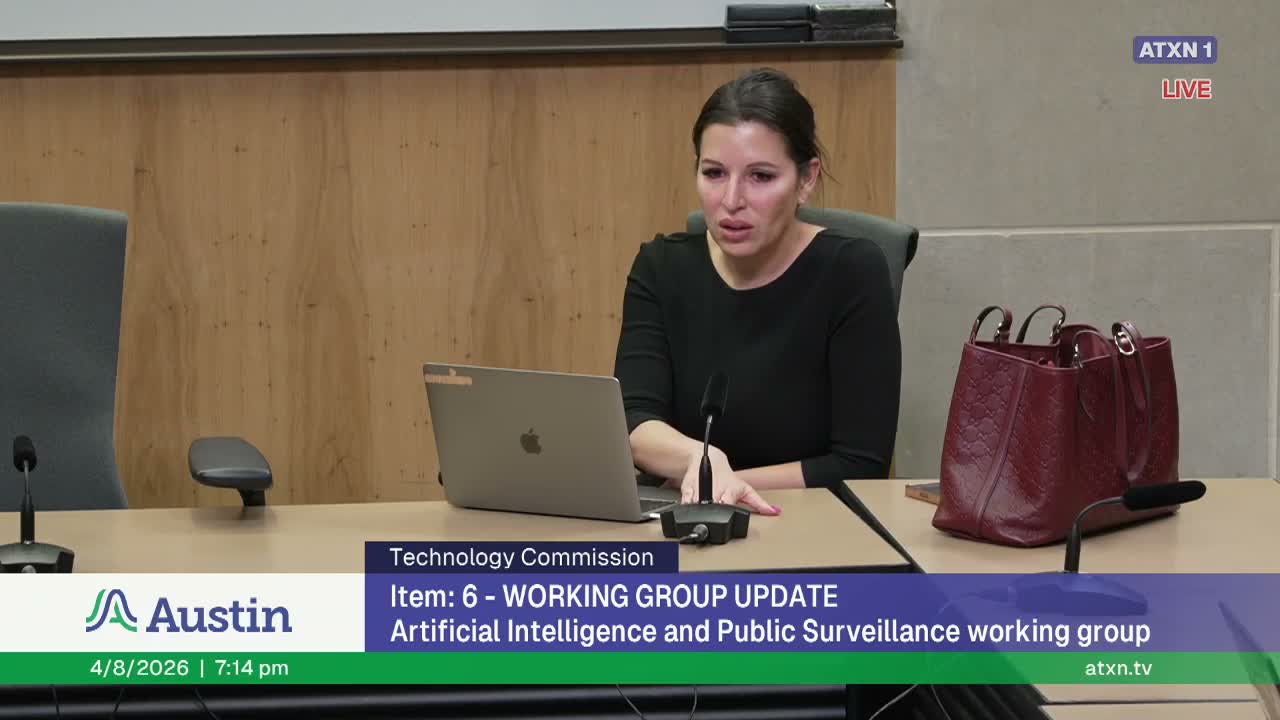
Commissioner Brian Williams updated the full commission on the AI and public-surveillance working group’s recent meeting with Dr. Sharon Strober of the University of Texas and others. Williams said the group reaffirmed the commission’s prior recommendation to remove license-plate readers (LPRs) where possible but learned that state control of some camera locations inside the city constrains local removal efforts.
"We actually do not have as much leverage as what we would like with regard to the removal of those cameras or even other places where we make conflict with the state," Williams said, explaining that the state may control sites inside city limits and that engagement with state entities like DIR will be necessary.
Williams and other commissioners discussed alternative pathways the city might use if the commission cannot secure removal, including limiting how long LPR data are retained, restricting access and narrowing permissible uses to data directly relevant to solving crimes. "We may have some influence with how the data is used," Williams said, framing data-life and access limits as a plausible local route.
The conversation shifted to data centers, where commissioners noted overlapping interests across commissions (energy, land use, community benefits). Commissioners suggested inviting experts from UT’s Bureau of Economic Geology, Austin Energy and other commissions to develop recommendations on sustainability, energy demand and community-benefit frameworks for large data facilities. Staff and commissioners agreed to coordinate cross-commission briefings and to keep the topic on upcoming agendas.
"We actually do not have as much leverage as what we would like with regard to the removal of those cameras or even other places where we make conflict with the state," Williams said, explaining that the state may control sites inside city limits and that engagement with state entities like DIR will be necessary.
Williams and other commissioners discussed alternative pathways the city might use if the commission cannot secure removal, including limiting how long LPR data are retained, restricting access and narrowing permissible uses to data directly relevant to solving crimes. "We may have some influence with how the data is used," Williams said, framing data-life and access limits as a plausible local route.
The conversation shifted to data centers, where commissioners noted overlapping interests across commissions (energy, land use, community benefits). Commissioners suggested inviting experts from UT’s Bureau of Economic Geology, Austin Energy and other commissions to develop recommendations on sustainability, energy demand and community-benefit frameworks for large data facilities. Staff and commissioners agreed to coordinate cross-commission briefings and to keep the topic on upcoming agendas.
View the Full Meeting & All Its Details
This article offers just a summary. Unlock complete video, transcripts, and insights as a Founder Member.
✓
Watch full, unedited meeting videos
✓
Search every word spoken in unlimited transcripts
✓
AI summaries & real-time alerts (all government levels)
✓
Permanent access to expanding government content
30-day money-back guarantee
