Board hearing highlights shrinking capital share and rising campus operating costs
April 08, 2026 | Board Council Commission Agencies , Executive, Washington
This article was created by AI summarizing key points discussed. AI makes mistakes, so for full details and context, please refer to the video of the full meeting. Please report any errors so we can fix them. Report an error »
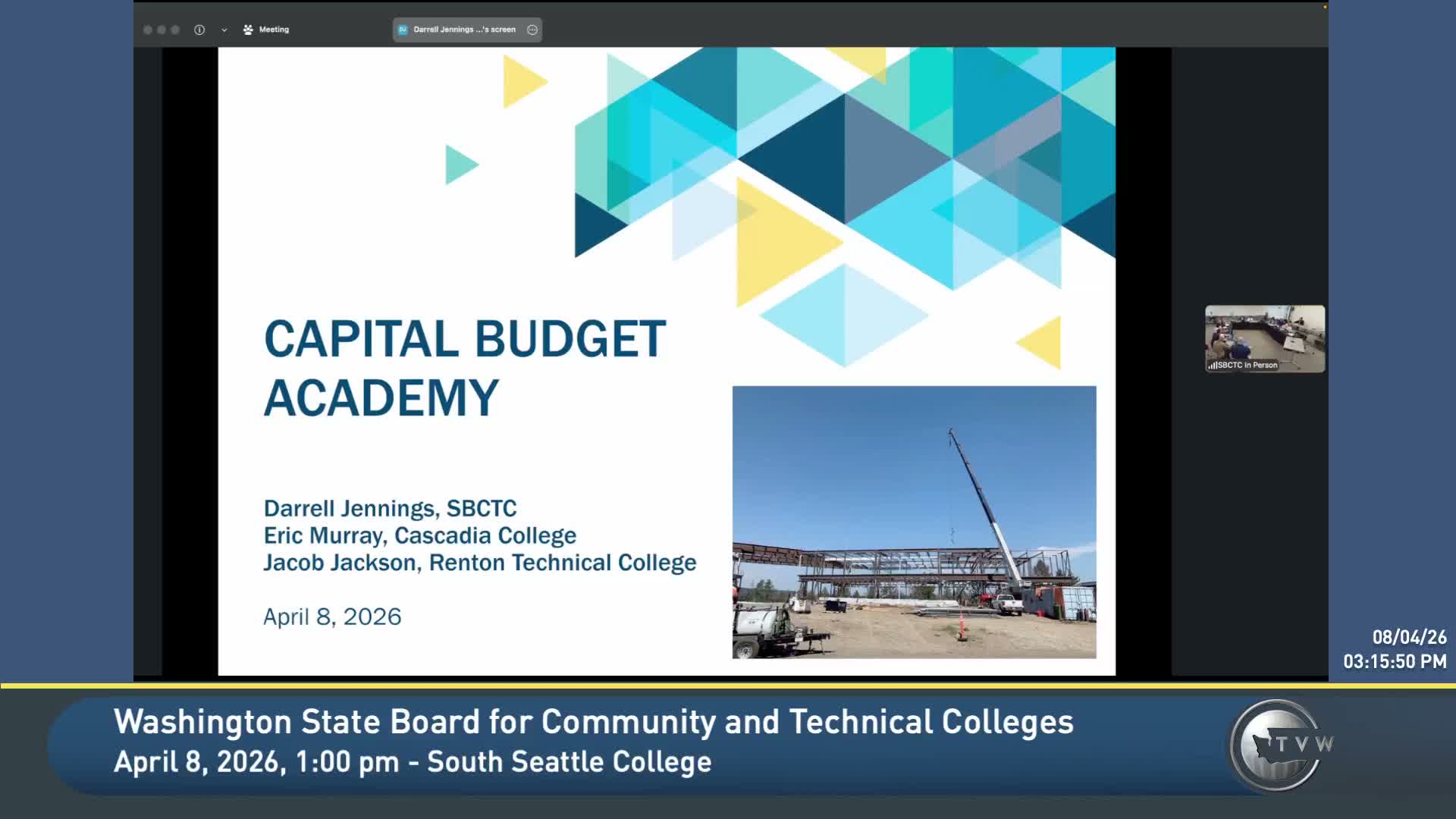
Board staff and college presidents presented a capital-budget overview and warned that rising costs and shifts in state bond allocations are reducing the share of capital funding available to the college system.
Capital budget director Gerald Jennings told the board that capital appropriations are project-specific and that the system’s capital appropriation this biennium is just under $400 million versus an operating budget roughly $2.4 billion. He detailed how capital sources are split (state bonds historically provide the majority) and reiterated that the legislature moved $72,000,000 of student building fees into the operating budget in the supplemental session to address near-term operating gaps.
Staff emphasized prioritization tools that govern how minor works (projects under $4 million), major projects (average $35–$45 million) and a newly introduced intermediate category (roughly $15M scope) are scored and placed on a statewide list that the legislature traditionally accepts. Presidents urged that intermediate projects can deliver faster, more cost-efficient renovations as available major-project dollars fall.
Presenters also highlighted compliance and decarbonization pressures: replacing gas-fired HVAC with electric units can more than double some project costs once electrical upgrades are included; the panel cited an example where an intended $350,000 replacement became a $650,000 electrical upgrade. Utilities are rising sharply in spots: one campus reported utility costs up 178% while usage rose 35% year over year.
The board heard that aging facilities (system average building age roughly in the 39–44 year range) require growing minor-works and infrastructure investments and that reserve funds (an emergency repair fund of roughly $3,000,000 and a hazardous-material mitigation fund) exist but are limited. Presidents and board staff discussed legislative advocacy to increase bonding capacity and noted current competition for state bonds across health, housing and other priorities.
Why it matters: reduced capital allocations and rising operating and compliance costs can force colleges to defer repairs, delay program expansion and potentially increase pressure on operating budgets, further stressing campuses already managing enrollment and workforce changes.
Next steps: staff offered to gather cross-state benchmark data, refine utilization metrics used for prioritization, and continue advocacy for additional capital bonding targeted at intermediate and renovation projects.
Capital budget director Gerald Jennings told the board that capital appropriations are project-specific and that the system’s capital appropriation this biennium is just under $400 million versus an operating budget roughly $2.4 billion. He detailed how capital sources are split (state bonds historically provide the majority) and reiterated that the legislature moved $72,000,000 of student building fees into the operating budget in the supplemental session to address near-term operating gaps.
Staff emphasized prioritization tools that govern how minor works (projects under $4 million), major projects (average $35–$45 million) and a newly introduced intermediate category (roughly $15M scope) are scored and placed on a statewide list that the legislature traditionally accepts. Presidents urged that intermediate projects can deliver faster, more cost-efficient renovations as available major-project dollars fall.
Presenters also highlighted compliance and decarbonization pressures: replacing gas-fired HVAC with electric units can more than double some project costs once electrical upgrades are included; the panel cited an example where an intended $350,000 replacement became a $650,000 electrical upgrade. Utilities are rising sharply in spots: one campus reported utility costs up 178% while usage rose 35% year over year.
The board heard that aging facilities (system average building age roughly in the 39–44 year range) require growing minor-works and infrastructure investments and that reserve funds (an emergency repair fund of roughly $3,000,000 and a hazardous-material mitigation fund) exist but are limited. Presidents and board staff discussed legislative advocacy to increase bonding capacity and noted current competition for state bonds across health, housing and other priorities.
Why it matters: reduced capital allocations and rising operating and compliance costs can force colleges to defer repairs, delay program expansion and potentially increase pressure on operating budgets, further stressing campuses already managing enrollment and workforce changes.
Next steps: staff offered to gather cross-state benchmark data, refine utilization metrics used for prioritization, and continue advocacy for additional capital bonding targeted at intermediate and renovation projects.
Don't Miss a Word: See the Full Meeting!
Go beyond summaries. Unlock every video, transcript, and key insight with a Founder Membership.
✓
Get instant access to full meeting videos
✓
Search and clip any phrase from complete transcripts
✓
Receive AI-powered summaries & custom alerts
✓
Enjoy lifetime, unrestricted access to government data
30-day money-back guarantee
