Senate committee hears testimony on banning synthetic food dyes from school meals
April 07, 2026 | 2026 Legislature Alaska, Alaska
This article was created by AI summarizing key points discussed. AI makes mistakes, so for full details and context, please refer to the video of the full meeting. Please report any errors so we can fix them. Report an error »
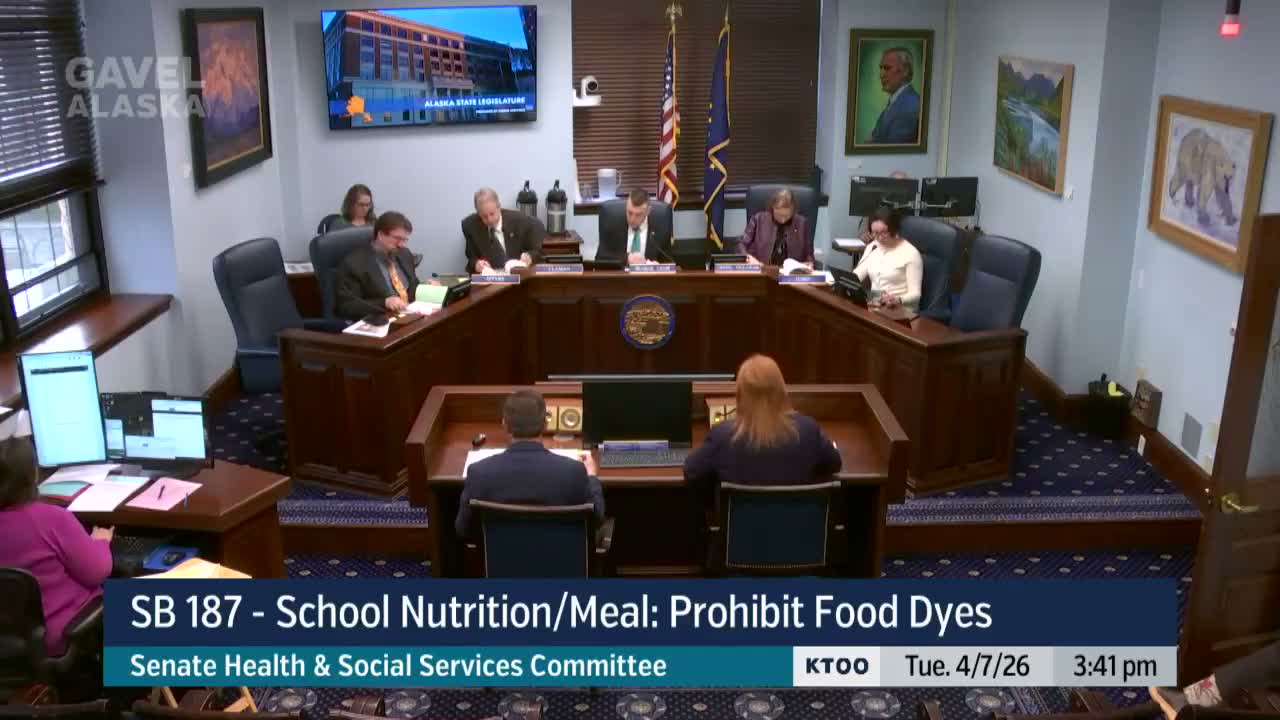
The Senate Health and Social Services Committee heard testimony on SB 187, a bill to prohibit specified synthetic food dyes in meals and beverages provided to students as part of school breakfast and lunch programs.
Senator Bill Wilkowski, the bill sponsor, described the measure as a public‑health step to remove non‑nutritive, petrochemical color additives from meals directed at children. "These are additives... they have no nutritional value at all," he said, and added that similar restrictions exist in other states and countries.
Phoebe Pepper, legislative intern to Senator Wilkowski, walked the committee through the sectional analysis, saying Section 1 would prohibit Red Dye 3, Red Dye 40, Yellow 5, Yellow 6, Blue 1, Blue 2 and give the bill an effective date of Jan. 1, 2028. Pepper said the wording focuses the ban on meals "provided by the school to enrolled students during a school day," intentionally excluding community feeding programs that are not full‑service school days.
Britney Robbins, civic engagement coordinator for Alaska Community Action on Toxics, presented invited testimony about health concerns and EPA categorizations. Robbins told the committee that several of the listed dyes have been associated in studies with hypersensitivity reactions and other health effects. "These exposures are preventable," Robbins said, and urged the committee to pass SB 187 out of committee.
Committee members asked about prevalence in district inventories and fiscal impacts. Pepper told the committee staff surveyed ten school districts (including Anchorage and Fairbanks) and found a small number of affected products, noting some districts located only five impacted items in a sample review and that substitutes were often similar in price. On enforcement, Pepper said the bill does not specify penalties; a parent could seek an injunction, and existing state tools could be used if statutory compliance issues arise.
After questioning, the committee set SB 187 aside for further public testimony and consideration.
Senator Bill Wilkowski, the bill sponsor, described the measure as a public‑health step to remove non‑nutritive, petrochemical color additives from meals directed at children. "These are additives... they have no nutritional value at all," he said, and added that similar restrictions exist in other states and countries.
Phoebe Pepper, legislative intern to Senator Wilkowski, walked the committee through the sectional analysis, saying Section 1 would prohibit Red Dye 3, Red Dye 40, Yellow 5, Yellow 6, Blue 1, Blue 2 and give the bill an effective date of Jan. 1, 2028. Pepper said the wording focuses the ban on meals "provided by the school to enrolled students during a school day," intentionally excluding community feeding programs that are not full‑service school days.
Britney Robbins, civic engagement coordinator for Alaska Community Action on Toxics, presented invited testimony about health concerns and EPA categorizations. Robbins told the committee that several of the listed dyes have been associated in studies with hypersensitivity reactions and other health effects. "These exposures are preventable," Robbins said, and urged the committee to pass SB 187 out of committee.
Committee members asked about prevalence in district inventories and fiscal impacts. Pepper told the committee staff surveyed ten school districts (including Anchorage and Fairbanks) and found a small number of affected products, noting some districts located only five impacted items in a sample review and that substitutes were often similar in price. On enforcement, Pepper said the bill does not specify penalties; a parent could seek an injunction, and existing state tools could be used if statutory compliance issues arise.
After questioning, the committee set SB 187 aside for further public testimony and consideration.
View the Full Meeting & All Its Details
This article offers just a summary. Unlock complete video, transcripts, and insights as a Founder Member.
✓
Watch full, unedited meeting videos
✓
Search every word spoken in unlimited transcripts
✓
AI summaries & real-time alerts (all government levels)
✓
Permanent access to expanding government content
30-day money-back guarantee
