Sen. Matt Klayman introduces bill to make failing to assist after deadly crash a class A felony
April 07, 2026 | 2026 Legislature Alaska, Alaska
This article was created by AI summarizing key points discussed. AI makes mistakes, so for full details and context, please refer to the video of the full meeting. Please report any errors so we can fix them. Report an error »
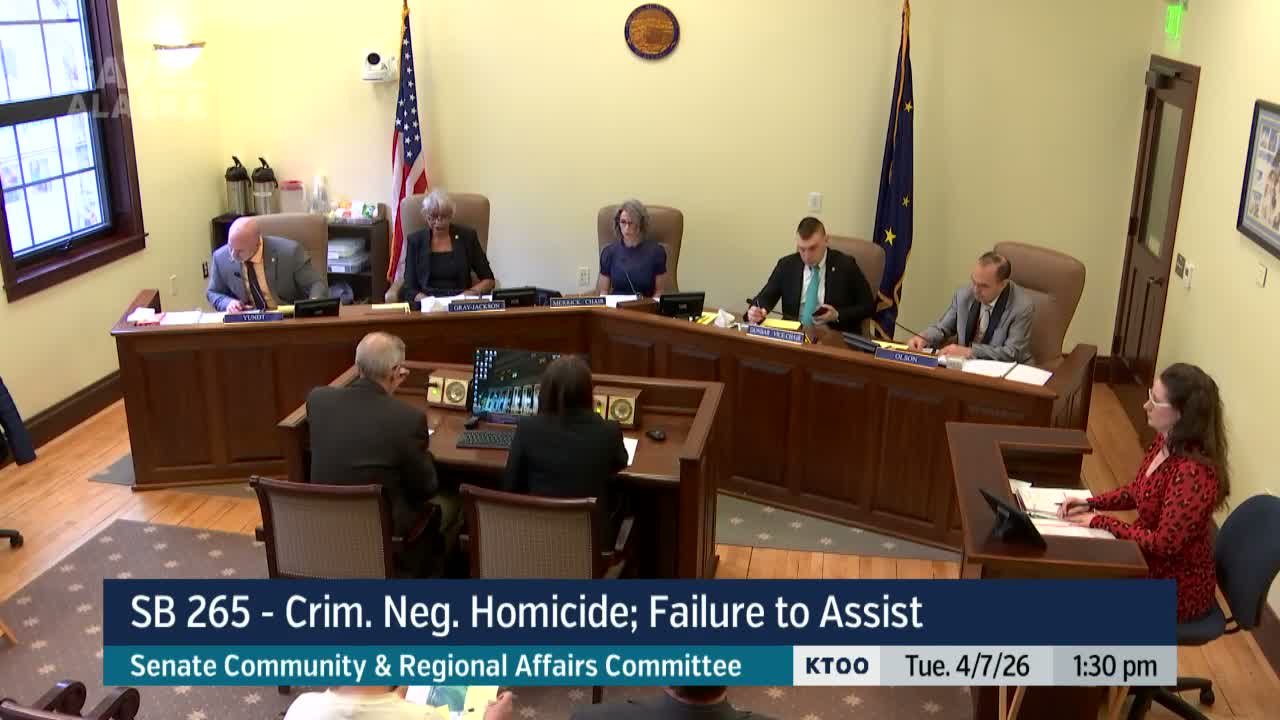
Sen. Matt Klayman introduced Senate Bill 265 to the Senate Community and Regional Affairs Committee on April 7, 2026, proposing a new, enhanced penalty when a motor‑vehicle operator acting with criminal negligence causes a death and fails to stop and render assistance.
Klayman told the committee the change is intended to improve public safety by increasing the incentive to stop and provide aid, invoking the medical “golden hour” and a personal loss: “She did not stop, and Jeff is not alive,” he said of a 2014 crash that killed his friend Jeff Duesenberry.
The bill would create distinct sentencing for failure to render assistance under Alaska Statute AS 28.35.060. Under the proposal read into the record, failure to render assistance when an injury occurs would be a class B felony; failure to render assistance when death occurs and the operator is convicted of criminally negligent homicide would be a class A felony with an enhanced presumptive sentence for first‑time offenders of 7 to 11 years. The sponsor said the enhanced presumptive term raises the typical presumptive range for a class A felony (which the sponsor stated as 4 to 7 years for first‑time offenders) and that maximum statutory terms for related offenses vary—criminally negligent homicide (AS 11.41.130) is charged as a class B felony with a statutory maximum the sponsor described as 10 years, while vehicular manslaughter under the cited statute was characterized in the presentation as a class A felony with a possible maximum of 20 years.
Aspen French, legislative intern to Sen. Klayman, read the bill’s sectional analysis for the committee, noting conforming changes, creation of the new subsection in AS 28.35.060(d) tying the enhanced penalty to convictions for criminally negligent homicide (AS 11.41.130 or AS 11.41.170) and an effective date provision.
There were no questions from committee members during this introductory hearing. Chair Senator Merrick thanked the sponsor and staff and said the committee would take the bill up at a future hearing with invited public testimony.
Next steps: The committee did not vote on SB 265; the bill was set aside for a future hearing that will include invited and public testimony.
Klayman told the committee the change is intended to improve public safety by increasing the incentive to stop and provide aid, invoking the medical “golden hour” and a personal loss: “She did not stop, and Jeff is not alive,” he said of a 2014 crash that killed his friend Jeff Duesenberry.
The bill would create distinct sentencing for failure to render assistance under Alaska Statute AS 28.35.060. Under the proposal read into the record, failure to render assistance when an injury occurs would be a class B felony; failure to render assistance when death occurs and the operator is convicted of criminally negligent homicide would be a class A felony with an enhanced presumptive sentence for first‑time offenders of 7 to 11 years. The sponsor said the enhanced presumptive term raises the typical presumptive range for a class A felony (which the sponsor stated as 4 to 7 years for first‑time offenders) and that maximum statutory terms for related offenses vary—criminally negligent homicide (AS 11.41.130) is charged as a class B felony with a statutory maximum the sponsor described as 10 years, while vehicular manslaughter under the cited statute was characterized in the presentation as a class A felony with a possible maximum of 20 years.
Aspen French, legislative intern to Sen. Klayman, read the bill’s sectional analysis for the committee, noting conforming changes, creation of the new subsection in AS 28.35.060(d) tying the enhanced penalty to convictions for criminally negligent homicide (AS 11.41.130 or AS 11.41.170) and an effective date provision.
There were no questions from committee members during this introductory hearing. Chair Senator Merrick thanked the sponsor and staff and said the committee would take the bill up at a future hearing with invited public testimony.
Next steps: The committee did not vote on SB 265; the bill was set aside for a future hearing that will include invited and public testimony.
View the Full Meeting & All Its Details
This article offers just a summary. Unlock complete video, transcripts, and insights as a Founder Member.
✓
Watch full, unedited meeting videos
✓
Search every word spoken in unlimited transcripts
✓
AI summaries & real-time alerts (all government levels)
✓
Permanent access to expanding government content
30-day money-back guarantee
