Senate committee advances bill to centralize permitting of subterranean transit, 8-2-1
April 07, 2026 | 2026 Legislature TN, Tennessee
This article was created by AI summarizing key points discussed. AI makes mistakes, so for full details and context, please refer to the video of the full meeting. Please report any errors so we can fix them. Report an error »
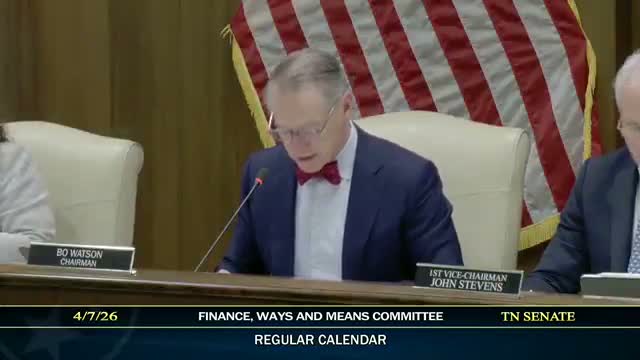
The Senate Finance Ways and Means Committee on April 17 advanced SB 2205, a bill that would create a statewide framework to coordinate permitting, oversight and appeals for subterranean transportation projects.
Leader Johnson, sponsor of the finance amendment, told the committee that "as amended, this bill would enact the subterranean transportation infrastructure coordination act to establish a comprehensive statewide framework governing their permitting, coordination, and oversight of subterranean transportation infrastructure projects," and said dedicated fee revenue is projected to "exceed $1,000,000 annually," which the amendment expects to offset operating costs.
Under the amendment, the bill would establish a governor's infrastructure coordination council to align multi-agency review and a subterranean transportation infrastructure coordination authority to administer the program, hear appeals and resolve disputes across jurisdictions. The measure would vest exclusive jurisdiction over subsurface construction with the state, require the state fire marshal to implement uniform permitting and inspection processes, and preempt conflicting local requirements for subsurface projects; surface construction would remain subject to local building and land-use standards but within defined timelines.
Several members pressed the sponsor on emergency response and jurisdictional issues. Senator Yarbrough argued the proposal gives the private operator broad authority and asked "do they... have police forces and like EMS licensed professionals and ambulances and fire professionals?" Leader Johnson replied that the state fire marshal would have oversight of emergency-response protocols and that operating agreements with local responders were expected to be part of project planning.
Yarbrough also raised concerns about the authority's condemnation powers and long-term fiscal risk to the state if a private operator failed, saying creating a board that "has the ability to rewrite laws" could leave the state exposed. The sponsor said contract terms negotiated by state agencies, including bonding and other protections, are the mechanisms planners are using to address those concerns and that existing projects underway would be folded into the statutory framework prospectively.
The committee adopted the finance amendment by voice and then voted on the bill as amended. The clerk recorded 8 ayes, 2 no's and 1 present on voting; the committee recommended SB 2205 as amended for passage to the committee on the calendar.
Next steps: the bill now moves to the full Senate calendar for further consideration.
Leader Johnson, sponsor of the finance amendment, told the committee that "as amended, this bill would enact the subterranean transportation infrastructure coordination act to establish a comprehensive statewide framework governing their permitting, coordination, and oversight of subterranean transportation infrastructure projects," and said dedicated fee revenue is projected to "exceed $1,000,000 annually," which the amendment expects to offset operating costs.
Under the amendment, the bill would establish a governor's infrastructure coordination council to align multi-agency review and a subterranean transportation infrastructure coordination authority to administer the program, hear appeals and resolve disputes across jurisdictions. The measure would vest exclusive jurisdiction over subsurface construction with the state, require the state fire marshal to implement uniform permitting and inspection processes, and preempt conflicting local requirements for subsurface projects; surface construction would remain subject to local building and land-use standards but within defined timelines.
Several members pressed the sponsor on emergency response and jurisdictional issues. Senator Yarbrough argued the proposal gives the private operator broad authority and asked "do they... have police forces and like EMS licensed professionals and ambulances and fire professionals?" Leader Johnson replied that the state fire marshal would have oversight of emergency-response protocols and that operating agreements with local responders were expected to be part of project planning.
Yarbrough also raised concerns about the authority's condemnation powers and long-term fiscal risk to the state if a private operator failed, saying creating a board that "has the ability to rewrite laws" could leave the state exposed. The sponsor said contract terms negotiated by state agencies, including bonding and other protections, are the mechanisms planners are using to address those concerns and that existing projects underway would be folded into the statutory framework prospectively.
The committee adopted the finance amendment by voice and then voted on the bill as amended. The clerk recorded 8 ayes, 2 no's and 1 present on voting; the committee recommended SB 2205 as amended for passage to the committee on the calendar.
Next steps: the bill now moves to the full Senate calendar for further consideration.
Don't Miss a Word: See the Full Meeting!
Go beyond summaries. Unlock every video, transcript, and key insight with a Founder Membership.
✓
Get instant access to full meeting videos
✓
Search and clip any phrase from complete transcripts
✓
Receive AI-powered summaries & custom alerts
✓
Enjoy lifetime, unrestricted access to government data
30-day money-back guarantee
