Public and advocates press for joint emergency communications; APD launches small CSO pilot
April 06, 2026 | Austin, Travis County, Texas
This article was created by AI summarizing key points discussed. AI makes mistakes, so for full details and context, please refer to the video of the full meeting. Please report any errors so we can fix them. Report an error »
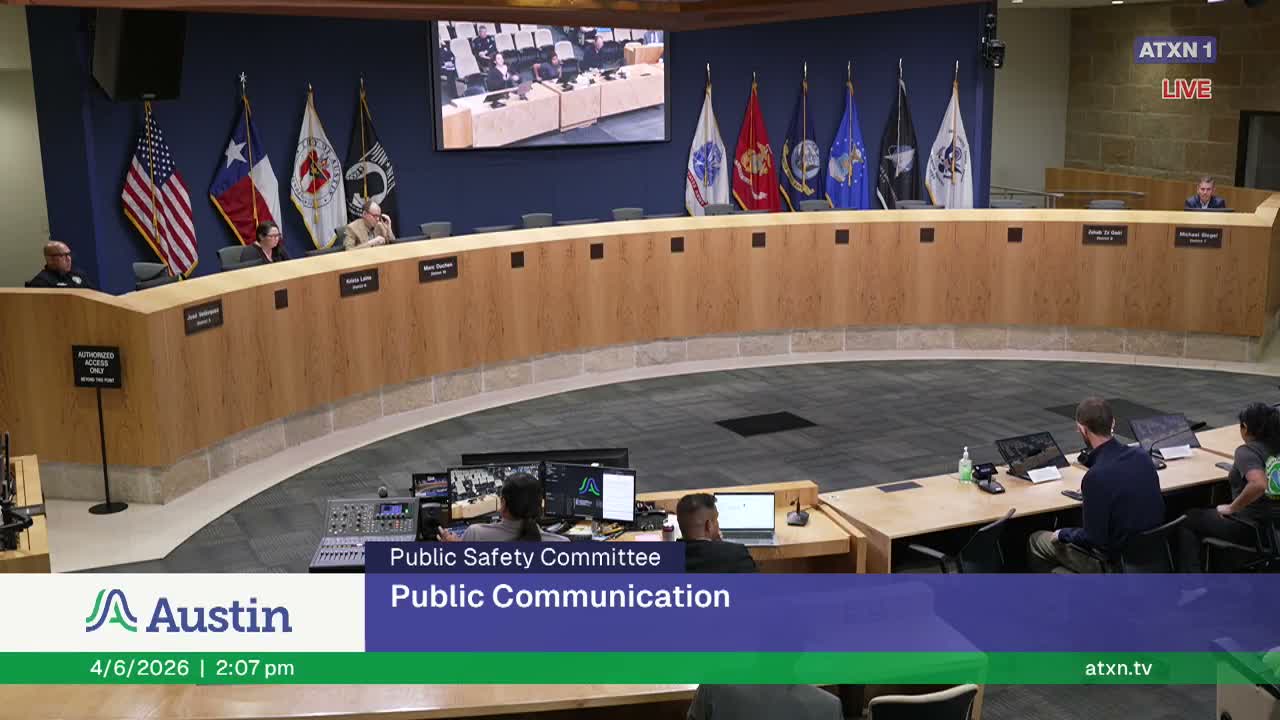
Public commenters and advocates urged the Public Safety Committee on April 6 to call a special meeting to consider a proposal to move 911 dispatch out of the police department and into a joint emergency communications structure meant to route mental-health and non-criminal calls to non-sworn responders.
Savannah Lee of Equity Action told the committee dispatch currently “defaults” to enforcement when housed under law enforcement and that civilian-led crisis teams work only when dispatch routes calls appropriately. Aloki Shaw, president of United Workers of Integral Care, and Peter Hunt of the Austin Justice Coalition echoed the call and urged a special meeting in May to ensure any transition can be considered ahead of the city’s budget cycle.
Assistant Chief Angie Jones described APD’s work on alternative-response models, noting reallocation of officers back to patrol, co-response pilots (Austin First and No Wrong Door), and partnership work to divert suitable calls to online reporting or 311. Jones introduced a small community-service-officer (CSO) pilot structured as a six-month trial with two part-time temporary CSOs, scheduled to work Fridays and Saturdays noon–10 p.m. in the Edwards sector. CSOs will be non-sworn, wear distinctive uniforms, carry radios and body-worn cameras, and handle low-acuity calls that have no enforcement nexus (examples: found/abandoned property, disabled/abandoned vehicles, non-injury private-property crashes, and delayed reports). APD said the pilot is intentionally small for budget and resource reasons, and that data from the pilot will inform any expansion.
Council members asked whether two temporary CSOs will generate useful data; APD replied the limited size is deliberate to refine the model, that vehicles were available for the pilot, and that legal constraints (transportation code) prevent CSOs from performing certain functions like removing vehicles from roadways unless a peace officer delegates.
Next steps: APD will run the six-month pilot, collect data (call sign tracking, surveys of residents and partnering officers), evaluate feasibility and cost for potential citywide implementation, and report results to the committee; council staff signaled intent to schedule broader discussions, including on a joint emergency communications structure.
Savannah Lee of Equity Action told the committee dispatch currently “defaults” to enforcement when housed under law enforcement and that civilian-led crisis teams work only when dispatch routes calls appropriately. Aloki Shaw, president of United Workers of Integral Care, and Peter Hunt of the Austin Justice Coalition echoed the call and urged a special meeting in May to ensure any transition can be considered ahead of the city’s budget cycle.
Assistant Chief Angie Jones described APD’s work on alternative-response models, noting reallocation of officers back to patrol, co-response pilots (Austin First and No Wrong Door), and partnership work to divert suitable calls to online reporting or 311. Jones introduced a small community-service-officer (CSO) pilot structured as a six-month trial with two part-time temporary CSOs, scheduled to work Fridays and Saturdays noon–10 p.m. in the Edwards sector. CSOs will be non-sworn, wear distinctive uniforms, carry radios and body-worn cameras, and handle low-acuity calls that have no enforcement nexus (examples: found/abandoned property, disabled/abandoned vehicles, non-injury private-property crashes, and delayed reports). APD said the pilot is intentionally small for budget and resource reasons, and that data from the pilot will inform any expansion.
Council members asked whether two temporary CSOs will generate useful data; APD replied the limited size is deliberate to refine the model, that vehicles were available for the pilot, and that legal constraints (transportation code) prevent CSOs from performing certain functions like removing vehicles from roadways unless a peace officer delegates.
Next steps: APD will run the six-month pilot, collect data (call sign tracking, surveys of residents and partnering officers), evaluate feasibility and cost for potential citywide implementation, and report results to the committee; council staff signaled intent to schedule broader discussions, including on a joint emergency communications structure.
Don't Miss a Word: See the Full Meeting!
Go beyond summaries. Unlock every video, transcript, and key insight with a Founder Membership.
✓
Get instant access to full meeting videos
✓
Search and clip any phrase from complete transcripts
✓
Receive AI-powered summaries & custom alerts
✓
Enjoy lifetime, unrestricted access to government data
30-day money-back guarantee
