Austin officials pressed over backlog of body‑worn camera footage for prosecutions
April 06, 2026 | Austin, Travis County, Texas
This article was created by AI summarizing key points discussed. AI makes mistakes, so for full details and context, please refer to the video of the full meeting. Please report any errors so we can fix them. Report an error »
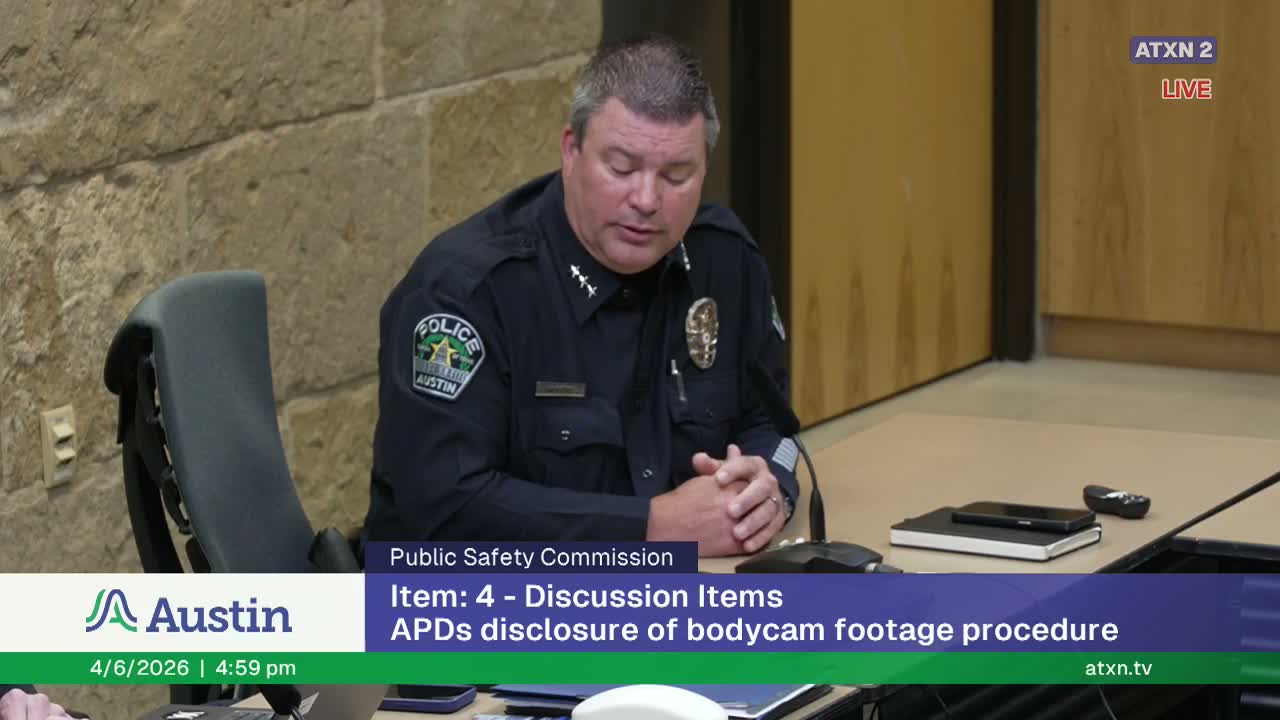
Austin officials on Tuesday pressed police and county prosecutors to address a months‑long backlog in delivering body‑worn camera footage to prosecutors and defense attorneys, with the city’s public defender calling the delay “the process has become the punishment, for folks.”
Adrienne, chief public defender for the Travis County Public Defender’s Office, told the commission that defense counsel routinely requests footage within days of appointment and that long waits — “six months, seven months, eight months, nine months” — prevent clients from resolving cases, accessing housing and employment, and impose collateral harms.
Austin Police Department representatives confirmed a large backlog and described efforts to reduce it. "The backlog with the district attorney's office is about 4,500 cases. The county attorney's office is about 3,900 cases," an APD leader told the commission, and said the department has been reducing the backlog by roughly 1,000 cases per month while continuing to generate new evidence in active cases.
Lucio Del Toro, first assistant in the Travis County Attorney's Office, said misdemeanor prosecutions rely on prompt access to digital evidence and that the backlog is a cross‑office problem tied to rising volume and staffing limits. Prosecutors and APD said they have been meeting to prioritize cases and provide personnel support to the police department's digital evidence management unit.
Panelists and commissioners identified several causes: multiple legacy systems and differing file formats across agencies, substantial volume of digital recordings from body cameras and in‑car systems, and staffing shortages in units that process and deliver evidence. APD said it is moving to a single platform (Axon) and working with prosecuting offices on standardization.
Commissioners sought concrete benchmarks. The chair said the commission needs to know when material is "overdue," asking whether the city can set time markers such as 30, 60 or 90 days. APD and prosecutors urged a tailored approach that considers case type; they agreed to return with proposals for timelines, prioritization criteria (including incarcerated people and violent cases), and process maps.
Several commissioners proposed short‑term remedies. One commissioner suggested focusing prosecutorial resources on dismissing or diverting a share of low‑priority nonviolent cases to reduce demand on evidence resources; prosecutors said state law and office policy require individualized case review, but that triage and diversion tools are being used. APD said some footage is available quickly when a subpoena is issued, indicating gaps in internal prioritization and workflows.
The commission asked City Legal for a written memo clarifying potential city liability, including any Brady or due‑process exposure, and requested APD produce a follow‑up presentation with clear KPIs, timelines and a plan for preventing future backlogs.
The office of the chief public defender and county attorneys urged rapid, measurable steps. APD said it is open to outside ideas and will return to the commission with a process‑level briefing and proposed benchmarks.
Adrienne, chief public defender for the Travis County Public Defender’s Office, told the commission that defense counsel routinely requests footage within days of appointment and that long waits — “six months, seven months, eight months, nine months” — prevent clients from resolving cases, accessing housing and employment, and impose collateral harms.
Austin Police Department representatives confirmed a large backlog and described efforts to reduce it. "The backlog with the district attorney's office is about 4,500 cases. The county attorney's office is about 3,900 cases," an APD leader told the commission, and said the department has been reducing the backlog by roughly 1,000 cases per month while continuing to generate new evidence in active cases.
Lucio Del Toro, first assistant in the Travis County Attorney's Office, said misdemeanor prosecutions rely on prompt access to digital evidence and that the backlog is a cross‑office problem tied to rising volume and staffing limits. Prosecutors and APD said they have been meeting to prioritize cases and provide personnel support to the police department's digital evidence management unit.
Panelists and commissioners identified several causes: multiple legacy systems and differing file formats across agencies, substantial volume of digital recordings from body cameras and in‑car systems, and staffing shortages in units that process and deliver evidence. APD said it is moving to a single platform (Axon) and working with prosecuting offices on standardization.
Commissioners sought concrete benchmarks. The chair said the commission needs to know when material is "overdue," asking whether the city can set time markers such as 30, 60 or 90 days. APD and prosecutors urged a tailored approach that considers case type; they agreed to return with proposals for timelines, prioritization criteria (including incarcerated people and violent cases), and process maps.
Several commissioners proposed short‑term remedies. One commissioner suggested focusing prosecutorial resources on dismissing or diverting a share of low‑priority nonviolent cases to reduce demand on evidence resources; prosecutors said state law and office policy require individualized case review, but that triage and diversion tools are being used. APD said some footage is available quickly when a subpoena is issued, indicating gaps in internal prioritization and workflows.
The commission asked City Legal for a written memo clarifying potential city liability, including any Brady or due‑process exposure, and requested APD produce a follow‑up presentation with clear KPIs, timelines and a plan for preventing future backlogs.
The office of the chief public defender and county attorneys urged rapid, measurable steps. APD said it is open to outside ideas and will return to the commission with a process‑level briefing and proposed benchmarks.
View the Full Meeting & All Its Details
This article offers just a summary. Unlock complete video, transcripts, and insights as a Founder Member.
✓
Watch full, unedited meeting videos
✓
Search every word spoken in unlimited transcripts
✓
AI summaries & real-time alerts (all government levels)
✓
Permanent access to expanding government content
30-day money-back guarantee
