Collegedale commission agrees to study new infrastructure development district, stops short of a vote
March 16, 2026 | Collegedale City, Hamilton County, Tennessee
This article was created by AI summarizing key points discussed. AI makes mistakes, so for full details and context, please refer to the video of the full meeting. Please report any errors so we can fix them. Report an error »
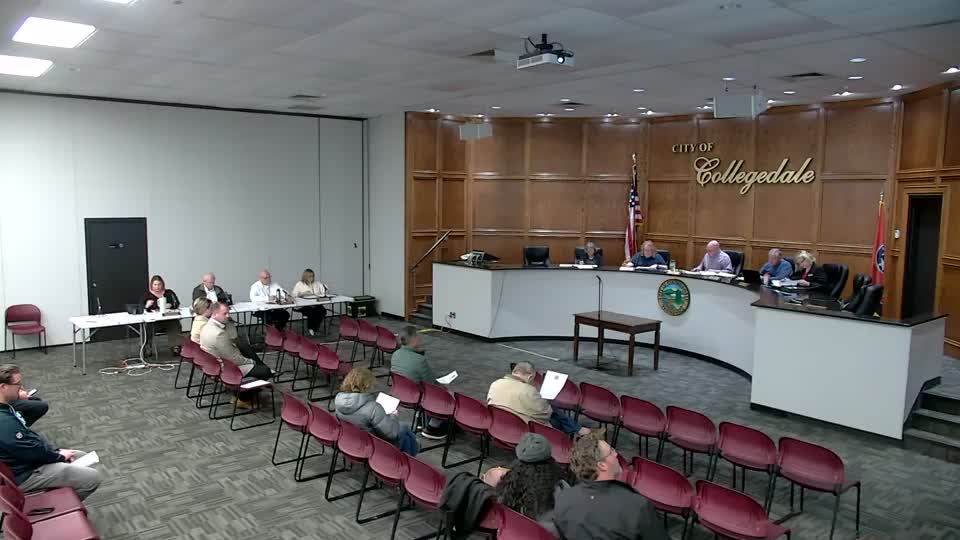
Mayor Lloyd opened the discussion on a proposed infrastructure development district that city staff said could help fund roads, water, sewer and stormwater for planned developments by capturing future tax revenue to pay back bonds issued up front.
City manager (staff) told the commission the tool functions similarly to tax-increment financing: the city or an authorized board would issue bonds for infrastructure, then capture future property and sales taxes generated by the district to repay those bonds. Staff said the approach could be applied to a retail portion of the Chastain property and, in some configurations, to residential subdivisions.
"This gives you one more tool in your toolbox that you don't currently have," Mayor Lloyd said, noting that the commission would not be obligated to use the tool if it approved exploring it further.
Commissioners and members of the public pressed staff on how any assessment would be collected and whether it would make homes harder to sell. Commissioner House said, "I think we need to understand the pros and cons before we even decide to set up a district," and asked for historical data and clearer explanations of collection mechanics.
A county official who spoke during the discussion said he had not been approached previously and that county participation had not been determined. "Until today, this was all new to me," he said, underscoring that whether fees would appear on a county tax bill depends on Hamilton County's willingness to participate.
Staff clarified that the state removed an earlier $5,000,000 minimum for some projects, that the process would require resolutions and public hearings, and that creation of an industrial development board would happen only later if the commission approved formal resolutions. Staff pointed out examples of potential expenditures, including a proposed bridge near Lee Highway and a roundabout on Edgemont Road, as types of infrastructure the district could finance.
After extended questions and public input, the commission signaled no objections to city staff moving forward with a fact-finding phase. Commissioners asked staff to meet with subject-matter experts and county officials, and to return with detailed application materials, resolution language and community-engagement plans before any decision or appointment of an industrial development board.
The meeting did not include any formal vote to create a district or board; commissioners emphasized that any final action would require separate resolutions, public hearings and a subsequent roll-call vote.
City manager (staff) told the commission the tool functions similarly to tax-increment financing: the city or an authorized board would issue bonds for infrastructure, then capture future property and sales taxes generated by the district to repay those bonds. Staff said the approach could be applied to a retail portion of the Chastain property and, in some configurations, to residential subdivisions.
"This gives you one more tool in your toolbox that you don't currently have," Mayor Lloyd said, noting that the commission would not be obligated to use the tool if it approved exploring it further.
Commissioners and members of the public pressed staff on how any assessment would be collected and whether it would make homes harder to sell. Commissioner House said, "I think we need to understand the pros and cons before we even decide to set up a district," and asked for historical data and clearer explanations of collection mechanics.
A county official who spoke during the discussion said he had not been approached previously and that county participation had not been determined. "Until today, this was all new to me," he said, underscoring that whether fees would appear on a county tax bill depends on Hamilton County's willingness to participate.
Staff clarified that the state removed an earlier $5,000,000 minimum for some projects, that the process would require resolutions and public hearings, and that creation of an industrial development board would happen only later if the commission approved formal resolutions. Staff pointed out examples of potential expenditures, including a proposed bridge near Lee Highway and a roundabout on Edgemont Road, as types of infrastructure the district could finance.
After extended questions and public input, the commission signaled no objections to city staff moving forward with a fact-finding phase. Commissioners asked staff to meet with subject-matter experts and county officials, and to return with detailed application materials, resolution language and community-engagement plans before any decision or appointment of an industrial development board.
The meeting did not include any formal vote to create a district or board; commissioners emphasized that any final action would require separate resolutions, public hearings and a subsequent roll-call vote.
View the Full Meeting & All Its Details
This article offers just a summary. Unlock complete video, transcripts, and insights as a Founder Member.
✓
Watch full, unedited meeting videos
✓
Search every word spoken in unlimited transcripts
✓
AI summaries & real-time alerts (all government levels)
✓
Permanent access to expanding government content
30-day money-back guarantee
