Traffic study: signal not warranted at Dobbs/Main; engineers recommend right-turn lane or mini roundabout
March 16, 2026 | Woodstock City, Cherokee County, Georgia
This article was created by AI summarizing key points discussed. AI makes mistakes, so for full details and context, please refer to the video of the full meeting. Please report any errors so we can fix them. Report an error »
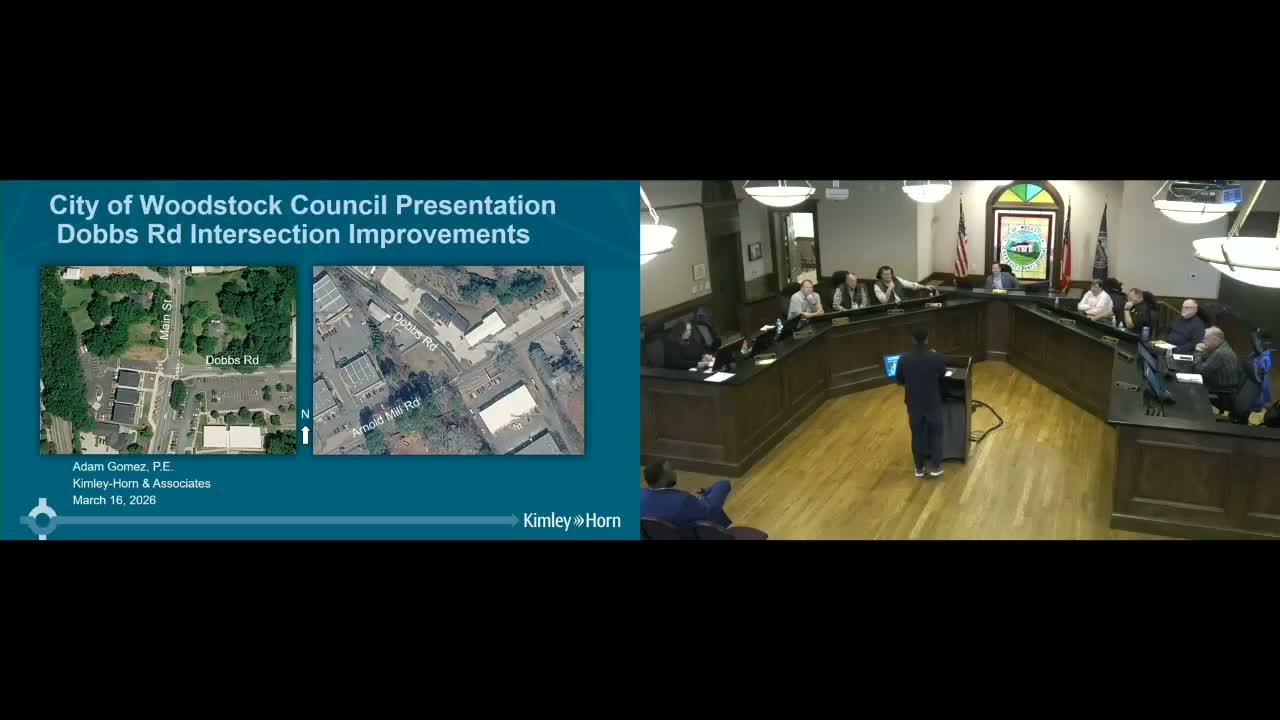
Adam Gomez, a traffic engineer with Kimley-Horn, told the Woodstock mayor and council that the traffic study for Dobbs Road and Main Street did not meet the Manual on Uniform Traffic Control Devices'nine signal warrants and therefore a traffic signal is not currently warranted.
Gomez said the study shows safety problems at the intersection: "Between 2018 and '23, a total of 14 collisions, nine of them angled," that pattern suggested a visibility or approach issue. He said site-distance constraints (landscaping and an eastbound grade near 8.5% compared with typical 5% for ADA considerations) and vehicle stacking on the single southbound lane on Main Street increase delay and collision risk.
The presentation outlined two staff-preferred options. One is a westbound Dobbs right-turn lane to ease operations and reduce queueing for left turns. The other is a mini or compact roundabout: Gomez said a mini roundabout would lower speeds and reduce conflict points (from 32 at a traditional intersection to eight for a roundabout), shorten pedestrian crossings and eliminate the angled-collision pattern that produces the most severe crash outcomes.
Gomez acknowledged tradeoffs: roundabouts require more upfront construction (retaining walls to address existing grades and possible reconstruction of intersection geometry) and higher immediate cost, while signals can be lower initial capital cost but require ongoing maintenance and coordination along corridors. He described compact designs (75'100-foot outer diameter for a mini) that are fully traversable for trucks using mountable curb sections.
Councilmembers tested the feasibility of a roundabout given the site's slope and approach geometry. One councilmember urged exploring art or landscaping in the central island to reflect local character if a roundabout is chosen; another asked staff to confirm sight-distance and grade constraints and to compare modeled delays for the alternatives.
Gomez and staff recommended further engineering analysis to refine cost estimates, exact geometry, and right-of-way impacts and to check ADA-grade compliance before a final selection. The council did not take formal action; the presentation closed to questions.
Gomez said the study shows safety problems at the intersection: "Between 2018 and '23, a total of 14 collisions, nine of them angled," that pattern suggested a visibility or approach issue. He said site-distance constraints (landscaping and an eastbound grade near 8.5% compared with typical 5% for ADA considerations) and vehicle stacking on the single southbound lane on Main Street increase delay and collision risk.
The presentation outlined two staff-preferred options. One is a westbound Dobbs right-turn lane to ease operations and reduce queueing for left turns. The other is a mini or compact roundabout: Gomez said a mini roundabout would lower speeds and reduce conflict points (from 32 at a traditional intersection to eight for a roundabout), shorten pedestrian crossings and eliminate the angled-collision pattern that produces the most severe crash outcomes.
Gomez acknowledged tradeoffs: roundabouts require more upfront construction (retaining walls to address existing grades and possible reconstruction of intersection geometry) and higher immediate cost, while signals can be lower initial capital cost but require ongoing maintenance and coordination along corridors. He described compact designs (75'100-foot outer diameter for a mini) that are fully traversable for trucks using mountable curb sections.
Councilmembers tested the feasibility of a roundabout given the site's slope and approach geometry. One councilmember urged exploring art or landscaping in the central island to reflect local character if a roundabout is chosen; another asked staff to confirm sight-distance and grade constraints and to compare modeled delays for the alternatives.
Gomez and staff recommended further engineering analysis to refine cost estimates, exact geometry, and right-of-way impacts and to check ADA-grade compliance before a final selection. The council did not take formal action; the presentation closed to questions.
View the Full Meeting & All Its Details
This article offers just a summary. Unlock complete video, transcripts, and insights as a Founder Member.
✓
Watch full, unedited meeting videos
✓
Search every word spoken in unlimited transcripts
✓
AI summaries & real-time alerts (all government levels)
✓
Permanent access to expanding government content
30-day money-back guarantee
