Council hears housing-audit results and starts discussion of PUDs, lot-of-record and downtown LDO amendments
March 16, 2026 | Woodstock City, Cherokee County, Georgia
This article was created by AI summarizing key points discussed. AI makes mistakes, so for full details and context, please refer to the video of the full meeting. Please report any errors so we can fix them. Report an error »
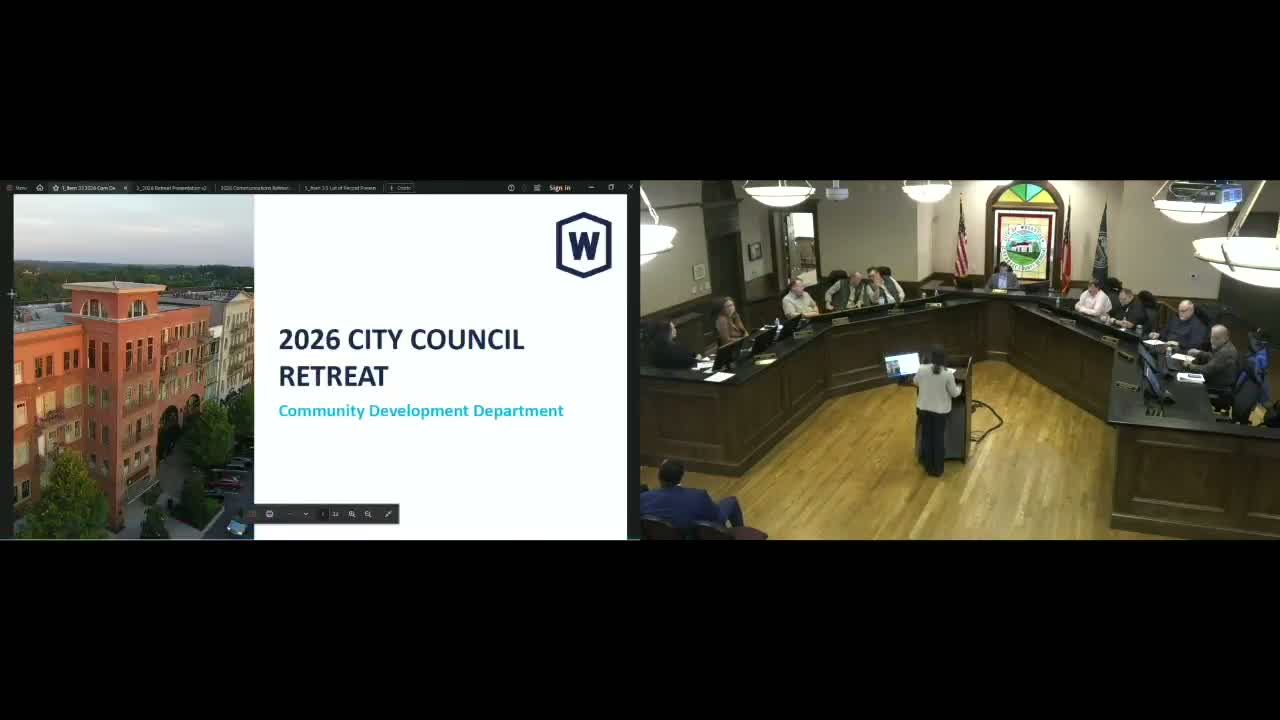
Melissa Sigman, representing the city's Community Development department, presented a months-long audit and rebuild of Woodstock's internal housing dataset and introduced a broader set of LDO updates and the PUD concept intended to implement adopted plans.
Sigman said staff compared multiple sources (the city's existing housing data, stormwater-billing parcel records, Cherokee County tax-parcel data and the city's GIS parcels) and performed manual visual checks where needed. "We went from a total of around 18,247 total dwelling units, both approved and constructed, to 18,562," Sigman reported. She said the new housing tracker will be a single, validated dataset staff can use for monthly reporting and planning.
On zoning tools, Sigman proposed creating a Planned Unit Development (PUD) district to allow a negotiated master-plan approach for infill and mixed-use projects outside downtown while providing certainty that developers will be held to an approved plan if changes are requested later. She described PUDs as a flexible but negotiated process that can include a two-step concept approval (concept followed by ministerial approvals) to reduce upfront cost for applicants and ensure deliverable outcomes.
The recommended LDO amendments (discussion only at this meeting) would also clarify lot-of-record rules for single-family construction (front-setback averaging restricted to homes on the same block/side; a 50% lot-coverage cap, 10-foot side/rear setbacks and 40-foot maximum height for many in-fill houses), remove some downtown architectural prescriptions for side streets, add a Type D3 street classification (no on-street striped parking), and align R4 minimum lot sizes with density standards (reducing R4 minimum to 5,500 sq ft while holding density metrics consistent).
Councilmembers expressed support for the master-plan certainty PUDs can provide and asked staff to: provide implementation options (area thresholds, opt-in overlays), add an ownership/tenure breakout to the housing tracker (owner-occupied vs. renter-occupied), and craft standards that encourage creative, characterful infill while guarding against inappropriate density increases. Sigman said staff would return with refined proposals and recommended thresholds after further stakeholder work.
No formal code amendments or votes were taken; the presentation was for direction and discussion only.
Sigman said staff compared multiple sources (the city's existing housing data, stormwater-billing parcel records, Cherokee County tax-parcel data and the city's GIS parcels) and performed manual visual checks where needed. "We went from a total of around 18,247 total dwelling units, both approved and constructed, to 18,562," Sigman reported. She said the new housing tracker will be a single, validated dataset staff can use for monthly reporting and planning.
On zoning tools, Sigman proposed creating a Planned Unit Development (PUD) district to allow a negotiated master-plan approach for infill and mixed-use projects outside downtown while providing certainty that developers will be held to an approved plan if changes are requested later. She described PUDs as a flexible but negotiated process that can include a two-step concept approval (concept followed by ministerial approvals) to reduce upfront cost for applicants and ensure deliverable outcomes.
The recommended LDO amendments (discussion only at this meeting) would also clarify lot-of-record rules for single-family construction (front-setback averaging restricted to homes on the same block/side; a 50% lot-coverage cap, 10-foot side/rear setbacks and 40-foot maximum height for many in-fill houses), remove some downtown architectural prescriptions for side streets, add a Type D3 street classification (no on-street striped parking), and align R4 minimum lot sizes with density standards (reducing R4 minimum to 5,500 sq ft while holding density metrics consistent).
Councilmembers expressed support for the master-plan certainty PUDs can provide and asked staff to: provide implementation options (area thresholds, opt-in overlays), add an ownership/tenure breakout to the housing tracker (owner-occupied vs. renter-occupied), and craft standards that encourage creative, characterful infill while guarding against inappropriate density increases. Sigman said staff would return with refined proposals and recommended thresholds after further stakeholder work.
No formal code amendments or votes were taken; the presentation was for direction and discussion only.
View the Full Meeting & All Its Details
This article offers just a summary. Unlock complete video, transcripts, and insights as a Founder Member.
✓
Watch full, unedited meeting videos
✓
Search every word spoken in unlimited transcripts
✓
AI summaries & real-time alerts (all government levels)
✓
Permanent access to expanding government content
30-day money-back guarantee
