House unanimously approves bill making AI-generated sexual images of minors a felony after intent carve-out
March 30, 2026 | 2026 Legislature LA, Louisiana
This article was created by AI summarizing key points discussed. AI makes mistakes, so for full details and context, please refer to the video of the full meeting. Please report any errors so we can fix them. Report an error »
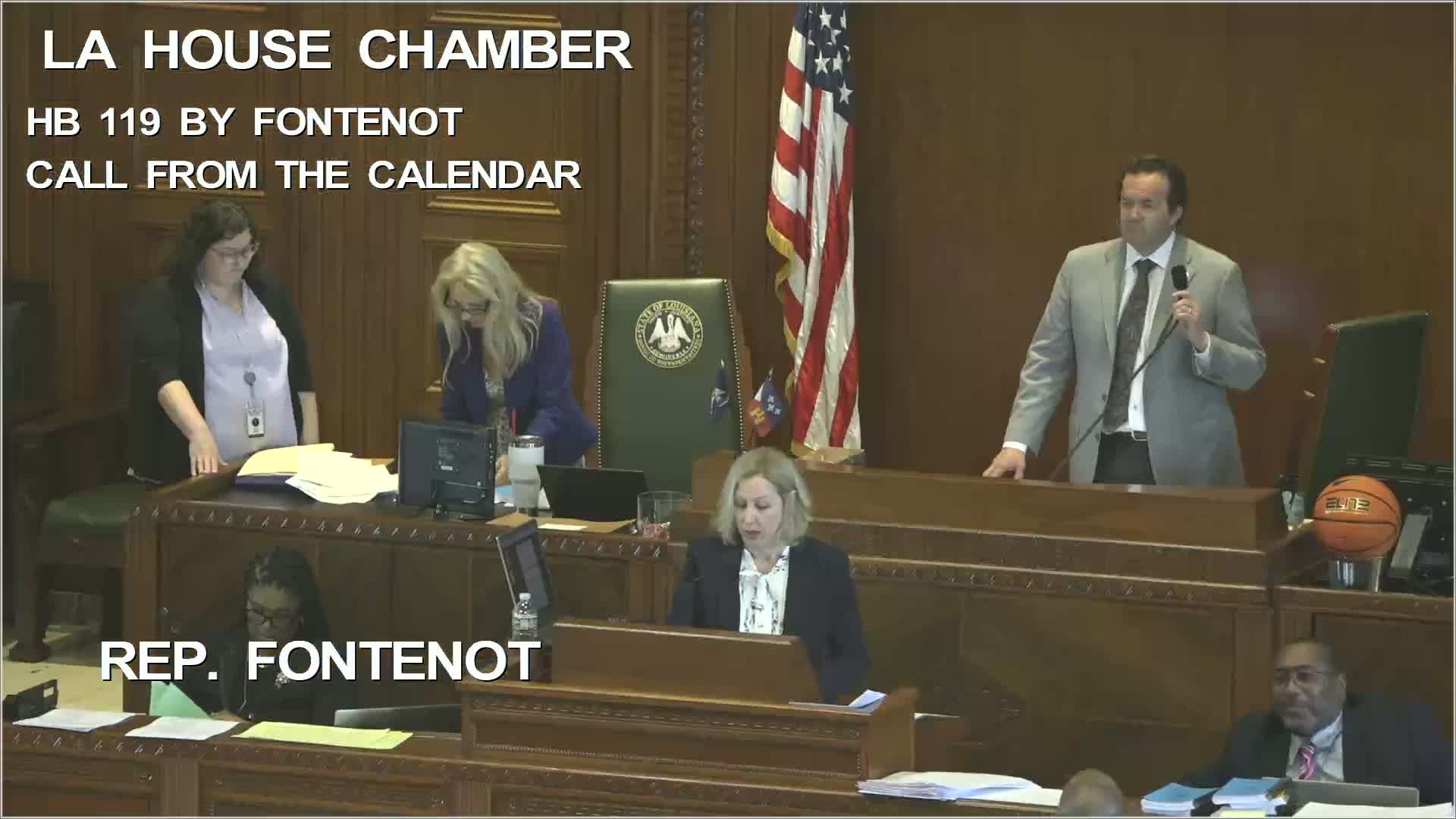
The House unanimously passed House Bill 119 on March 26, criminalizing the creation, dissemination and knowing possession of sexually explicit images of minors produced by artificial intelligence.
Sponsor Representative Fontenot said the bill responds to incidents in his community in which AI-generated imagery circulated and that current child-pornography statutes did not reach purely synthetic images. "What this bill seeks to accomplish is to ensure that if you create, disseminate, or possess artificial intelligence of a child, in a sexual manner ... the penalty shall be that of a felony offense," he told the chamber.
The measure prompted lengthy debate about the breadth of the possession clause. Representatives repeatedly raised scenarios in which young people might receive an image unsolicited — by group text, an airdrop, or other means — and questioned whether such recipients could be criminally liable. Representative Jordan and others warned the provision could sweep in innocent recipients; Representative Marcel offered a floor amendment to carve out people who neither consented to the receipt nor had specific intent to possess the image for gratification.
"This section does not apply to a person who receives any video or still image created by artificial intelligence and who has not consented to receipt of such video or still image," Representative Marcel said as part of the amendment he offered and later withdrew while working with the sponsor; the House ultimately adopted clearer language addressing specific intent and consent.
Representative Fontenot told colleagues the amended text requires proof that a person knowingly and intentionally possessed or disseminated the image, and that the changes put the bill in a posture that targeted perpetrators rather than accidental recipients. After the sponsor and amendment authors worked together on the floor wording, the bill passed 101–0.
Next steps: The bill will proceed through the remaining legislative steps. Sponsors said they will continue to coordinate with prosecutors and privacy stakeholders to refine training and enforcement guidance so that the law targets creators and disseminators rather than victims or inadvertent recipients.
Quotes on the floor and vote tallies are drawn from the House transcript of March 26, 2026.
Sponsor Representative Fontenot said the bill responds to incidents in his community in which AI-generated imagery circulated and that current child-pornography statutes did not reach purely synthetic images. "What this bill seeks to accomplish is to ensure that if you create, disseminate, or possess artificial intelligence of a child, in a sexual manner ... the penalty shall be that of a felony offense," he told the chamber.
The measure prompted lengthy debate about the breadth of the possession clause. Representatives repeatedly raised scenarios in which young people might receive an image unsolicited — by group text, an airdrop, or other means — and questioned whether such recipients could be criminally liable. Representative Jordan and others warned the provision could sweep in innocent recipients; Representative Marcel offered a floor amendment to carve out people who neither consented to the receipt nor had specific intent to possess the image for gratification.
"This section does not apply to a person who receives any video or still image created by artificial intelligence and who has not consented to receipt of such video or still image," Representative Marcel said as part of the amendment he offered and later withdrew while working with the sponsor; the House ultimately adopted clearer language addressing specific intent and consent.
Representative Fontenot told colleagues the amended text requires proof that a person knowingly and intentionally possessed or disseminated the image, and that the changes put the bill in a posture that targeted perpetrators rather than accidental recipients. After the sponsor and amendment authors worked together on the floor wording, the bill passed 101–0.
Next steps: The bill will proceed through the remaining legislative steps. Sponsors said they will continue to coordinate with prosecutors and privacy stakeholders to refine training and enforcement guidance so that the law targets creators and disseminators rather than victims or inadvertent recipients.
Quotes on the floor and vote tallies are drawn from the House transcript of March 26, 2026.
Don't Miss a Word: See the Full Meeting!
Go beyond summaries. Unlock every video, transcript, and key insight with a Founder Membership.
✓
Get instant access to full meeting videos
✓
Search and clip any phrase from complete transcripts
✓
Receive AI-powered summaries & custom alerts
✓
Enjoy lifetime, unrestricted access to government data
30-day money-back guarantee
