Signal Mountain council sets parameters for short‑term rental fees and punitive penalties amid enforcement concerns
March 23, 2026 | Signal Mountain, Hamilton County, Tennessee
This article was created by AI summarizing key points discussed. AI makes mistakes, so for full details and context, please refer to the video of the full meeting. Please report any errors so we can fix them. Report an error »
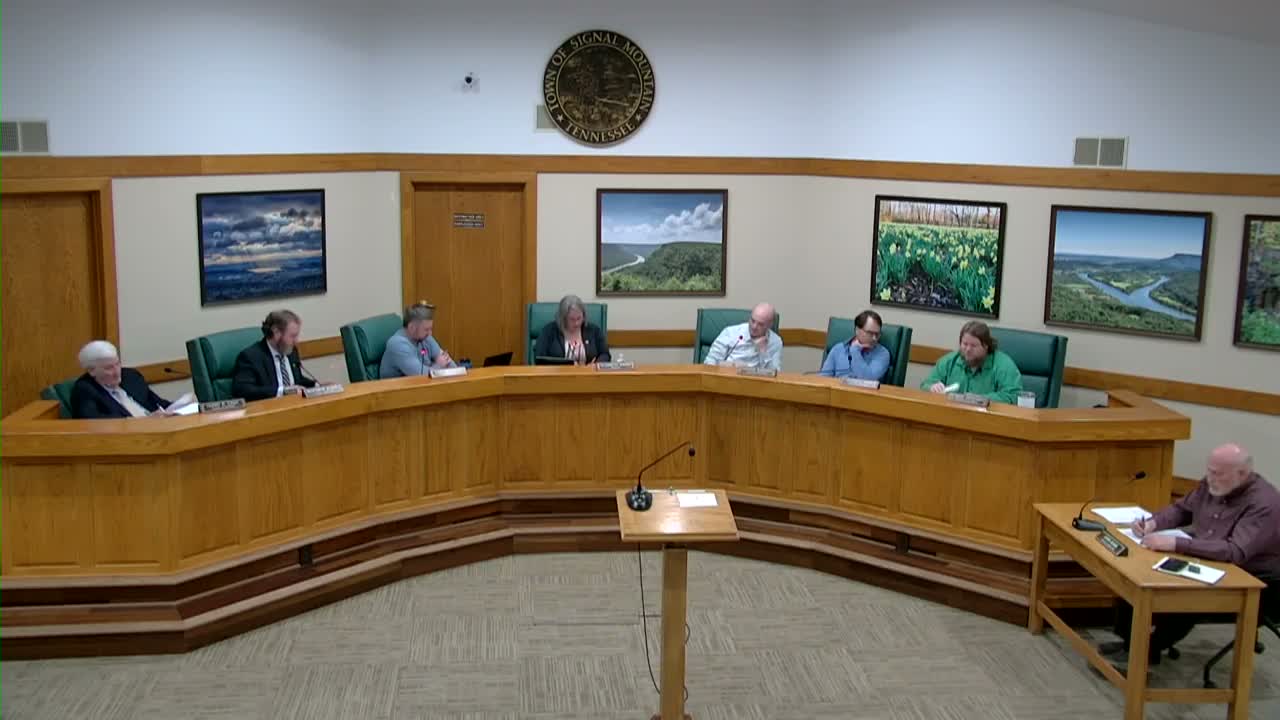
Signal Mountain’s council on March 23 discussed raising the town’s short‑term vacation rental application fee and setting a penalty regime for unpermitted rentals, with members balancing deterrence against the town’s limited enforcement capacity.
Council discussed a proposed fee schedule that would raise the application fee to $300, set renewal at $150 and impose a punitive penalty structure for violations. Members debated several penalty options: a per‑day fine (examples discussed included $500–$600/day), a single high initial penalty (proposals ranged from $1,000 to $3,000 or higher), and combinations (an initial one‑time fee plus per‑day penalties thereafter). One councilor recommended a $3,000 initial penalty with $600 per day; another proposed $3,000 initial with $500/day to align administrative hearing officer authority and the town’s capacity to collect or pursue collections.
Councilors emphasized enforceability. “If it’s hard to figure that out, you just go back to the day of citation,” one councilor said while others warned that tracking online listings and occupancy dates will be time‑consuming. Staff noted online platforms may not assist municipalities and that enforcement could require records and additional staff time. Council members discussed inserting application language requiring applicants to provide records on occupancy dates if requested and warned that some owners might refuse to cooperate.
The council reached informal consensus on fee and penalty parameters to be drafted into ordinance language for legal review: increase application fee to $300, set renewal at $150, and include a punitive penalty framework (draft language to specify initial penalty and daily amounts and to clarify the start date for accrual and collection mechanism). Staff and the town attorney will draft final ordinance text and enforcement procedures for a future vote.
Why it matters: The policy aims to deter unpermitted short‑term rentals while protecting administrative feasibility; councilors expressed concern about the town’s capacity to investigate historical listings and enforce per‑day fines without additional staff or data access from listing platforms.
Next steps: Staff and legal counsel to draft ordinance language that clarifies the penalty start date (date of citation or date of violation), evidence requirements, and collection path (administrative hearing officer authority vs. finance/collections).
Council discussed a proposed fee schedule that would raise the application fee to $300, set renewal at $150 and impose a punitive penalty structure for violations. Members debated several penalty options: a per‑day fine (examples discussed included $500–$600/day), a single high initial penalty (proposals ranged from $1,000 to $3,000 or higher), and combinations (an initial one‑time fee plus per‑day penalties thereafter). One councilor recommended a $3,000 initial penalty with $600 per day; another proposed $3,000 initial with $500/day to align administrative hearing officer authority and the town’s capacity to collect or pursue collections.
Councilors emphasized enforceability. “If it’s hard to figure that out, you just go back to the day of citation,” one councilor said while others warned that tracking online listings and occupancy dates will be time‑consuming. Staff noted online platforms may not assist municipalities and that enforcement could require records and additional staff time. Council members discussed inserting application language requiring applicants to provide records on occupancy dates if requested and warned that some owners might refuse to cooperate.
The council reached informal consensus on fee and penalty parameters to be drafted into ordinance language for legal review: increase application fee to $300, set renewal at $150, and include a punitive penalty framework (draft language to specify initial penalty and daily amounts and to clarify the start date for accrual and collection mechanism). Staff and the town attorney will draft final ordinance text and enforcement procedures for a future vote.
Why it matters: The policy aims to deter unpermitted short‑term rentals while protecting administrative feasibility; councilors expressed concern about the town’s capacity to investigate historical listings and enforce per‑day fines without additional staff or data access from listing platforms.
Next steps: Staff and legal counsel to draft ordinance language that clarifies the penalty start date (date of citation or date of violation), evidence requirements, and collection path (administrative hearing officer authority vs. finance/collections).
Don't Miss a Word: See the Full Meeting!
Go beyond summaries. Unlock every video, transcript, and key insight with a Founder Membership.
✓
Get instant access to full meeting videos
✓
Search and clip any phrase from complete transcripts
✓
Receive AI-powered summaries & custom alerts
✓
Enjoy lifetime, unrestricted access to government data
30-day money-back guarantee
