Regional colleges outline stepped-up workforce training, housing and apprenticeship plans for North County
May 21, 2024 | Carlsbad, San Diego County, California
This article was created by AI summarizing key points discussed. AI makes mistakes, so for full details and context, please refer to the video of the full meeting. Please report any errors so we can fix them. Report an error »
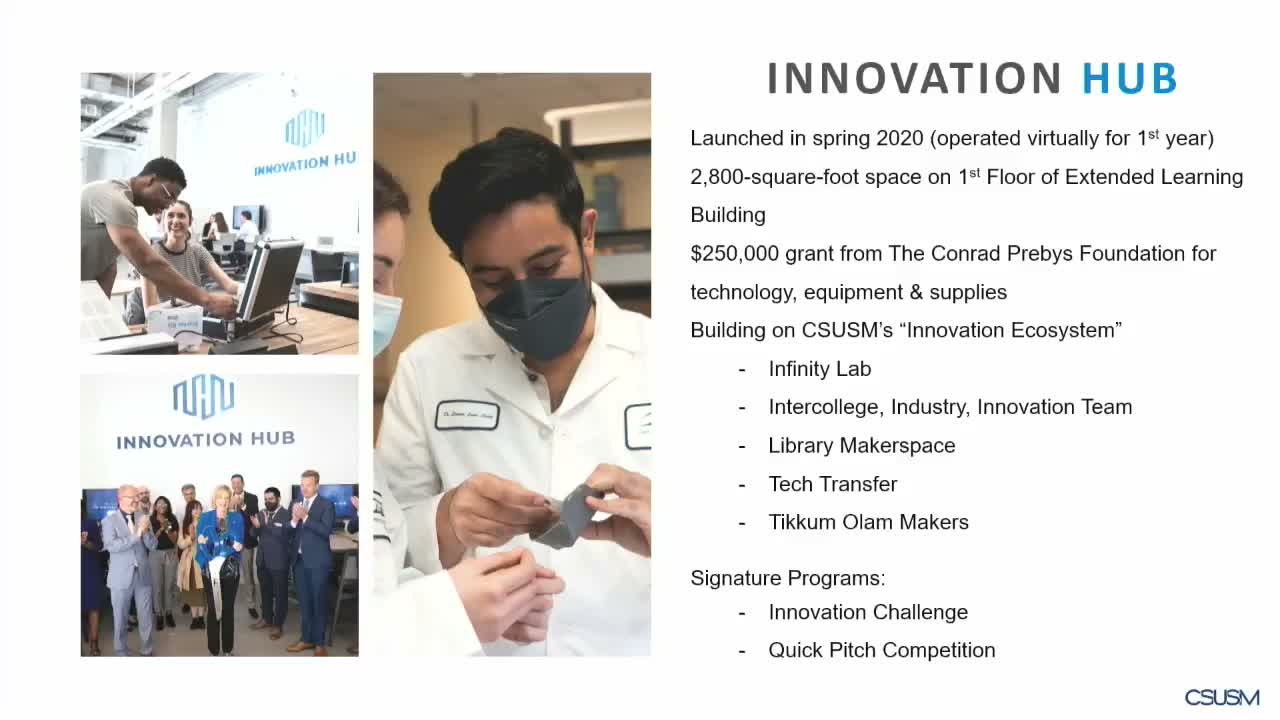
Three higher-education leaders told the subcommittee they are expanding programs and partnerships to meet regional workforce needs and to keep students in North County.
Patricia Bridal, chief of community engagement at Cal State San Marcos, said CSUSM is growing nursing, public health, social work, cybersecurity and wildfire-science programs and is working on an integrated sciences and engineering building that CSUSM projects will increase engineering majors from about 300 to as many as 2,000 when fully built out. Bridal said CSUSM received two $10,000,000 gifts recently and a $91,000,000 state award to build new affordable housing that broke ground in December. She described a proposed three-year accelerated behavioral-health bachelor’s pathway that will include built-in internships and is being designed with an initial $10,000,000 grant to develop the model.
Ben Gamboa, associate dean at MiraCosta College, said MiraCosta serves about 27,000 students annually and estimated its workforce programs contribute roughly $150,000,000 to the local economy. He outlined grant-supported efforts: $1,600,000 for a bioscience workforce hub, a pending $8,000,000 application, $21,600,000 in funds intended to support paid internships for employers and a $2,000,000 award for apprenticeship development. Gamboa also described new programs including an associate degree in artificial intelligence launching this fall and planned psychiatric and pharmacy technician programs targeted to local needs.
Linda Kurokawa, executive director of MiraCosta’s Technology Career Institute (TCI), described short-term, skills-focused training that TCI runs in the city-owned TCI building. Kurokawa said TCI expanded from three to 13 workforce-skills programs, offers accelerated certificates that can raise entry wages toward $35 an hour in some fields and is launching an aquaculture program in collaboration with UC San Diego and Scripps Institution partners. Kurokawa, who told the committee she plans to retire in three weeks, asked the city to continue its facility partnership and to consider further rent relief to support program costs.
Why it matters: The institutions’ growth plans target local labor shortages (health care, biotech, cybersecurity, AI and technical trades) and include apprenticeship and paid-internship mechanisms aimed at connecting students to local employers. Presenters repeatedly asked for employer partners and city support on housing, placements and apprenticeship coordination.
Next steps: Institutions asked the city and employers to engage via advisory boards, internship/apprenticeship partnerships and local placement opportunities; the college and university will continue program development and pursue funding and partnerships.
Patricia Bridal, chief of community engagement at Cal State San Marcos, said CSUSM is growing nursing, public health, social work, cybersecurity and wildfire-science programs and is working on an integrated sciences and engineering building that CSUSM projects will increase engineering majors from about 300 to as many as 2,000 when fully built out. Bridal said CSUSM received two $10,000,000 gifts recently and a $91,000,000 state award to build new affordable housing that broke ground in December. She described a proposed three-year accelerated behavioral-health bachelor’s pathway that will include built-in internships and is being designed with an initial $10,000,000 grant to develop the model.
Ben Gamboa, associate dean at MiraCosta College, said MiraCosta serves about 27,000 students annually and estimated its workforce programs contribute roughly $150,000,000 to the local economy. He outlined grant-supported efforts: $1,600,000 for a bioscience workforce hub, a pending $8,000,000 application, $21,600,000 in funds intended to support paid internships for employers and a $2,000,000 award for apprenticeship development. Gamboa also described new programs including an associate degree in artificial intelligence launching this fall and planned psychiatric and pharmacy technician programs targeted to local needs.
Linda Kurokawa, executive director of MiraCosta’s Technology Career Institute (TCI), described short-term, skills-focused training that TCI runs in the city-owned TCI building. Kurokawa said TCI expanded from three to 13 workforce-skills programs, offers accelerated certificates that can raise entry wages toward $35 an hour in some fields and is launching an aquaculture program in collaboration with UC San Diego and Scripps Institution partners. Kurokawa, who told the committee she plans to retire in three weeks, asked the city to continue its facility partnership and to consider further rent relief to support program costs.
Why it matters: The institutions’ growth plans target local labor shortages (health care, biotech, cybersecurity, AI and technical trades) and include apprenticeship and paid-internship mechanisms aimed at connecting students to local employers. Presenters repeatedly asked for employer partners and city support on housing, placements and apprenticeship coordination.
Next steps: Institutions asked the city and employers to engage via advisory boards, internship/apprenticeship partnerships and local placement opportunities; the college and university will continue program development and pursue funding and partnerships.
View the Full Meeting & All Its Details
This article offers just a summary. Unlock complete video, transcripts, and insights as a Founder Member.
✓
Watch full, unedited meeting videos
✓
Search every word spoken in unlimited transcripts
✓
AI summaries & real-time alerts (all government levels)
✓
Permanent access to expanding government content
30-day money-back guarantee
