Carlsbad Arts Commission unanimously approves $117,128 community arts grants funding plan for FY 2024–25
May 02, 2024 | Carlsbad, San Diego County, California
This article was created by AI summarizing key points discussed. AI makes mistakes, so for full details and context, please refer to the video of the full meeting. Please report any errors so we can fix them. Report an error »
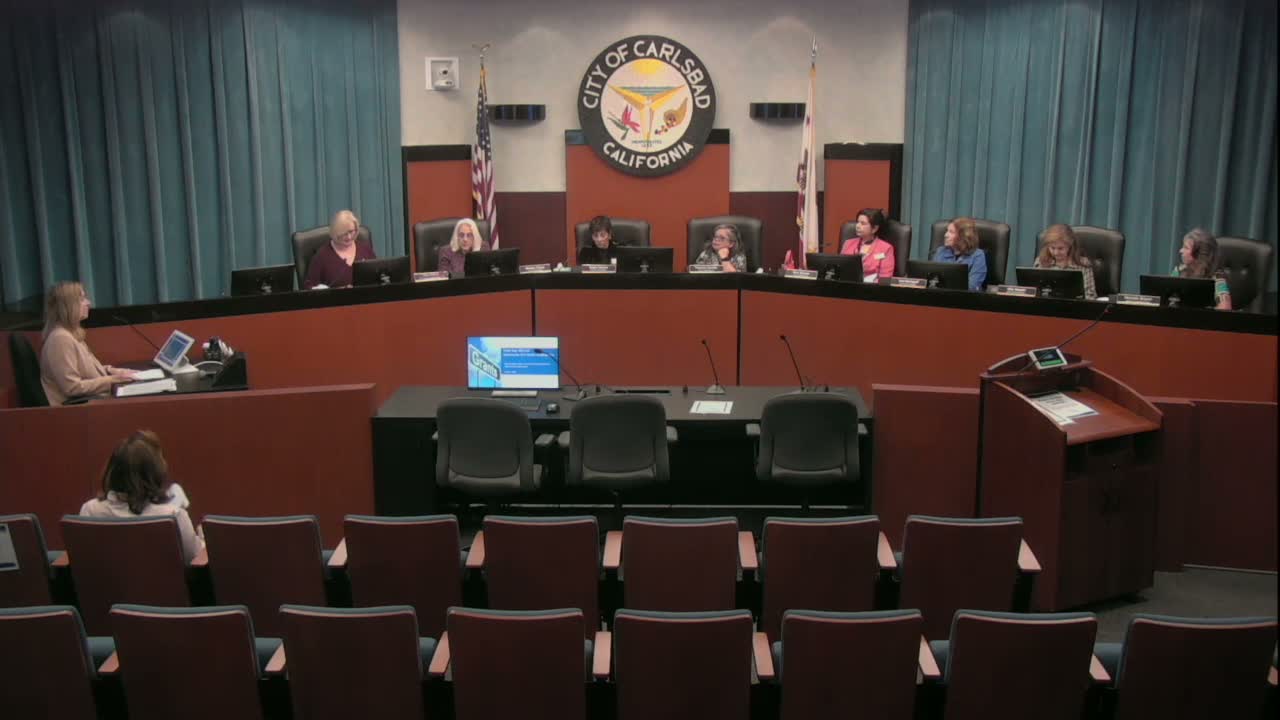
The Carlsbad Arts Commission on May 2 approved the fiscal year 2024–25 Community Arts Grants funding plan, distributing $117,128 among arts-education projects, arts organizations and an emerging-organization award after a 14-member peer panel reviewed 32 eligible applications.
Wendy Sabin Lasker, the community arts coordinator who presented the plan, said the city received 35 applications in total, 32 of which met eligibility criteria. Panelists reviewed applications digitally between March 25 and April 15, with each application typically reviewed by three evaluators. ‘‘We had 14 panelists this time, which allowed us to do a full three-review process per application,’’ Sabin Lasker said. She told commissioners that scoring bands were applied to determine award rates: top scores received full awards while lower bands received proportionally reduced amounts; applications scoring below 70% were not funded.
The commission heard that schools fared well: Sabin Lasker said a decision to target at least 35% of funds to schools resulted in slightly more than 40% of awards going to school-based projects. Totals by category included $65,340 awarded to arts-education projects and $47,280 to arts-in-school requests, while arts organizations received $69,840 in total awards and an emerging organization received $4,500 of a $5,000 request.
Commissioners asked about several specific decisions. Commissioner Carrillo asked why Campania/Capania Studios scored low; Sabin Lasker said reviewers felt the workshop format served a relatively small audience and that applications are scored on reach, impact and the project’s compelling case for funding. Commissioner George raised questions about STEM/STEAM-style proposals that appeared similar across applicants; Sabin Lasker said reviewers examined demonstrated arts integration and noted one science-focused program was not funded this year.
Commissioner George moved to approve the funding plan; Commissioner Ferroni seconded. The commission approved the plan unanimously.
The grants will be distributed as 80% at contract execution and the remaining 20% upon receipt of a final project report. Sabin Lasker said staff can follow up with applicants to clarify application language where reviewers flagged potential errors. The commission’s next steps include notifying awardees and executing standard agreements that allow the city to request receipts if needed.
Next procedural steps: the approved funding plan will be implemented under staff oversight; awardees must complete projects within the one-year activity period beginning September 3, 2024, with final reports due no later than October 3, 2025.
Wendy Sabin Lasker, the community arts coordinator who presented the plan, said the city received 35 applications in total, 32 of which met eligibility criteria. Panelists reviewed applications digitally between March 25 and April 15, with each application typically reviewed by three evaluators. ‘‘We had 14 panelists this time, which allowed us to do a full three-review process per application,’’ Sabin Lasker said. She told commissioners that scoring bands were applied to determine award rates: top scores received full awards while lower bands received proportionally reduced amounts; applications scoring below 70% were not funded.
The commission heard that schools fared well: Sabin Lasker said a decision to target at least 35% of funds to schools resulted in slightly more than 40% of awards going to school-based projects. Totals by category included $65,340 awarded to arts-education projects and $47,280 to arts-in-school requests, while arts organizations received $69,840 in total awards and an emerging organization received $4,500 of a $5,000 request.
Commissioners asked about several specific decisions. Commissioner Carrillo asked why Campania/Capania Studios scored low; Sabin Lasker said reviewers felt the workshop format served a relatively small audience and that applications are scored on reach, impact and the project’s compelling case for funding. Commissioner George raised questions about STEM/STEAM-style proposals that appeared similar across applicants; Sabin Lasker said reviewers examined demonstrated arts integration and noted one science-focused program was not funded this year.
Commissioner George moved to approve the funding plan; Commissioner Ferroni seconded. The commission approved the plan unanimously.
The grants will be distributed as 80% at contract execution and the remaining 20% upon receipt of a final project report. Sabin Lasker said staff can follow up with applicants to clarify application language where reviewers flagged potential errors. The commission’s next steps include notifying awardees and executing standard agreements that allow the city to request receipts if needed.
Next procedural steps: the approved funding plan will be implemented under staff oversight; awardees must complete projects within the one-year activity period beginning September 3, 2024, with final reports due no later than October 3, 2025.
View the Full Meeting & All Its Details
This article offers just a summary. Unlock complete video, transcripts, and insights as a Founder Member.
✓
Watch full, unedited meeting videos
✓
Search every word spoken in unlimited transcripts
✓
AI summaries & real-time alerts (all government levels)
✓
Permanent access to expanding government content
30-day money-back guarantee
