Carlsbad officials outline legislative platform, funding priorities and sponsored bills
May 13, 2024 | Carlsbad, San Diego County, California
This article was created by AI summarizing key points discussed. AI makes mistakes, so for full details and context, please refer to the video of the full meeting. Please report any errors so we can fix them. Report an error »
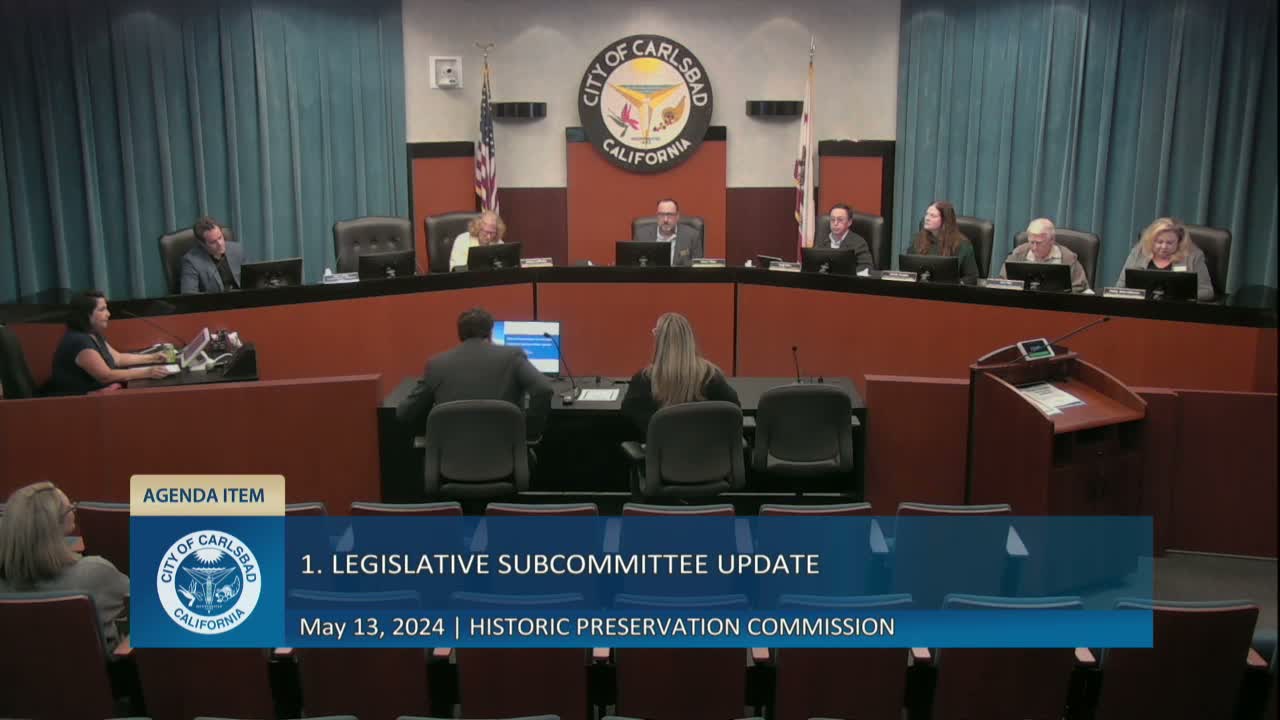
City staff and a council member told the Carlsbad Historic Preservation Commission on May 13 that the city is actively using an adopted legislative platform and a standing legislative subcommittee to guide state and federal advocacy and to pursue funding for local projects.
Jason Haber, the city’s Intergovernmental Affairs Director, described the program framework adopted by the City Council in 2018 that guides how staff and lobbyists monitor bills, prepare position statements, and engage at the state and federal levels. Haber walked the commission through the legislative calendar—including committee referrals, crossover deadlines and the Sept. 30 deadline for the governor’s signature—and said staff monitors hundreds of bills each year so the city can respond quickly when its platform provides a predetermined position.
Councilmember Melanie Burkholder, a member of the legislative subcommittee, highlighted alignment between the platform and the city’s strategic plan—community character, quality of life and environmental sustainability—and gave examples of recent and proposed advocacy. She cited past successes and current sponsored measures discussed in the presentation, and said city representatives will travel to Washington, D.C., to meet federal officials and members of Congress on behalf of the city’s priorities.
Haber and Burkholder pointed to recent funding outcomes and requests: they reported a $350,000 state award for a State Street electric-vehicle charging station and described a $5 million City Council seed contribution to support a conceptual railroad-lowering project that would be used to leverage larger regional and federal grants. Staff also noted the city is sponsoring bills that would, for example, create e‑bike rider training and age minimums (listed in the materials as AB 2234) and referenced a bill described in the staff packet as a Brown Act exemption (listed as 2715).
Commissioners asked where to find the city’s legislative platform (Haber said it is posted on the city website) and how staff prioritizes funding requests; presenters said departments identify projects with potential funding gaps and the city coordinates with regional partners (SANDAG, NCTD) and outside grant writers to pursue opportunities. No commission action was requested or taken; the presentation was informational and staff invited commissioners to provide feedback for items that intersect with historic preservation interests.
The commission moved on to other agenda items after the presentation.
Jason Haber, the city’s Intergovernmental Affairs Director, described the program framework adopted by the City Council in 2018 that guides how staff and lobbyists monitor bills, prepare position statements, and engage at the state and federal levels. Haber walked the commission through the legislative calendar—including committee referrals, crossover deadlines and the Sept. 30 deadline for the governor’s signature—and said staff monitors hundreds of bills each year so the city can respond quickly when its platform provides a predetermined position.
Councilmember Melanie Burkholder, a member of the legislative subcommittee, highlighted alignment between the platform and the city’s strategic plan—community character, quality of life and environmental sustainability—and gave examples of recent and proposed advocacy. She cited past successes and current sponsored measures discussed in the presentation, and said city representatives will travel to Washington, D.C., to meet federal officials and members of Congress on behalf of the city’s priorities.
Haber and Burkholder pointed to recent funding outcomes and requests: they reported a $350,000 state award for a State Street electric-vehicle charging station and described a $5 million City Council seed contribution to support a conceptual railroad-lowering project that would be used to leverage larger regional and federal grants. Staff also noted the city is sponsoring bills that would, for example, create e‑bike rider training and age minimums (listed in the materials as AB 2234) and referenced a bill described in the staff packet as a Brown Act exemption (listed as 2715).
Commissioners asked where to find the city’s legislative platform (Haber said it is posted on the city website) and how staff prioritizes funding requests; presenters said departments identify projects with potential funding gaps and the city coordinates with regional partners (SANDAG, NCTD) and outside grant writers to pursue opportunities. No commission action was requested or taken; the presentation was informational and staff invited commissioners to provide feedback for items that intersect with historic preservation interests.
The commission moved on to other agenda items after the presentation.
View the Full Meeting & All Its Details
This article offers just a summary. Unlock complete video, transcripts, and insights as a Founder Member.
✓
Watch full, unedited meeting videos
✓
Search every word spoken in unlimited transcripts
✓
AI summaries & real-time alerts (all government levels)
✓
Permanent access to expanding government content
30-day money-back guarantee
