Five‑year forecast shows widening gaps as SAFER grant sunsets
February 01, 2026 | Merced City, Merced County, California
This article was created by AI summarizing key points discussed. AI makes mistakes, so for full details and context, please refer to the video of the full meeting. Please report any errors so we can fix them. Report an error »
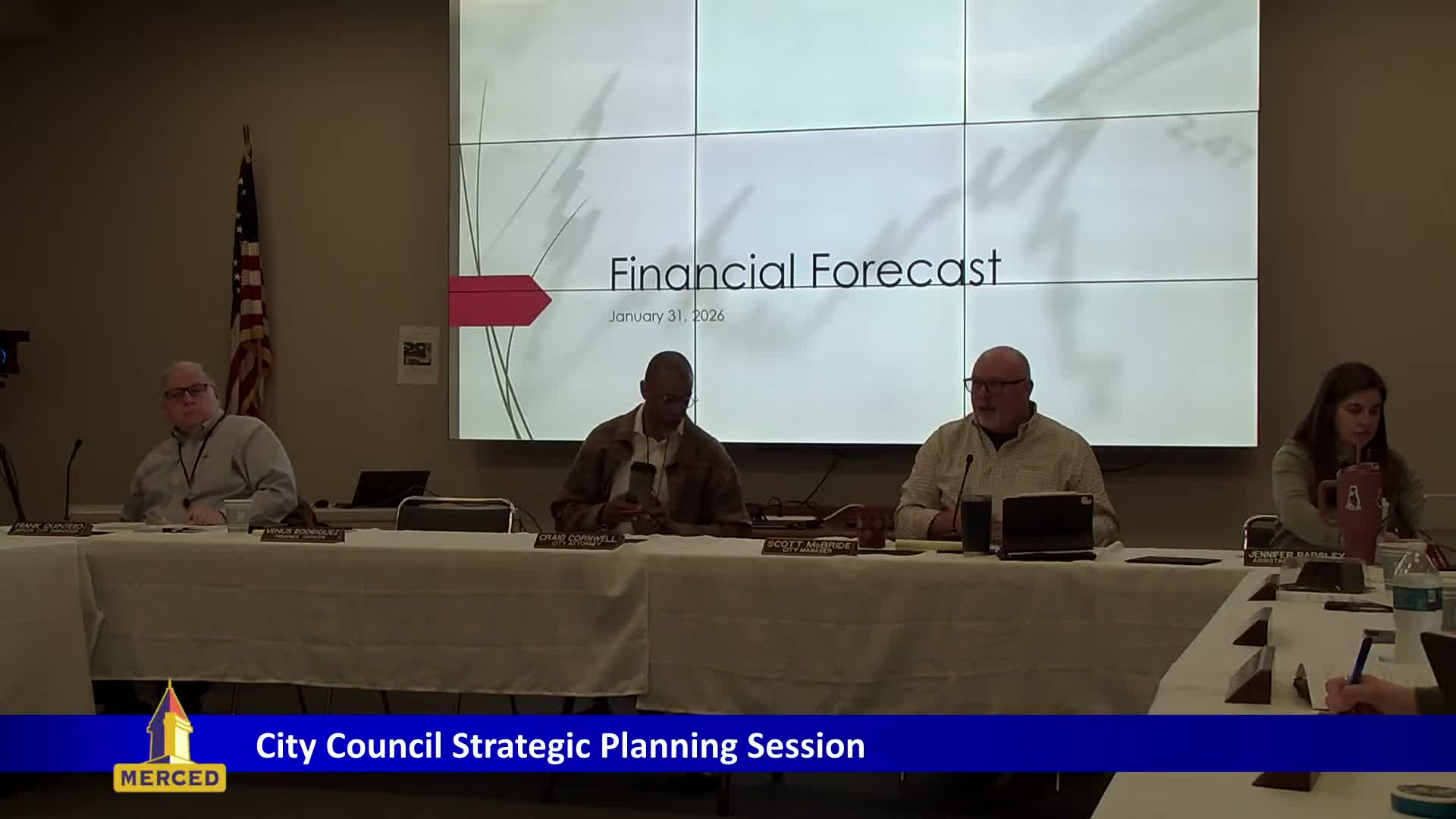
Venus, a city finance presenter, told the Merced City Council that the five‑year revenue forecast relies on historical actuals and consultant input and expects modest annual increases in most revenue lines: “Most of the revenues, smaller revenues are anywhere from a 1 to 3% increase,” she said, noting a 3% sales‑tax assumption and 5–6% property tax growth in the years shown.
The presentation listed several expense pressures: expiring MOUs, a sharp rise in benefit costs (Venus used a 10–11% estimate after a recent 15% jump), higher workers’ compensation and general liability, and CalPERS charges tied to the city’s unfunded pension liability. Venus said the city’s operating forecast excludes one‑time items such as PC and fleet replacement and does not assume new grants beyond current commitments.
A key near‑term loss is the SAFER grant for fire staffing. “The grant expires March 2027,” Fire Chief Casey Wilson confirmed in the council’s Q&A, noting the SAFER award currently funds 24 firefighter positions. Venus quantified the fiscal effect: removing SAFER revenue reduces the general fund by roughly $3–4 million a year in the later forecast years and contributes to a $5–6 million annual gap in some years when compared to projected expenditures.
Council and staff identified mitigation options that will come back to the council for decisions: increasing development‑service fees, raising certain user fees, pursuing a CFD or maintenance district for targeted services, pursuing grant opportunities (including reapplying for SAFER when a NOFO opens), and considering the timing or phasing of capital projects. Staff noted one immediate option is a business license audit to find unregistered activity and capture additional revenue.
The city manager emphasized the forecast shows most revenue is constrained and that personnel costs (about 75% of general‑fund expenditures) limit options for new ongoing programs. Staff will return with detailed CIP lists, fee‑study results and revenue scenarios for council consideration.
The presentation listed several expense pressures: expiring MOUs, a sharp rise in benefit costs (Venus used a 10–11% estimate after a recent 15% jump), higher workers’ compensation and general liability, and CalPERS charges tied to the city’s unfunded pension liability. Venus said the city’s operating forecast excludes one‑time items such as PC and fleet replacement and does not assume new grants beyond current commitments.
A key near‑term loss is the SAFER grant for fire staffing. “The grant expires March 2027,” Fire Chief Casey Wilson confirmed in the council’s Q&A, noting the SAFER award currently funds 24 firefighter positions. Venus quantified the fiscal effect: removing SAFER revenue reduces the general fund by roughly $3–4 million a year in the later forecast years and contributes to a $5–6 million annual gap in some years when compared to projected expenditures.
Council and staff identified mitigation options that will come back to the council for decisions: increasing development‑service fees, raising certain user fees, pursuing a CFD or maintenance district for targeted services, pursuing grant opportunities (including reapplying for SAFER when a NOFO opens), and considering the timing or phasing of capital projects. Staff noted one immediate option is a business license audit to find unregistered activity and capture additional revenue.
The city manager emphasized the forecast shows most revenue is constrained and that personnel costs (about 75% of general‑fund expenditures) limit options for new ongoing programs. Staff will return with detailed CIP lists, fee‑study results and revenue scenarios for council consideration.
Don't Miss a Word: See the Full Meeting!
Go beyond summaries. Unlock every video, transcript, and key insight with a Founder Membership.
✓
Get instant access to full meeting videos
✓
Search and clip any phrase from complete transcripts
✓
Receive AI-powered summaries & custom alerts
✓
Enjoy lifetime, unrestricted access to government data
30-day money-back guarantee
