Neighbors protest 96‑unit Bryant Road apartment plan; Planning Commission deadlocks, agrees to reconsider with notice
March 12, 2026 | Lexington City, Fayette County, Kentucky
This article was created by AI summarizing key points discussed. AI makes mistakes, so for full details and context, please refer to the video of the full meeting. Please report any errors so we can fix them. Report an error »
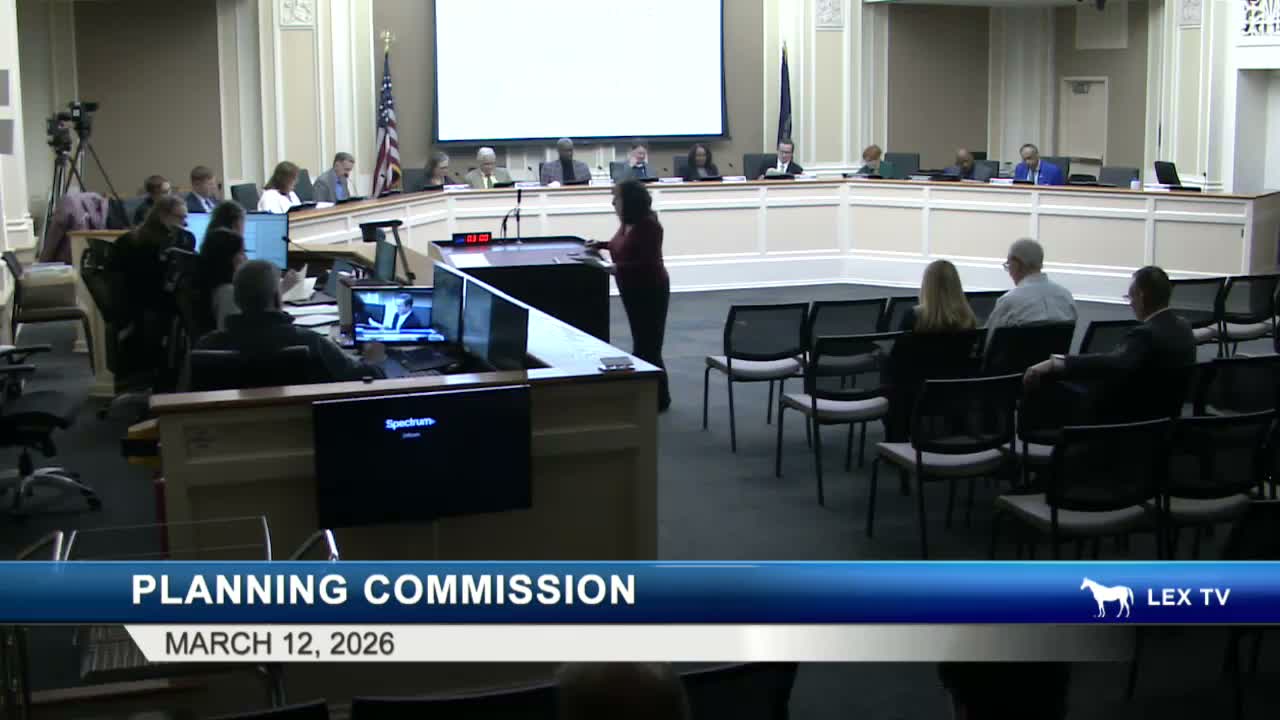
A proposal to build roughly 96–100 apartments on Bryant Road drew strong public opposition at the Lexington Planning Commission on March 12, and commissioners failed to approve the preliminary development plan in a 5–5 tie.
Residents from adjoining neighborhoods told the commission the narrow site, mature trees and local traffic capacity make the project inappropriate as drawn. "There is no such thing as tree mitigation in this scenario," said Camelo Brooks, who owns property backing the site, arguing that mature trees cannot be replaced by new plantings. Mike Bedarian and other neighbors described traffic congestion at nearby intersections and said the development would reduce privacy and property values.
Planning staff described the proposal as a preliminary development plan for a multi‑building apartment complex with a clubhouse, pool and parking; the applicant’s materials show about 96 units on roughly five acres and a plan to connect stormwater to an existing basin and the Brighton Rail Trail. Applicant representative Jihad Halani of Vision Engineering told commissioners the buildings would be set back about 100 feet from adjacent property lines and that the developer would provide a roughly 30‑foot vegetative buffer, fencing and supplemental plantings. Halani also said the applicant would offer a minimum 30% tree‑canopy commitment on the final development plan and additional mitigation for any large trees removed.
The urban forester cautioned that much of the existing stand is second‑growth and affected by Dutch elm disease, but highlighted a ring of five large sycamores and a low‑lying drainage area he urged the applicant to preserve. Commissioners pressed the applicant on whether certain trees could be saved, the feasibility of mitigation, and whether the project’s massing and the amount of commercial space proposed on the first floor met the intent of mixed‑use zoning.
Commissioner discussion split along competing policy lines: some members emphasized the city’s infill development priorities while others cited compatibility, tree preservation and neighborhood impacts. A motion to approve the preliminary plan failed on a tie vote. After the vote, the applicant asked for an opportunity to present new information and concessions; the commission approved a motion for reconsideration with notice and set the item for continuation on April 9 so the chair, staff and legal counsel can verify any new material before it is considered. The applicant agreed to waive the 90‑day review timeline to permit the continuance.
Next steps: the developer will provide any new materials to staff and the chair for review; the commission will decide whether the new information qualifies as basis for reconsideration at the April 9 meeting.
Residents from adjoining neighborhoods told the commission the narrow site, mature trees and local traffic capacity make the project inappropriate as drawn. "There is no such thing as tree mitigation in this scenario," said Camelo Brooks, who owns property backing the site, arguing that mature trees cannot be replaced by new plantings. Mike Bedarian and other neighbors described traffic congestion at nearby intersections and said the development would reduce privacy and property values.
Planning staff described the proposal as a preliminary development plan for a multi‑building apartment complex with a clubhouse, pool and parking; the applicant’s materials show about 96 units on roughly five acres and a plan to connect stormwater to an existing basin and the Brighton Rail Trail. Applicant representative Jihad Halani of Vision Engineering told commissioners the buildings would be set back about 100 feet from adjacent property lines and that the developer would provide a roughly 30‑foot vegetative buffer, fencing and supplemental plantings. Halani also said the applicant would offer a minimum 30% tree‑canopy commitment on the final development plan and additional mitigation for any large trees removed.
The urban forester cautioned that much of the existing stand is second‑growth and affected by Dutch elm disease, but highlighted a ring of five large sycamores and a low‑lying drainage area he urged the applicant to preserve. Commissioners pressed the applicant on whether certain trees could be saved, the feasibility of mitigation, and whether the project’s massing and the amount of commercial space proposed on the first floor met the intent of mixed‑use zoning.
Commissioner discussion split along competing policy lines: some members emphasized the city’s infill development priorities while others cited compatibility, tree preservation and neighborhood impacts. A motion to approve the preliminary plan failed on a tie vote. After the vote, the applicant asked for an opportunity to present new information and concessions; the commission approved a motion for reconsideration with notice and set the item for continuation on April 9 so the chair, staff and legal counsel can verify any new material before it is considered. The applicant agreed to waive the 90‑day review timeline to permit the continuance.
Next steps: the developer will provide any new materials to staff and the chair for review; the commission will decide whether the new information qualifies as basis for reconsideration at the April 9 meeting.
Don't Miss a Word: See the Full Meeting!
Go beyond summaries. Unlock every video, transcript, and key insight with a Founder Membership.
✓
Get instant access to full meeting videos
✓
Search and clip any phrase from complete transcripts
✓
Receive AI-powered summaries & custom alerts
✓
Enjoy lifetime, unrestricted access to government data
30-day money-back guarantee
