Fort Pierce commission approves 5% raise or $1.20, retroactive to Oct. 1, resolving Teamsters impasse
March 19, 2026 | Fort Pierce, St. Lucie County, Florida
This article was created by AI summarizing key points discussed. AI makes mistakes, so for full details and context, please refer to the video of the full meeting. Please report any errors so we can fix them. Report an error »
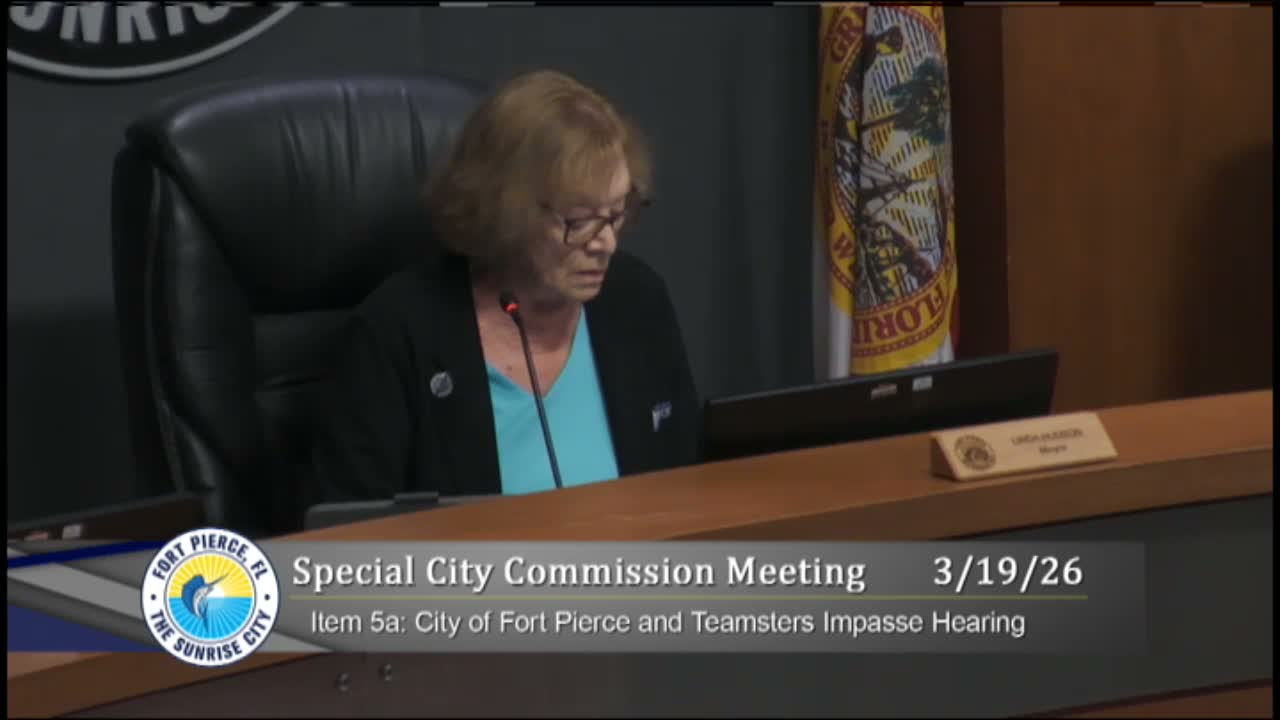
The Fort Pierce City Commission voted 4–1 on March 19 to resolve an impasse with Teamsters Local 769 by adopting a wage adjustment of 5% across the board or $1.20 per hour (whichever is greater), retroactive to Oct. 1.
Steve Myers, representing Teamsters Local 769, told the commission both sides already agree to a 5% increase but that the dispute turned on a flat minimum increase for the lowest‑paid employees. "Both the union and the city agree on the 5% wage increase. That's not in dispute," Myers said, adding the union seeks a $1.60/hour minimum increase because "the difference between the proposals is small in dollars, but it has a significant impact on the employees." He said many bargaining‑unit workers earn between about $16 and $20 an hour and that a $0.40‑per‑hour gap matters to employees facing rising rents and living costs.
City counsel JK Keller and finance staff urged fiscal caution. Keller said the budgeted cost for a straight 5% increase is about $456,000 and that the city's proposal — 5% or $1.20, whichever is greater — was offered to protect lower paid workers while staying close to the budgeted amount. "The city's first offer was a flat 5% increase for all the members in the unit," Keller said, adding the alternative with a $1.20 minimum was an attempt to stay within budget.
Finance representative Ms. Morris presented staff's cost calculations: the city had budgeted roughly $456,000 for a 5% increase; the city's 5% or $1.20 alternative increases the budget by about $34,015; staff said the union's $1.60 minimum produced a larger wage‑and‑benefit cost that staff presented on the screen as approximately $607,000 in total wage+benefit cost and described the incremental budget impact as about $151,229 beyond what was budgeted. Morris told commissioners the additional cost would likely come from the fund balance/reserves or from vacancy savings but warned there are other unanticipated demands on reserves (she cited parking‑garage repairs and an FEC bill).
Commissioners questioned the parties' headcount and calculations. Jared Sorensen, HR manager, said the bargaining unit includes approximately 139 employees, that 79 employees would fall below the city's $1.20 threshold, and that 124 employees would fall below the union's $1.60 threshold depending on the approach used.
After public rebuttal closed with no outside public commenters, commissioners debated fiscal risk, recruitment and retention, and the timing of upcoming negotiations. Commissioner Zadofsky moved to adopt 5% or $1.20 per hour retroactive to Oct. 1; Commissioner Broderick seconded. The roll call vote was Commissioner Broderick — yes; Commissioner Zadofsky — yes; Commissioner Gaines — no; Commissioner Johnson — yes; Mayor Hudson — yes. The motion passed 4–1. The commission also voted separately to increase pay ranges (minimums and maximums in the classification plan) by 5%; staff said that range change has no immediate additional cost but could affect future hiring rates.
City Attorney Beverly Hedges reminded commissioners they were not bound to any of the proposals presented and that the commission has broad discretion under the applicable Florida statute to fashion an alternative remedy to resolve the impasse. The adopted changes will be reduced to writing and, under the statutory process described in the hearing, will be presented to the bargaining unit for ratification or imposition procedures described by counsel.
The commission asked staff to monitor first‑quarter payroll and return with a financial snapshot so elected officials and the public can see whether vacancy savings or other line‑item differences will cover the near‑term $34,000 gap and how the decision affects future budgets. The commission adjourned the special meeting following the votes.
Steve Myers, representing Teamsters Local 769, told the commission both sides already agree to a 5% increase but that the dispute turned on a flat minimum increase for the lowest‑paid employees. "Both the union and the city agree on the 5% wage increase. That's not in dispute," Myers said, adding the union seeks a $1.60/hour minimum increase because "the difference between the proposals is small in dollars, but it has a significant impact on the employees." He said many bargaining‑unit workers earn between about $16 and $20 an hour and that a $0.40‑per‑hour gap matters to employees facing rising rents and living costs.
City counsel JK Keller and finance staff urged fiscal caution. Keller said the budgeted cost for a straight 5% increase is about $456,000 and that the city's proposal — 5% or $1.20, whichever is greater — was offered to protect lower paid workers while staying close to the budgeted amount. "The city's first offer was a flat 5% increase for all the members in the unit," Keller said, adding the alternative with a $1.20 minimum was an attempt to stay within budget.
Finance representative Ms. Morris presented staff's cost calculations: the city had budgeted roughly $456,000 for a 5% increase; the city's 5% or $1.20 alternative increases the budget by about $34,015; staff said the union's $1.60 minimum produced a larger wage‑and‑benefit cost that staff presented on the screen as approximately $607,000 in total wage+benefit cost and described the incremental budget impact as about $151,229 beyond what was budgeted. Morris told commissioners the additional cost would likely come from the fund balance/reserves or from vacancy savings but warned there are other unanticipated demands on reserves (she cited parking‑garage repairs and an FEC bill).
Commissioners questioned the parties' headcount and calculations. Jared Sorensen, HR manager, said the bargaining unit includes approximately 139 employees, that 79 employees would fall below the city's $1.20 threshold, and that 124 employees would fall below the union's $1.60 threshold depending on the approach used.
After public rebuttal closed with no outside public commenters, commissioners debated fiscal risk, recruitment and retention, and the timing of upcoming negotiations. Commissioner Zadofsky moved to adopt 5% or $1.20 per hour retroactive to Oct. 1; Commissioner Broderick seconded. The roll call vote was Commissioner Broderick — yes; Commissioner Zadofsky — yes; Commissioner Gaines — no; Commissioner Johnson — yes; Mayor Hudson — yes. The motion passed 4–1. The commission also voted separately to increase pay ranges (minimums and maximums in the classification plan) by 5%; staff said that range change has no immediate additional cost but could affect future hiring rates.
City Attorney Beverly Hedges reminded commissioners they were not bound to any of the proposals presented and that the commission has broad discretion under the applicable Florida statute to fashion an alternative remedy to resolve the impasse. The adopted changes will be reduced to writing and, under the statutory process described in the hearing, will be presented to the bargaining unit for ratification or imposition procedures described by counsel.
The commission asked staff to monitor first‑quarter payroll and return with a financial snapshot so elected officials and the public can see whether vacancy savings or other line‑item differences will cover the near‑term $34,000 gap and how the decision affects future budgets. The commission adjourned the special meeting following the votes.
Don't Miss a Word: See the Full Meeting!
Go beyond summaries. Unlock every video, transcript, and key insight with a Founder Membership.
✓
Get instant access to full meeting videos
✓
Search and clip any phrase from complete transcripts
✓
Receive AI-powered summaries & custom alerts
✓
Enjoy lifetime, unrestricted access to government data
30-day money-back guarantee
