Bill to default Tennessee drug scheduling to federal labels advances amid TBI concerns
April 01, 2026 | 2026 Legislature TN, Tennessee
This article was created by AI summarizing key points discussed. AI makes mistakes, so for full details and context, please refer to the video of the full meeting. Please report any errors so we can fix them. Report an error »
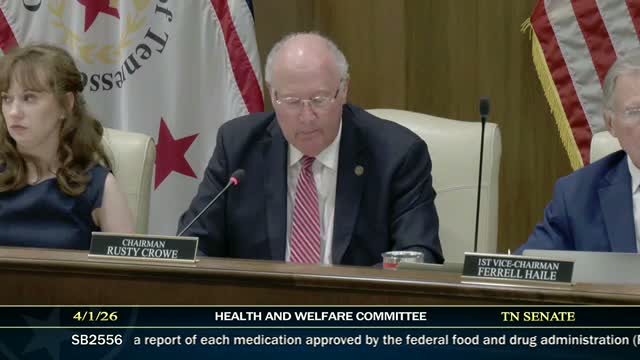
A bill to make Tennessee follow federal scheduling for FDA‑approved drugs by default cleared the Senate health committee after extended testimony and debate.
Sponsor Senator Reeves said the measure is designed to close a gap that can delay patient access to new therapies: "...when it actually comes to Tennessee, whatever the schedule is at the federal level, that will be the schedule at the state of Tennessee," he told members, adding the change would allow doctors to prescribe FDA‑approved treatments without waiting months for state rulemaking.
Attorney Patrick Brennan, who advised the committee, cited past examples — including zolrenone and Epidiolex — and said federal scheduling ambiguity can leave prescribers and pharmacists uncertain. "This bill would simply make it a default that until the state has acted... new drugs approved by the FDA would be treated the same way they are under federal law," Brennan said.
Patrick Powell, deputy general counsel for the Tennessee Bureau of Investigation, testified in opposition to aspects of the current amendment, listing three core concerns: "outsourcing of state authority to the feds," elimination of mental health's ability to object to scheduling, and how the bill might undercut state bans on substances such as salvia or xylazine if the federal government later schedules them.
Proponents replied that the legislation preserves the state's authority to reschedule or ban substances and that the bill only creates a default treatment for FDA‑approved products prior to state action. Brennan and other proponents said the Department of Mental Health and the legislature could act at any time to modify state scheduling.
After recesses for testimony and extensive Q&A on practical implications — including whether existing prescriptions and refills would be affected if the state later rescheduled a drug more strictly — the committee adopted the amendment and reported the bill to the calendar; the committee recorded 8 ayes and 1 present not voting on final committee action.
Supporters emphasized the bill aims to reduce a sometimes lengthy gap between federal approval and state scheduling that can delay access to drugs with potentially life‑saving uses; opponents urged care to preserve state regulatory prerogatives and to avoid creating ambiguity where Tennessee has chosen stricter controls for certain substances.
Sponsor Senator Reeves said the measure is designed to close a gap that can delay patient access to new therapies: "...when it actually comes to Tennessee, whatever the schedule is at the federal level, that will be the schedule at the state of Tennessee," he told members, adding the change would allow doctors to prescribe FDA‑approved treatments without waiting months for state rulemaking.
Attorney Patrick Brennan, who advised the committee, cited past examples — including zolrenone and Epidiolex — and said federal scheduling ambiguity can leave prescribers and pharmacists uncertain. "This bill would simply make it a default that until the state has acted... new drugs approved by the FDA would be treated the same way they are under federal law," Brennan said.
Patrick Powell, deputy general counsel for the Tennessee Bureau of Investigation, testified in opposition to aspects of the current amendment, listing three core concerns: "outsourcing of state authority to the feds," elimination of mental health's ability to object to scheduling, and how the bill might undercut state bans on substances such as salvia or xylazine if the federal government later schedules them.
Proponents replied that the legislation preserves the state's authority to reschedule or ban substances and that the bill only creates a default treatment for FDA‑approved products prior to state action. Brennan and other proponents said the Department of Mental Health and the legislature could act at any time to modify state scheduling.
After recesses for testimony and extensive Q&A on practical implications — including whether existing prescriptions and refills would be affected if the state later rescheduled a drug more strictly — the committee adopted the amendment and reported the bill to the calendar; the committee recorded 8 ayes and 1 present not voting on final committee action.
Supporters emphasized the bill aims to reduce a sometimes lengthy gap between federal approval and state scheduling that can delay access to drugs with potentially life‑saving uses; opponents urged care to preserve state regulatory prerogatives and to avoid creating ambiguity where Tennessee has chosen stricter controls for certain substances.
Don't Miss a Word: See the Full Meeting!
Go beyond summaries. Unlock every video, transcript, and key insight with a Founder Membership.
✓
Get instant access to full meeting videos
✓
Search and clip any phrase from complete transcripts
✓
Receive AI-powered summaries & custom alerts
✓
Enjoy lifetime, unrestricted access to government data
30-day money-back guarantee
