Council directs phased plan to build city‑run ambulance service; staff estimates $5.5–6 million annual operations
March 17, 2026 | National City, San Diego County, California
This article was created by AI summarizing key points discussed. AI makes mistakes, so for full details and context, please refer to the video of the full meeting. Please report any errors so we can fix them. Report an error »
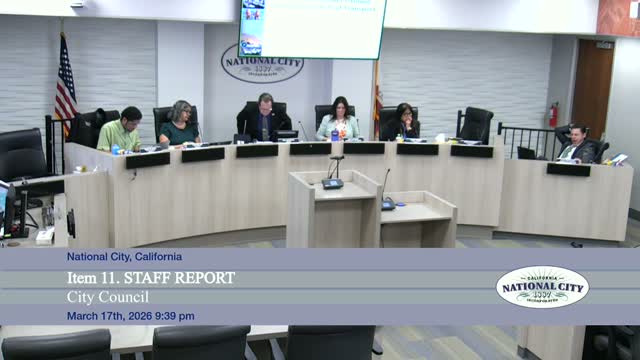
The council voted to begin phased implementation of a city‑operated ground emergency medical transport program following a presentation by Battalion Chief Jeremy Day of the National City Fire Department.
Day said National City averages about 8,500–8,800 ambulance responses annually and presented a system design that would deploy three 24‑hour frontline ambulances (one at each of the city's three stations) and two reserve units for surge capacity. To staff that model under the department's three‑platoon system would require approximately 18 new frontline FTEs (two per ambulance per shift across platoons) plus supervisory positions; staff estimated about 21 total new positions including management.
A preliminary financial analysis presented by staff estimated annual operating costs of $5.5–6.0 million, which would include an annual repayment of startup costs. The finance assumptions included a 10% payback schedule for startup with interest assumptions and an estimated repayment obligation of roughly $700,000–800,000 per year over about 11 years. Day emphasized the program would be structured as an enterprise fund and intended to be supported primarily by ambulance transport revenue and publicly provided EMS reimbursement (PPGMT/Medi‑Cal enhancements for public providers), not the general fund.
Councilmembers asked about timeline and risk: staff estimated a 12–14 month build‑out to operational status and said the city would negotiate an interim extension with the existing contractor to ensure continuity while the program is stood up. Council members also asked for more detail on payer mix, collection assumptions, contingency funding and training/recruitment pathways; Day and staff said they will continue refining revenue forecasting, pursue grants to offset startup capital and coordinate with human resources on recruitment and training, including local pipeline opportunities with Sweetwater High School and Southwestern College.
Why it matters: The item would shift ambulance transport from a privately contracted model to a city‑run enterprise, with implications for response times, workforce development, billing/revenue and municipal service delivery.
What happens next: Council approved staff to proceed through phases 1–5 (classification development, hiring, procurement, fleet acquisition, testing and training) and asked for regular updates on financial assumptions and implementation milestones; major contracts, appropriations and budget actions will return to council for approval before activation.
Day said National City averages about 8,500–8,800 ambulance responses annually and presented a system design that would deploy three 24‑hour frontline ambulances (one at each of the city's three stations) and two reserve units for surge capacity. To staff that model under the department's three‑platoon system would require approximately 18 new frontline FTEs (two per ambulance per shift across platoons) plus supervisory positions; staff estimated about 21 total new positions including management.
A preliminary financial analysis presented by staff estimated annual operating costs of $5.5–6.0 million, which would include an annual repayment of startup costs. The finance assumptions included a 10% payback schedule for startup with interest assumptions and an estimated repayment obligation of roughly $700,000–800,000 per year over about 11 years. Day emphasized the program would be structured as an enterprise fund and intended to be supported primarily by ambulance transport revenue and publicly provided EMS reimbursement (PPGMT/Medi‑Cal enhancements for public providers), not the general fund.
Councilmembers asked about timeline and risk: staff estimated a 12–14 month build‑out to operational status and said the city would negotiate an interim extension with the existing contractor to ensure continuity while the program is stood up. Council members also asked for more detail on payer mix, collection assumptions, contingency funding and training/recruitment pathways; Day and staff said they will continue refining revenue forecasting, pursue grants to offset startup capital and coordinate with human resources on recruitment and training, including local pipeline opportunities with Sweetwater High School and Southwestern College.
Why it matters: The item would shift ambulance transport from a privately contracted model to a city‑run enterprise, with implications for response times, workforce development, billing/revenue and municipal service delivery.
What happens next: Council approved staff to proceed through phases 1–5 (classification development, hiring, procurement, fleet acquisition, testing and training) and asked for regular updates on financial assumptions and implementation milestones; major contracts, appropriations and budget actions will return to council for approval before activation.
Don't Miss a Word: See the Full Meeting!
Go beyond summaries. Unlock every video, transcript, and key insight with a Founder Membership.
✓
Get instant access to full meeting videos
✓
Search and clip any phrase from complete transcripts
✓
Receive AI-powered summaries & custom alerts
✓
Enjoy lifetime, unrestricted access to government data
30-day money-back guarantee
