Council reviews 2023 speed-enforcement gains and signals workshop to update 2001 speed-hump policy
May 28, 2024 | El Cajon, San Diego County, California
This article was created by AI summarizing key points discussed. AI makes mistakes, so for full details and context, please refer to the video of the full meeting. Please report any errors so we can fix them. Report an error »
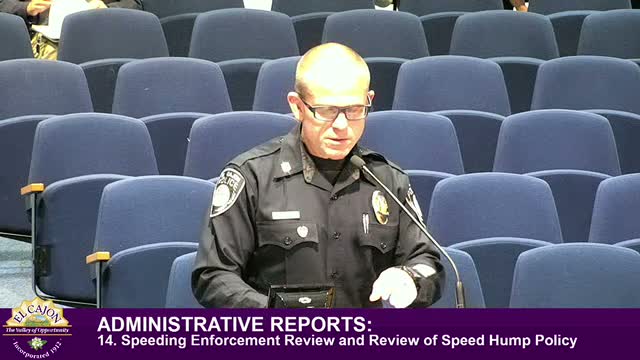
Captain Jeremiah Larson presented the city's traffic enforcement report and said El Cajon increased its motor-unit staffing from three to four officers, which coincided with a 154% increase in motor-division citations between 2022 and 2023 and roughly 1,337 total traffic citations in 2023 (about 147 for speeding). Staff described tools in use: eight fixed speed display signs, two portable speed trailers, two portable message sign boards, and coordinated county motor-unit details and grant-funded overtime.
Larson and staff emphasized a mix of enforcement, targeted overtime details, and engineering while noting the challenge that enforcement requires officers to observe infractions in the act. Council members raised resident concerns about red-light runners and asked about enforcement strategies; staff said targeted details and community reports inform deployments.
Staff also reviewed the city's existing speed-hump policy (adopted in 2001) and described a typical sequence used by other cities: enforcement first, then striping or other engineering measures, and speed humps as a last resort. Staff summarized Encinitas'style quantitative criteria (80th-percentile speed thresholds, crash history, cut-through volume, pedestrian and sidewalk considerations) and said Taft Street did not qualify for speed humps under that scoring but may qualify for striping or stop-sign changes.
Council members expressed support for a community workshop to revisit and reduce subjectivity in the 2001 policy; members discussed timing to avoid "workshop fatigue," trade-offs between engineering solutions and impacts on residents, and possible use of speed cushions that can be removed. The council reached general consensus that a workshop would be helpful, leaving exact timing to staff.
No formal change to the speed-hump policy was adopted at the meeting; staff will return with options and potentially a public workshop later in the year.
Larson and staff emphasized a mix of enforcement, targeted overtime details, and engineering while noting the challenge that enforcement requires officers to observe infractions in the act. Council members raised resident concerns about red-light runners and asked about enforcement strategies; staff said targeted details and community reports inform deployments.
Staff also reviewed the city's existing speed-hump policy (adopted in 2001) and described a typical sequence used by other cities: enforcement first, then striping or other engineering measures, and speed humps as a last resort. Staff summarized Encinitas'style quantitative criteria (80th-percentile speed thresholds, crash history, cut-through volume, pedestrian and sidewalk considerations) and said Taft Street did not qualify for speed humps under that scoring but may qualify for striping or stop-sign changes.
Council members expressed support for a community workshop to revisit and reduce subjectivity in the 2001 policy; members discussed timing to avoid "workshop fatigue," trade-offs between engineering solutions and impacts on residents, and possible use of speed cushions that can be removed. The council reached general consensus that a workshop would be helpful, leaving exact timing to staff.
No formal change to the speed-hump policy was adopted at the meeting; staff will return with options and potentially a public workshop later in the year.
View the Full Meeting & All Its Details
This article offers just a summary. Unlock complete video, transcripts, and insights as a Founder Member.
✓
Watch full, unedited meeting videos
✓
Search every word spoken in unlimited transcripts
✓
AI summaries & real-time alerts (all government levels)
✓
Permanent access to expanding government content
30-day money-back guarantee
