San Diego police brief council: homicides, vehicle thefts and hate crimes fell in 2025
March 16, 2026 | San Diego City, San Diego County, California
This article was created by AI summarizing key points discussed. AI makes mistakes, so for full details and context, please refer to the video of the full meeting. Please report any errors so we can fix them. Report an error »
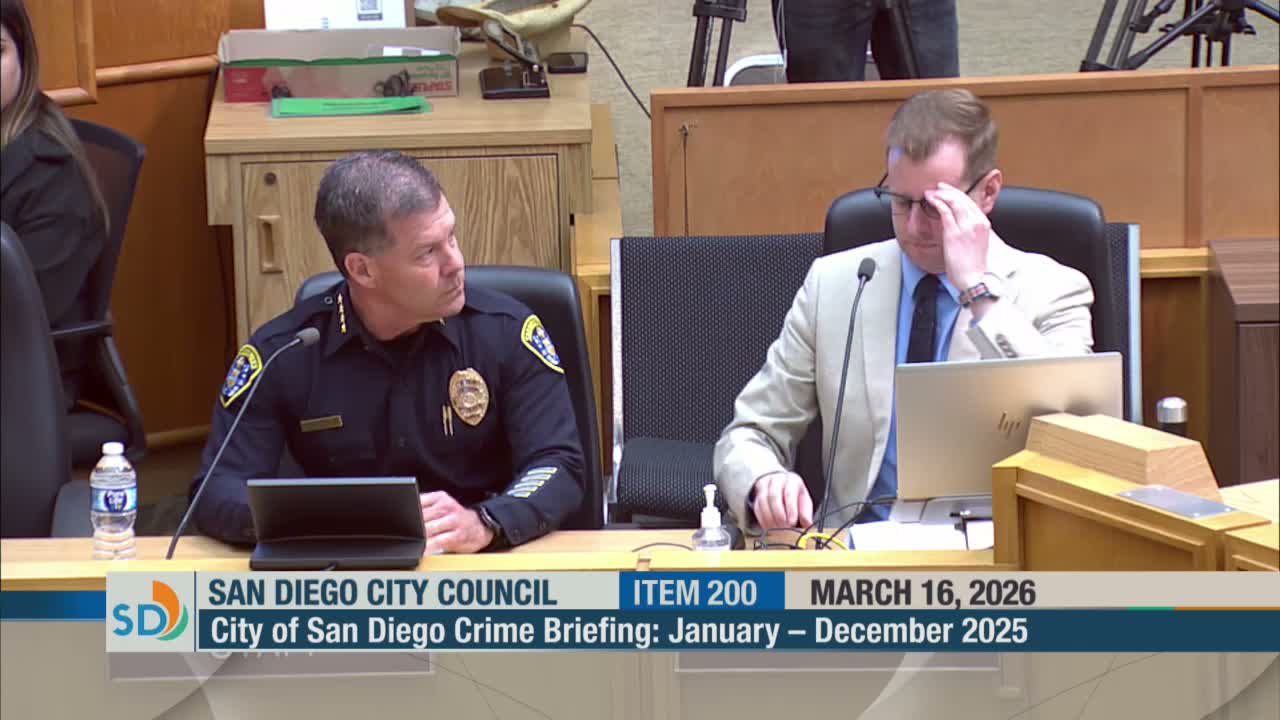
Chief Scott Wall told the City Council on March 16 that San Diego recorded declines across major crime categories in 2025, calling it the fourth consecutive year of reductions. “Last year, crime dropped for the fourth year in a row,” Chief Wall said, noting homicide investigations fell roughly 25% and vehicle theft dropped about 22% citywide.
The presentation, delivered alongside Jordan Pankhauser of the department’s crime analysis unit, used FBI NIBRS reporting and five‑year trend charts to show a 6.3% overall decline and improved clearance rates for serious crimes. Pankhauser said the department’s homicide unit solved 26 of the 27 murders in 2025 and credited automated license plate readers (ALPRs) with helping to solve about a third of those cases.
The briefing included a breakdown of NIBRS categories: crimes against persons (violent offenses), crimes against property (robbery, burglary, theft) and crimes against society (enforcement‑driven offenses such as drug violations). Pankhauser told the council that crimes against society rose about 6% amid increased enforcement related to a late‑2024 state change, while nonfatal shootings declined substantially from an earlier spike.
Council members praised the reductions but pressed the police chief on several operational points. Council member Bob Wolpert thanked officers and community partners and asked about training and retention; Chief Wall said he has restructured the training division, started two field training teams and shifted training to shorter, more frequent cycles. “One of my top three priorities is to develop inspiring leaders,” Wall said.
On staffing, Chief Wall said SDPD is operating with a vacancy roughly equal to 10% of budgeted posts and estimated the city is several hundred to more than a thousand officers short of comparable cities at similar scale, while noting creative staffing and technology help bridge gaps. He also said the department cut nearly $7 million in overtime without reducing response capability for high‑priority calls.
Council members asked about technology and civil‑liberties safeguards. Wall said ALPRs and smart streetlight cameras helped reduce vehicle theft and solve homicides but emphasized transparency practices: “We do not share our automated license plate reader system with any other city,” he told the council and said retention and auditing protocols are in place. The council also asked whether ALPRs were used for immigration enforcement; Chief Wall said the department complies with state law and does not use the system for immigration purposes.
Public commenters — including local nonprofits and community groups involved in violence‑interruption and youth programs — largely supported the department’s community partnerships and urged continued investment in prevention and mental‑health resources. Several speakers urged careful, transparent oversight of surveillance technology.
The briefing was informational and required no council action; council members thanked staff and community partners and said they would continue to prioritize training, community partnerships and the pairing of technology with oversight.
The presentation, delivered alongside Jordan Pankhauser of the department’s crime analysis unit, used FBI NIBRS reporting and five‑year trend charts to show a 6.3% overall decline and improved clearance rates for serious crimes. Pankhauser said the department’s homicide unit solved 26 of the 27 murders in 2025 and credited automated license plate readers (ALPRs) with helping to solve about a third of those cases.
The briefing included a breakdown of NIBRS categories: crimes against persons (violent offenses), crimes against property (robbery, burglary, theft) and crimes against society (enforcement‑driven offenses such as drug violations). Pankhauser told the council that crimes against society rose about 6% amid increased enforcement related to a late‑2024 state change, while nonfatal shootings declined substantially from an earlier spike.
Council members praised the reductions but pressed the police chief on several operational points. Council member Bob Wolpert thanked officers and community partners and asked about training and retention; Chief Wall said he has restructured the training division, started two field training teams and shifted training to shorter, more frequent cycles. “One of my top three priorities is to develop inspiring leaders,” Wall said.
On staffing, Chief Wall said SDPD is operating with a vacancy roughly equal to 10% of budgeted posts and estimated the city is several hundred to more than a thousand officers short of comparable cities at similar scale, while noting creative staffing and technology help bridge gaps. He also said the department cut nearly $7 million in overtime without reducing response capability for high‑priority calls.
Council members asked about technology and civil‑liberties safeguards. Wall said ALPRs and smart streetlight cameras helped reduce vehicle theft and solve homicides but emphasized transparency practices: “We do not share our automated license plate reader system with any other city,” he told the council and said retention and auditing protocols are in place. The council also asked whether ALPRs were used for immigration enforcement; Chief Wall said the department complies with state law and does not use the system for immigration purposes.
Public commenters — including local nonprofits and community groups involved in violence‑interruption and youth programs — largely supported the department’s community partnerships and urged continued investment in prevention and mental‑health resources. Several speakers urged careful, transparent oversight of surveillance technology.
The briefing was informational and required no council action; council members thanked staff and community partners and said they would continue to prioritize training, community partnerships and the pairing of technology with oversight.
Don't Miss a Word: See the Full Meeting!
Go beyond summaries. Unlock every video, transcript, and key insight with a Founder Membership.
✓
Get instant access to full meeting videos
✓
Search and clip any phrase from complete transcripts
✓
Receive AI-powered summaries & custom alerts
✓
Enjoy lifetime, unrestricted access to government data
30-day money-back guarantee
