Council sets aside CEQA exemption for 710 Garnet streetery after neighbors cite noise, parking and cumulative impacts
March 16, 2026 | San Diego City, San Diego County, California
This article was created by AI summarizing key points discussed. AI makes mistakes, so for full details and context, please refer to the video of the full meeting. Please report any errors so we can fix them. Report an error »
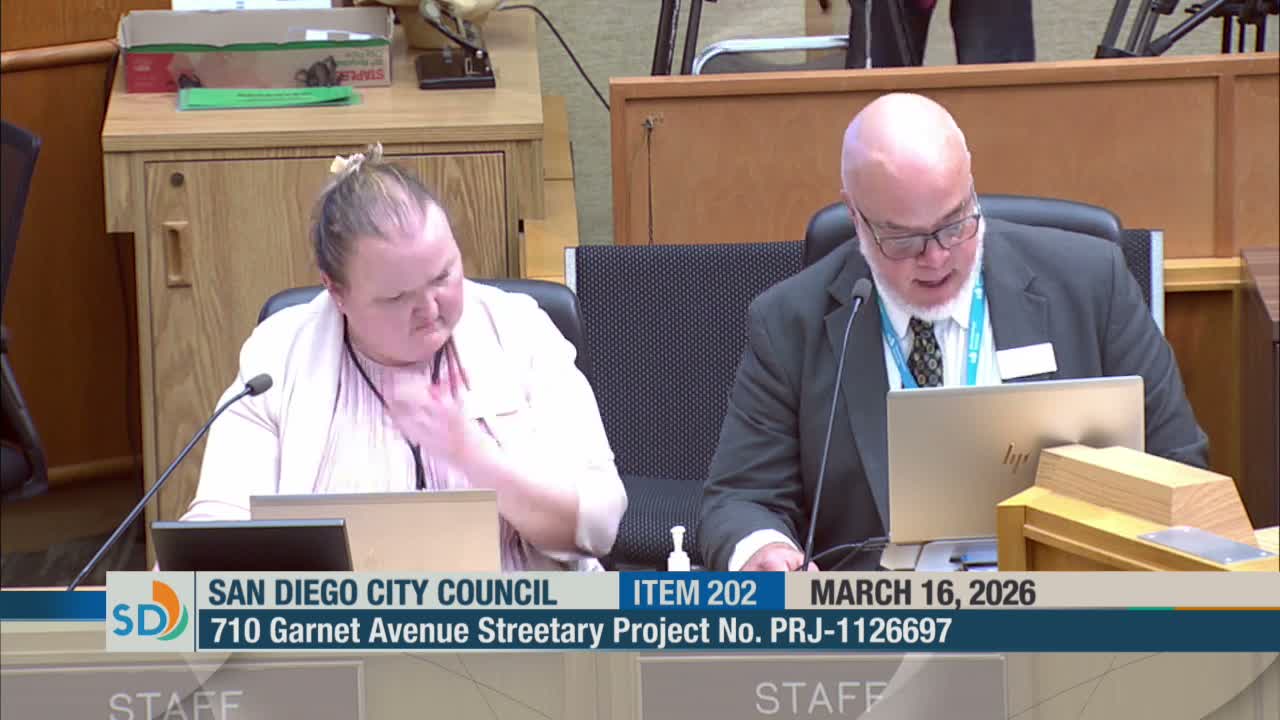
The City Council voted on March 16 to grant an appeal and set aside the environmental determination for a proposed streetery at 710 Garnet Avenue, reversing staff’s October 2025 finding that the project qualified for a categorical CEQA infill exemption.
Council President Joe Lacava moved to grant the appeal after appellants and many residents provided detailed testimony alleging a history of amplified noise, repeated complaints, prior court‑ordered mediation and local public‑safety incidents tied to the bar. Appellant Scott Chipman, speaking for neighbors and the Pacific Beach planning group, argued the exemption was improper under CEQA’s unusual‑circumstances and cumulative‑impacts exceptions, and cited parking and coastal‑access concerns. “There are hundreds of noise complaints and years of cumulative impacts,” Chipman told the council.
Applicant Scott Slaga, owner of 7 10 Beach Club, defended his venue and described investments he said he had made to mitigate sound — including roughly $150,000 in remodel and sound‑mitigation work and the later addition of air conditioning to reduce the need to open doors. Slaga disputed claims of ongoing violations and said the outdoor seating area is modest and essential to business recovery.
City staff had recommended denying the appeal and said the project met the five criteria for a Class 32 infill exemption (site under 5 acres, urban context, no habitat value, screening for traffic/noise impacts, and compliance with local regulations). The city attorney reminded the council the review is de novo and must be supported by substantial evidence in the record.
Council members focused their deliberations on whether appellant evidence created a reasonable possibility of significant environmental impacts related to ambient noise and cumulative effects when combined with existing operations. The council emphasized the limited scope of the action: this vote set aside the CEQA exemption and required a more complete environmental review; it did not approve or deny the streetery permit itself. Staff noted that, depending on the outcome of follow‑up CEQA work, any coastal or right‑of‑way permits would still be required and could be appealed to the Coastal Commission.
The motion passed 8–1 (Council member Campeo voted no). Council President Lacava and others said the action was narrowly tailored to require fuller environmental review in light of the evidence presented by residents; several council members urged that the permit process nonetheless give all parties opportunities for remediation, mitigation and dialogue.
Next steps: staff will return with additional environmental analysis and a revised determination; project approvals (coastal development permit/public right‑of‑way permit) remain subject to separate hearings and potential Coastal Commission review.
Council President Joe Lacava moved to grant the appeal after appellants and many residents provided detailed testimony alleging a history of amplified noise, repeated complaints, prior court‑ordered mediation and local public‑safety incidents tied to the bar. Appellant Scott Chipman, speaking for neighbors and the Pacific Beach planning group, argued the exemption was improper under CEQA’s unusual‑circumstances and cumulative‑impacts exceptions, and cited parking and coastal‑access concerns. “There are hundreds of noise complaints and years of cumulative impacts,” Chipman told the council.
Applicant Scott Slaga, owner of 7 10 Beach Club, defended his venue and described investments he said he had made to mitigate sound — including roughly $150,000 in remodel and sound‑mitigation work and the later addition of air conditioning to reduce the need to open doors. Slaga disputed claims of ongoing violations and said the outdoor seating area is modest and essential to business recovery.
City staff had recommended denying the appeal and said the project met the five criteria for a Class 32 infill exemption (site under 5 acres, urban context, no habitat value, screening for traffic/noise impacts, and compliance with local regulations). The city attorney reminded the council the review is de novo and must be supported by substantial evidence in the record.
Council members focused their deliberations on whether appellant evidence created a reasonable possibility of significant environmental impacts related to ambient noise and cumulative effects when combined with existing operations. The council emphasized the limited scope of the action: this vote set aside the CEQA exemption and required a more complete environmental review; it did not approve or deny the streetery permit itself. Staff noted that, depending on the outcome of follow‑up CEQA work, any coastal or right‑of‑way permits would still be required and could be appealed to the Coastal Commission.
The motion passed 8–1 (Council member Campeo voted no). Council President Lacava and others said the action was narrowly tailored to require fuller environmental review in light of the evidence presented by residents; several council members urged that the permit process nonetheless give all parties opportunities for remediation, mitigation and dialogue.
Next steps: staff will return with additional environmental analysis and a revised determination; project approvals (coastal development permit/public right‑of‑way permit) remain subject to separate hearings and potential Coastal Commission review.
Don't Miss a Word: See the Full Meeting!
Go beyond summaries. Unlock every video, transcript, and key insight with a Founder Membership.
✓
Get instant access to full meeting videos
✓
Search and clip any phrase from complete transcripts
✓
Receive AI-powered summaries & custom alerts
✓
Enjoy lifetime, unrestricted access to government data
30-day money-back guarantee
