Jurupa Valley council directs staff toward new City Hall annex, not full remodel
March 19, 2026 | Jurupa Valley, Riverside County, California
This article was created by AI summarizing key points discussed. AI makes mistakes, so for full details and context, please refer to the video of the full meeting. Please report any errors so we can fix them. Report an error »
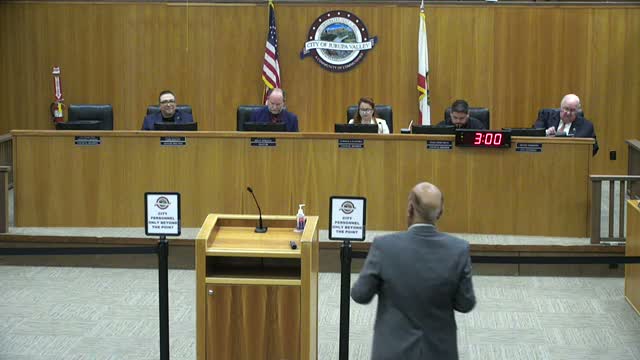
Council members gave staff direction on March 19 to pursue a new City Hall annex rather than a full gut-and-remodel of the existing historic building, after a staff presentation that laid out three options and rough cost estimates.
Paul Torr, who led the project briefing, told the council the existing building ‘‘was constructed in 1930’’ and has had additions over the years; staff estimated basic essential renovations that would make the building functional at roughly $8,000,000. The annex option — a new, detached 20,000‑square‑foot ‘‘NX Building’’ behind the existing structure — was estimated to cost about $19,000,000 for the shell plus roughly $7,000,000 in off‑site/site improvements, bringing that option near $25,000,000 when relocations and parking were included.
City Manager Butler outlined potential financing sources and scenarios, saying the city has about $4–5 million in general government impact‑fee funds available and over $60 million in general‑fund reserves. Butler described a range of approaches — from using impact‑fee or CFD (community facilities district) revenue streams to certificates of participation — and stressed the city’s intention to ‘‘use as little general‑fund money as possible’’ while still advancing the project.
Councilmembers who spoke in the study session said they favored the annex because it would provide capacity and allow the existing city hall to remain open during construction. ‘‘This building is not functioning for our staff — we’re packed in here like sardines,’’ Councilmember Sanchez said, urging action to address HVAC, plumbing and ADA issues. Another councilmember echoed that, calling Option 1 ‘‘the more financially responsible decision’’ because it adds long‑term capacity and avoids costly temporary relocations.
Staff said the annex path also allows the city to keep core public services operating in the existing building while moving front‑counter services to the new facility. Torr told the council staff will return with refined design plans and a detailed financing plan, and warned construction and relocation would likely take two to three years once underway.
What happens next: staff will refine the schematic design and financing scenarios and return with a recommended financing plan and schedule. No formal appropriation or contract award occurred on March 19; the council’s vote provided direction only.
Paul Torr, who led the project briefing, told the council the existing building ‘‘was constructed in 1930’’ and has had additions over the years; staff estimated basic essential renovations that would make the building functional at roughly $8,000,000. The annex option — a new, detached 20,000‑square‑foot ‘‘NX Building’’ behind the existing structure — was estimated to cost about $19,000,000 for the shell plus roughly $7,000,000 in off‑site/site improvements, bringing that option near $25,000,000 when relocations and parking were included.
City Manager Butler outlined potential financing sources and scenarios, saying the city has about $4–5 million in general government impact‑fee funds available and over $60 million in general‑fund reserves. Butler described a range of approaches — from using impact‑fee or CFD (community facilities district) revenue streams to certificates of participation — and stressed the city’s intention to ‘‘use as little general‑fund money as possible’’ while still advancing the project.
Councilmembers who spoke in the study session said they favored the annex because it would provide capacity and allow the existing city hall to remain open during construction. ‘‘This building is not functioning for our staff — we’re packed in here like sardines,’’ Councilmember Sanchez said, urging action to address HVAC, plumbing and ADA issues. Another councilmember echoed that, calling Option 1 ‘‘the more financially responsible decision’’ because it adds long‑term capacity and avoids costly temporary relocations.
Staff said the annex path also allows the city to keep core public services operating in the existing building while moving front‑counter services to the new facility. Torr told the council staff will return with refined design plans and a detailed financing plan, and warned construction and relocation would likely take two to three years once underway.
What happens next: staff will refine the schematic design and financing scenarios and return with a recommended financing plan and schedule. No formal appropriation or contract award occurred on March 19; the council’s vote provided direction only.
Don't Miss a Word: See the Full Meeting!
Go beyond summaries. Unlock every video, transcript, and key insight with a Founder Membership.
✓
Get instant access to full meeting videos
✓
Search and clip any phrase from complete transcripts
✓
Receive AI-powered summaries & custom alerts
✓
Enjoy lifetime, unrestricted access to government data
30-day money-back guarantee
