WCIA director warns Lynnwood council of rising liability costs, urges caution on land use and personnel
March 16, 2026 | Lynnwood, Snohomish County, Washington
This article was created by AI summarizing key points discussed. AI makes mistakes, so for full details and context, please refer to the video of the full meeting. Please report any errors so we can fix them. Report an error »
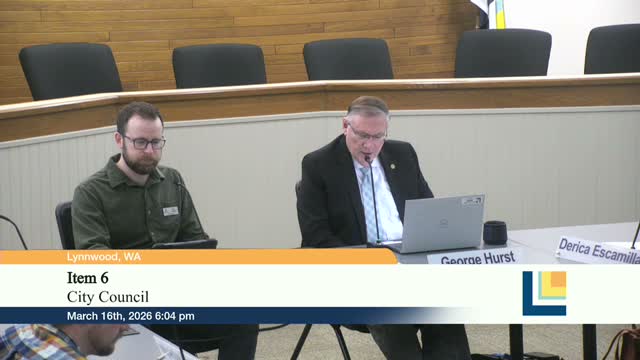
Anne Bennett, executive director of the Washington Cities Insurance Authority, told the Lynnwood City Council on March 16 that cities face a “historically hard market” for liability coverage and that the trend is driving higher reserves and premiums for municipal risk pools.
Bennett said WCIA, a nonprofit municipal risk pool formed in 1981 with more than 165 members and roughly $220 million in assets, retains the first $5 million of many losses and uses reinsurance for amounts above that. “Within the last 10 years, our reinsurance costs have increased 750%,” she said, describing how rising reinsurance prices and large jury verdicts are forcing members to increase reserves.
Her presentation cited recent high-dollar public‑entity payouts and described situations that commonly expose cities to litigation. She warned that council members’ on-the-record comments about development disputes or personnel matters can be used in court to establish liability. “Do not insert yourself in the process,” Bennett said, summarizing lessons from cases such as Westmart v. Burien where council statements and settlement-handling contributed to multimillion‑dollar outcomes.
Bennett told the council that elected officials retain legislative immunity for acts taken in a legislative session — for example adopting budgets, ordinances and resolutions — and that WCIA’s coverage applies when members act within the course and scope of their duties. But she drew a line around executive‑function activities such as hiring, firing and discipline: “If you are aware of an issue, you need to report it to them, and they will handle it,” Bennett said, urging councillors not to take a hands‑on role in personnel matters.
She also advised care when communicating in writing or on social media, and during executive sessions. Bennett recounted an instance where a privileged memo from executive session was passed to outside parties, triggering sanctions and damaging trust. “Be mindful of your written communications,” she said, noting that emails and text messages can become evidence.
Councilmembers asked for city‑specific loss and premium history. Bennett and WCIA staff said the city can access loss reports and risk‑profile data and offered to provide detailed reports to staff and council. “We can get you that information,” she told the council.
The training closed with staff and council acknowledging the tension between protecting the city from legal exposure and carrying out public responsibilities. Bennett encouraged the council to consult the city attorney on specific legal questions and to lean on WCIA’s risk‑management resources when designing policy or discussing contentious projects.
The council thanked Bennett and moved on to the night’s transportation briefing.
Bennett said WCIA, a nonprofit municipal risk pool formed in 1981 with more than 165 members and roughly $220 million in assets, retains the first $5 million of many losses and uses reinsurance for amounts above that. “Within the last 10 years, our reinsurance costs have increased 750%,” she said, describing how rising reinsurance prices and large jury verdicts are forcing members to increase reserves.
Her presentation cited recent high-dollar public‑entity payouts and described situations that commonly expose cities to litigation. She warned that council members’ on-the-record comments about development disputes or personnel matters can be used in court to establish liability. “Do not insert yourself in the process,” Bennett said, summarizing lessons from cases such as Westmart v. Burien where council statements and settlement-handling contributed to multimillion‑dollar outcomes.
Bennett told the council that elected officials retain legislative immunity for acts taken in a legislative session — for example adopting budgets, ordinances and resolutions — and that WCIA’s coverage applies when members act within the course and scope of their duties. But she drew a line around executive‑function activities such as hiring, firing and discipline: “If you are aware of an issue, you need to report it to them, and they will handle it,” Bennett said, urging councillors not to take a hands‑on role in personnel matters.
She also advised care when communicating in writing or on social media, and during executive sessions. Bennett recounted an instance where a privileged memo from executive session was passed to outside parties, triggering sanctions and damaging trust. “Be mindful of your written communications,” she said, noting that emails and text messages can become evidence.
Councilmembers asked for city‑specific loss and premium history. Bennett and WCIA staff said the city can access loss reports and risk‑profile data and offered to provide detailed reports to staff and council. “We can get you that information,” she told the council.
The training closed with staff and council acknowledging the tension between protecting the city from legal exposure and carrying out public responsibilities. Bennett encouraged the council to consult the city attorney on specific legal questions and to lean on WCIA’s risk‑management resources when designing policy or discussing contentious projects.
The council thanked Bennett and moved on to the night’s transportation briefing.
Don't Miss a Word: See the Full Meeting!
Go beyond summaries. Unlock every video, transcript, and key insight with a Founder Membership.
✓
Get instant access to full meeting videos
✓
Search and clip any phrase from complete transcripts
✓
Receive AI-powered summaries & custom alerts
✓
Enjoy lifetime, unrestricted access to government data
30-day money-back guarantee
