Chugach Electric outlines four Southcentral hydro projects and pushes for 2033 ITC deadline
March 31, 2026 | 2026 Legislature Alaska, Alaska
This article was created by AI summarizing key points discussed. AI makes mistakes, so for full details and context, please refer to the video of the full meeting. Please report any errors so we can fix them. Report an error »
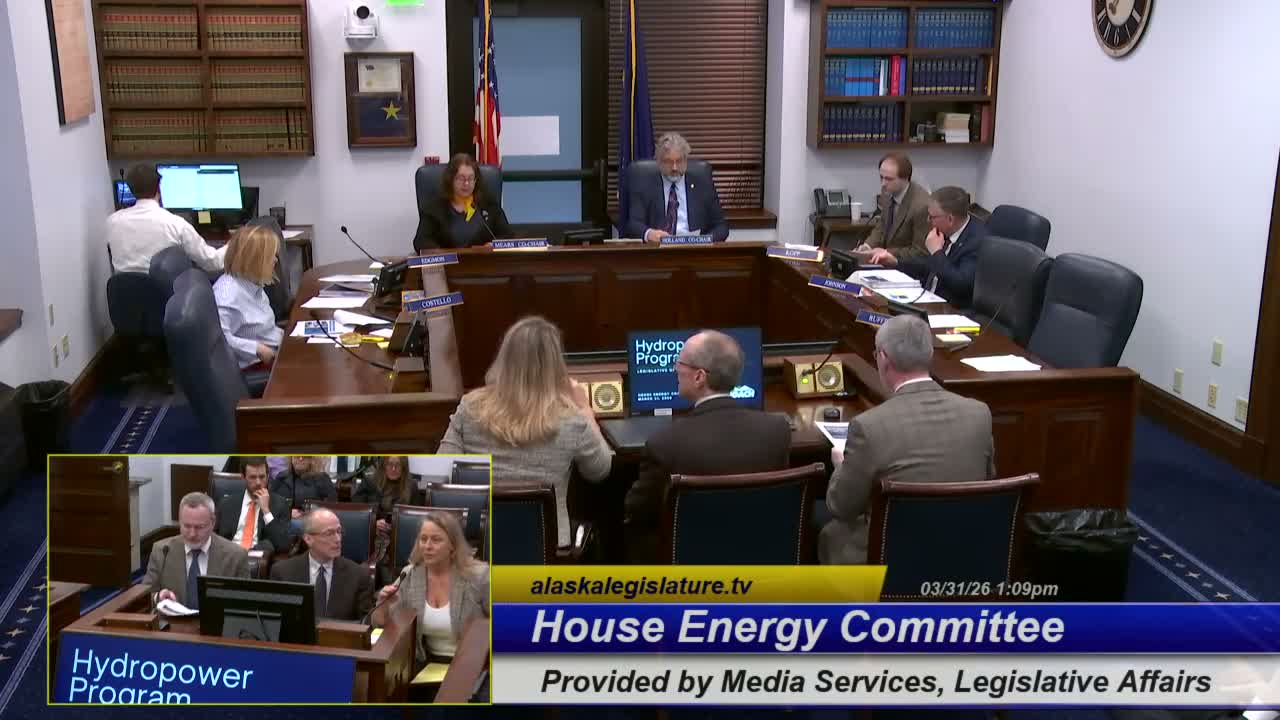
Chugach Electric briefed the Alaska House Energy Committee on Tuesday about a new hydroelectric program that the utility says could add roughly 50 megawatts from four shortlisted projects across Southcentral Alaska.
The utility presented the shortlist — Caribou Creek, Canyon Creek, Boulder Creek and Godwin Creek — as part of a broader decarbonization strategy. Arthur Miller, Chugach’s CEO, told the committee the company remains heavily reliant on natural gas (about 80% of generation) and is pursuing generation that lowers long-term costs and supports reliability. “We are looking to reduce our carbon intensity by at least 35% by 2030 and at least 50% by 2040 without a negative material impact on electric rates and reliability,” Miller said.
Dustin Hires, Chugach’s vice president of corporate programs, described the program’s site-selection funnel: an initial universe of about 158 candidate sites in the region was screened for proximity to roads and transmission, estimated capital cost, and environmental constraints; that review produced a short list of three storage projects and one run-of-river project. Hires said the four projects together would produce roughly 150,000 MWh annually and stressed that Chugach is still in preliminary feasibility. “These 4 came out of the screening process and … we thought was viable, that we could bite off,” Hires said.
Hires and Miller emphasized the early-stage nature of the work. Chugach has submitted preliminary FERC permit applications and state water-rights paperwork but has not begun formal licensing. The utility described an aggressive target: to begin construction in earnest by 2033 so projects qualify for the federal Investment Tax Credit (ITC) timelines tied to recent federal legislation. Hires said meeting that date requires moving quickly through feasibility, stakeholder engagement, geotechnical work, stream gauging, and transmission coordination.
Committee members pressed on likely impacts. A member asked how ratepayers will shoulder upfront capital costs; Miller said hydro projects carry high initial costs but lower all-in operating costs than thermal generation over the long term and that Chugach has not finalized rate-impact numbers. He described likely financing steps — tracking costs under deferred work orders, using commercial paper initially, and potentially issuing bonds later — and said Chugach could seek regulatory approval for construction-period cost recovery if necessary.
Representatives also raised environmental and local-use concerns. Hires listed fish habitat, wilderness-designated areas, inter-basin transfer issues and tribal interests as early filters. Specific site briefs noted local conditions: Canyon Creek (≈6 MW) sits on Forest Service land and is expected to be FERC-jurisdictional; Godwin Creek (≈16 MW) would require multiple dams and cross federal/state/city lands near Resurrection Bay and Seward; Caribou Creek (≈18 MW) has geology and permafrost risks that Chugach’s geotech work will investigate.
Chugach said preliminary outreach has included state and federal agencies, tribes and early contacts with utilities that own transmission in affected corridors; more detailed utility-to-utility negotiations will occur during feasibility and system-impact studies. The utility also highlighted how hydro — as synchronous generation with storage capability — can support grid stability in ways inverter-based resources cannot.
Chugach representatives closed by stressing the projects are not yet committed. They framed the four projects as a manageable portfolio that could be advanced or dropped depending on feasibility results, stakeholder input and transmission studies. The committee did not take formal action on any of the projects; Chugach said it expects to complete feasibility work and, if warranted, bring a formal proposal to its board late in the year or early next year.
The committee will receive future updates as Chugach advances geotechnical and environmental studies and completes the preliminary FERC process.
The utility presented the shortlist — Caribou Creek, Canyon Creek, Boulder Creek and Godwin Creek — as part of a broader decarbonization strategy. Arthur Miller, Chugach’s CEO, told the committee the company remains heavily reliant on natural gas (about 80% of generation) and is pursuing generation that lowers long-term costs and supports reliability. “We are looking to reduce our carbon intensity by at least 35% by 2030 and at least 50% by 2040 without a negative material impact on electric rates and reliability,” Miller said.
Dustin Hires, Chugach’s vice president of corporate programs, described the program’s site-selection funnel: an initial universe of about 158 candidate sites in the region was screened for proximity to roads and transmission, estimated capital cost, and environmental constraints; that review produced a short list of three storage projects and one run-of-river project. Hires said the four projects together would produce roughly 150,000 MWh annually and stressed that Chugach is still in preliminary feasibility. “These 4 came out of the screening process and … we thought was viable, that we could bite off,” Hires said.
Hires and Miller emphasized the early-stage nature of the work. Chugach has submitted preliminary FERC permit applications and state water-rights paperwork but has not begun formal licensing. The utility described an aggressive target: to begin construction in earnest by 2033 so projects qualify for the federal Investment Tax Credit (ITC) timelines tied to recent federal legislation. Hires said meeting that date requires moving quickly through feasibility, stakeholder engagement, geotechnical work, stream gauging, and transmission coordination.
Committee members pressed on likely impacts. A member asked how ratepayers will shoulder upfront capital costs; Miller said hydro projects carry high initial costs but lower all-in operating costs than thermal generation over the long term and that Chugach has not finalized rate-impact numbers. He described likely financing steps — tracking costs under deferred work orders, using commercial paper initially, and potentially issuing bonds later — and said Chugach could seek regulatory approval for construction-period cost recovery if necessary.
Representatives also raised environmental and local-use concerns. Hires listed fish habitat, wilderness-designated areas, inter-basin transfer issues and tribal interests as early filters. Specific site briefs noted local conditions: Canyon Creek (≈6 MW) sits on Forest Service land and is expected to be FERC-jurisdictional; Godwin Creek (≈16 MW) would require multiple dams and cross federal/state/city lands near Resurrection Bay and Seward; Caribou Creek (≈18 MW) has geology and permafrost risks that Chugach’s geotech work will investigate.
Chugach said preliminary outreach has included state and federal agencies, tribes and early contacts with utilities that own transmission in affected corridors; more detailed utility-to-utility negotiations will occur during feasibility and system-impact studies. The utility also highlighted how hydro — as synchronous generation with storage capability — can support grid stability in ways inverter-based resources cannot.
Chugach representatives closed by stressing the projects are not yet committed. They framed the four projects as a manageable portfolio that could be advanced or dropped depending on feasibility results, stakeholder input and transmission studies. The committee did not take formal action on any of the projects; Chugach said it expects to complete feasibility work and, if warranted, bring a formal proposal to its board late in the year or early next year.
The committee will receive future updates as Chugach advances geotechnical and environmental studies and completes the preliminary FERC process.
View the Full Meeting & All Its Details
This article offers just a summary. Unlock complete video, transcripts, and insights as a Founder Member.
✓
Watch full, unedited meeting videos
✓
Search every word spoken in unlimited transcripts
✓
AI summaries & real-time alerts (all government levels)
✓
Permanent access to expanding government content
30-day money-back guarantee
