Assembly approves time‑based restoration goals for utilities after storms
March 24, 2026 | 2026 Legislature NY, New York
This article was created by AI summarizing key points discussed. AI makes mistakes, so for full details and context, please refer to the video of the full meeting. Please report any errors so we can fix them. Report an error »
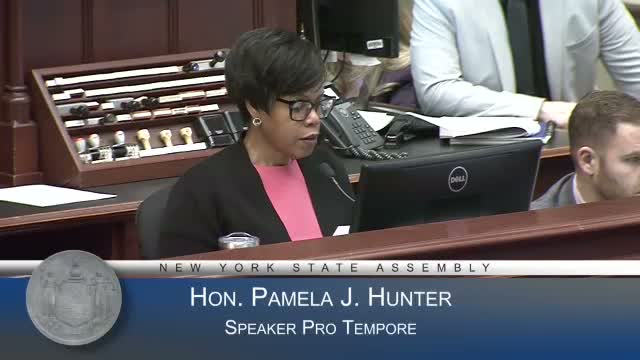
Assemblymember Otis, sponsor of A.6285, told the floor the bill would amend the public service law to require electric utilities to include time‑based restoration goals and staffing details in emergency response plans so that customers are restored more promptly after storms.
Otis said the measure aims to reduce reliance on distant mutual aid and encourage more proximate staffing arrangements; he said regulators at the Public Service Commission (PSC) would retain latitude to account for different kinds of storms. "Emergency response plans should include details of staffing, equipment, and performance schedule with the goal of achieving restoration of service based upon a time based restoration schedule established by the Commission," he stated.
Opponents, including several members who described existing PSC authority and penalties, warned that generic time targets may not account for variability across events and could raise costs for ratepayers. Assemblymember Walsh argued that benchmarks alone "don't prevent outages, and they don't improve restoration times" and preferred focusing on infrastructure hardening and investment. Members also questioned whether penalties would be borne by ratepayers or shareholders and whether the PSC could implement similar rules without legislation.
The measure received extended floor questioning about data, storm classification, safety versus speed, and potential rate impacts; sponsors said the bill does not change PSC enforcement tools and envisioned the commission setting differentiated benchmarks through its processes. The Assembly recorded the vote and passed the bill (Ayes 109, Nays 34).
Otis said the measure aims to reduce reliance on distant mutual aid and encourage more proximate staffing arrangements; he said regulators at the Public Service Commission (PSC) would retain latitude to account for different kinds of storms. "Emergency response plans should include details of staffing, equipment, and performance schedule with the goal of achieving restoration of service based upon a time based restoration schedule established by the Commission," he stated.
Opponents, including several members who described existing PSC authority and penalties, warned that generic time targets may not account for variability across events and could raise costs for ratepayers. Assemblymember Walsh argued that benchmarks alone "don't prevent outages, and they don't improve restoration times" and preferred focusing on infrastructure hardening and investment. Members also questioned whether penalties would be borne by ratepayers or shareholders and whether the PSC could implement similar rules without legislation.
The measure received extended floor questioning about data, storm classification, safety versus speed, and potential rate impacts; sponsors said the bill does not change PSC enforcement tools and envisioned the commission setting differentiated benchmarks through its processes. The Assembly recorded the vote and passed the bill (Ayes 109, Nays 34).
Don't Miss a Word: See the Full Meeting!
Go beyond summaries. Unlock every video, transcript, and key insight with a Founder Membership.
✓
Get instant access to full meeting videos
✓
Search and clip any phrase from complete transcripts
✓
Receive AI-powered summaries & custom alerts
✓
Enjoy lifetime, unrestricted access to government data
30-day money-back guarantee
