Director Artis tells Legislature roughly $400 million flowed into Oklahoma aerospace, details UAS, hangar and MRO projects
March 30, 2026 | 2026 Legislature OK, Oklahoma
This article was created by AI summarizing key points discussed. AI makes mistakes, so for full details and context, please refer to the video of the full meeting. Please report any errors so we can fix them. Report an error »
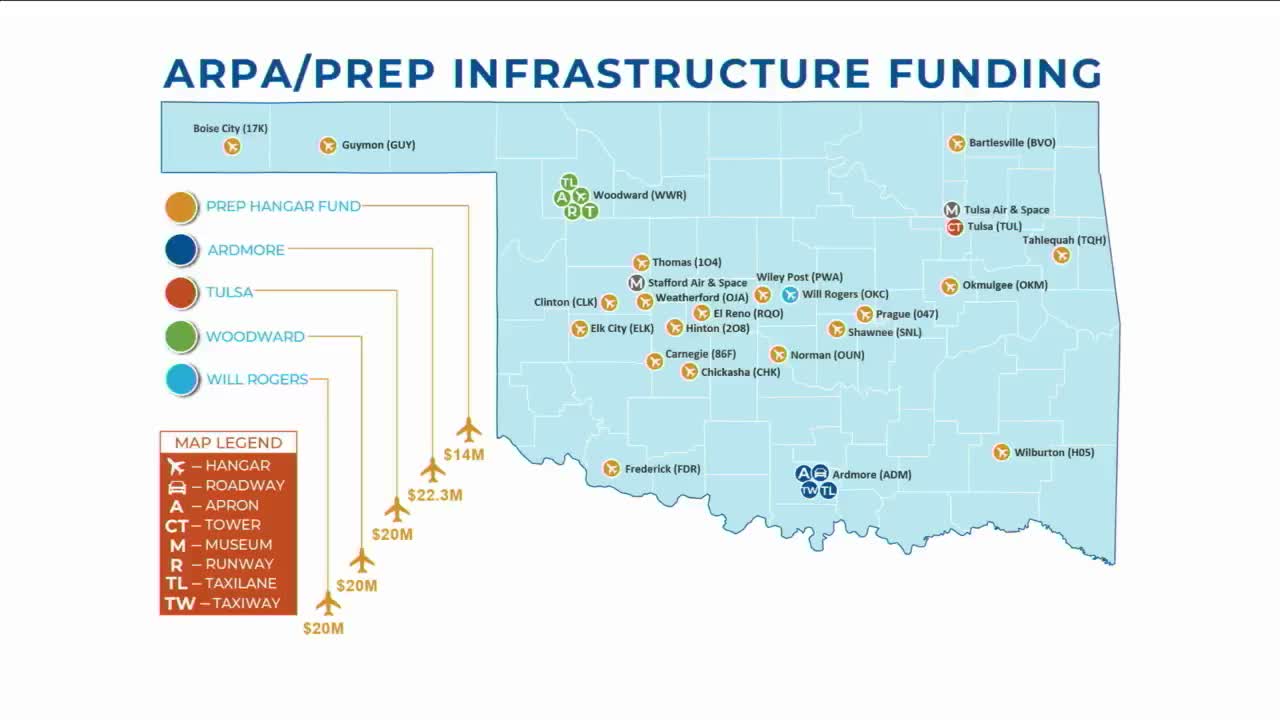
Director Artis, director of the Oklahoma Department of Aerospace and Aeronautics, told a legislative oversight committee on Monday that since PREP and ARPA investments began the state has put about $400 million into aerospace and defense and that agency staff will provide members a spreadsheet with a mid‑level breakdown of those totals.
Artis said the agency split its work across recurring programs and one‑time appropriations. He reported that ARPA money—about $600,000—paid for two museums and is otherwise closed out. The larger PREP allocations have supported four major projects: Woodward development work, an Ardmore air cargo/apron effort, the Will Rogers MRO hangar and the Tulsa air traffic control tower. The Will Rogers MRO hangar is substantially complete, Artis said, and construction at Woodward is expected to wrap up by fall. He cautioned that the Tulsa tower may not be operational until FAA equipment moves and staff training are finished, possibly mid‑2027.
Artis said the agency has used a $14 million PREP hangar fund across the state to create roughly 200 new hangar units (about 600,000 square feet). Two hangar projects remain: Wiley Post (expected to be bid in the coming months) and a Shawnee hangar that depends on FEMA funds after damage from a past tornado. A separate $4 million commercial service program has been used for revenue guarantees to attract new routes; Artis cited Oklahoma City’s seasonal Cancun service as an example and explained how minimum revenue guarantees are intended to be recycled so communities do not repeatedly draw on the fund.
On unmanned aircraft systems, Artis said the department has about $10 million in UAS infrastructure funding across three major projects. He described radar work at the Clinton‑Sherman Test Range (about $3.1 million in two contract phases) to create expanded test airspace for large high‑speed drones, a roughly $2.5 million investment at Camp Gruber with the Oklahoma National Guard to develop a UAS testing hub, and a Tulsa program (referred to as THETA) that aims to integrate "trustworthy autonomy" for first‑responder and commercial uses. "We're not just talking about small drones," Artis said. "These are drones that can fly 200, 300, 400, 500 knots...that could keep up with an F‑35," and he tied the investments to the need for radar and sense‑and‑avoid systems that meet FAA operational rules for beyond‑visual‑line‑of‑sight flights.
Artis also described how the agency reallocated a $16 million appropriation originally set for a Lufthansa MRO project that did not proceed. That $16 million was repurposed for three projects: an expansion of Kratos activities in Bristow, a planned MRO test cell or related facility in the Oklahoma City area (converting a U.S. Air Force mobile test unit to a permanent facility), and a space‑engine expansion in the Tulsa area. Artis said the agencies would seek formal commission approval where required.
He outlined FY‑26 appropriations supporting engine test cells ($8.1 million split between projects), about $15 million set aside for an expanded Will Rogers MRO wide‑body hangar concept, and a $3 million appropriation for a siting study related to a Durant air traffic control tower. On workforce development, Artis said the agency combines $1 million in annual appropriation with $1 million in statutory funds for a $2 million aerospace education program that supports competitive grants, classroom lab improvements, a high‑school aircraft build program (Tango Flight) and internship subsidies.
Committee members asked for lists of participating schools and grant recipients; Artis offered to provide a cleaned spreadsheet. Representative Stairs asked about UAS cameras and sensors; Artis clarified that while drones have visual cameras, the FAA's "see and avoid" standards require sensors and radar for many beyond‑visual‑line‑of‑sight operations.
The director concluded by summarizing remaining PREP/ARPA encumbrances and nonconstruction expenditures (building demolitions, security/IT work) and said the agency hopes to spend the remaining PREP funds by the end of the fiscal year. The committee did not take formal action on any items in the presentation.
Artis said the agency split its work across recurring programs and one‑time appropriations. He reported that ARPA money—about $600,000—paid for two museums and is otherwise closed out. The larger PREP allocations have supported four major projects: Woodward development work, an Ardmore air cargo/apron effort, the Will Rogers MRO hangar and the Tulsa air traffic control tower. The Will Rogers MRO hangar is substantially complete, Artis said, and construction at Woodward is expected to wrap up by fall. He cautioned that the Tulsa tower may not be operational until FAA equipment moves and staff training are finished, possibly mid‑2027.
Artis said the agency has used a $14 million PREP hangar fund across the state to create roughly 200 new hangar units (about 600,000 square feet). Two hangar projects remain: Wiley Post (expected to be bid in the coming months) and a Shawnee hangar that depends on FEMA funds after damage from a past tornado. A separate $4 million commercial service program has been used for revenue guarantees to attract new routes; Artis cited Oklahoma City’s seasonal Cancun service as an example and explained how minimum revenue guarantees are intended to be recycled so communities do not repeatedly draw on the fund.
On unmanned aircraft systems, Artis said the department has about $10 million in UAS infrastructure funding across three major projects. He described radar work at the Clinton‑Sherman Test Range (about $3.1 million in two contract phases) to create expanded test airspace for large high‑speed drones, a roughly $2.5 million investment at Camp Gruber with the Oklahoma National Guard to develop a UAS testing hub, and a Tulsa program (referred to as THETA) that aims to integrate "trustworthy autonomy" for first‑responder and commercial uses. "We're not just talking about small drones," Artis said. "These are drones that can fly 200, 300, 400, 500 knots...that could keep up with an F‑35," and he tied the investments to the need for radar and sense‑and‑avoid systems that meet FAA operational rules for beyond‑visual‑line‑of‑sight flights.
Artis also described how the agency reallocated a $16 million appropriation originally set for a Lufthansa MRO project that did not proceed. That $16 million was repurposed for three projects: an expansion of Kratos activities in Bristow, a planned MRO test cell or related facility in the Oklahoma City area (converting a U.S. Air Force mobile test unit to a permanent facility), and a space‑engine expansion in the Tulsa area. Artis said the agencies would seek formal commission approval where required.
He outlined FY‑26 appropriations supporting engine test cells ($8.1 million split between projects), about $15 million set aside for an expanded Will Rogers MRO wide‑body hangar concept, and a $3 million appropriation for a siting study related to a Durant air traffic control tower. On workforce development, Artis said the agency combines $1 million in annual appropriation with $1 million in statutory funds for a $2 million aerospace education program that supports competitive grants, classroom lab improvements, a high‑school aircraft build program (Tango Flight) and internship subsidies.
Committee members asked for lists of participating schools and grant recipients; Artis offered to provide a cleaned spreadsheet. Representative Stairs asked about UAS cameras and sensors; Artis clarified that while drones have visual cameras, the FAA's "see and avoid" standards require sensors and radar for many beyond‑visual‑line‑of‑sight operations.
The director concluded by summarizing remaining PREP/ARPA encumbrances and nonconstruction expenditures (building demolitions, security/IT work) and said the agency hopes to spend the remaining PREP funds by the end of the fiscal year. The committee did not take formal action on any items in the presentation.
Don't Miss a Word: See the Full Meeting!
Go beyond summaries. Unlock every video, transcript, and key insight with a Founder Membership.
✓
Get instant access to full meeting videos
✓
Search and clip any phrase from complete transcripts
✓
Receive AI-powered summaries & custom alerts
✓
Enjoy lifetime, unrestricted access to government data
30-day money-back guarantee
