House rejects amendment that would let courts compel peer‑support disclosures; peer‑support protections advance
March 31, 2026 | 2026 Legislature ME, Maine
This article was created by AI summarizing key points discussed. AI makes mistakes, so for full details and context, please refer to the video of the full meeting. Please report any errors so we can fix them. Report an error »
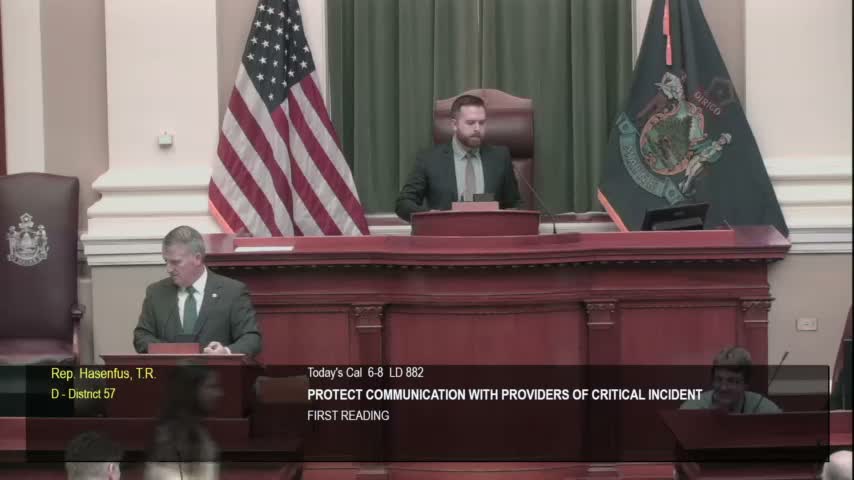
The Maine House on April 1 debated and then rejected a floor amendment to legislation designed to protect communications with critical-incident stress management and peer‑support providers for first responders.
Representative (speaker 14) offered the amendment to allow courts, after due process and opportunity to be heard, to compel disclosure in very limited circumstances — for example, when the information is instrumental to administering justice or raises a danger to others. The sponsor framed the amendment as a narrowly tailored "escape hatch" to balance confidentiality with the needs of the justice system.
Opponents said the floor amendment risked chilling participation in peer support programs that have been credited with helping first responders. Representative (speaker 9), identifying stakeholders who worked on the bill (including LifeFlight of Maine and county law enforcement), said the amendment "is too far in the weeds" and could deter officers, firefighters and EMS personnel from using peer support. Representative (speaker 16) agreed, saying the bill just passed "is enough to address the concerns" and that the amendment could work against the bill’s intent.
Members held a roll-call vote on adoption of House Amendment A; the transcript records the result as 54 in the affirmative and 92 in the negative, and the clerk announced the amendment failed. Following that vote the underlying bill to protect communications with providers of critical-incident stress management and peer support was ordered sent to the Senate for concurrence.
What happens next: The bill, as approved by the House, directs protections for peer-support communications while leaving mandated‑reporter obligations and other statutory exceptions intact; final legal effect and precise scope will depend on the bill text adopted by both chambers.
Representative (speaker 14) offered the amendment to allow courts, after due process and opportunity to be heard, to compel disclosure in very limited circumstances — for example, when the information is instrumental to administering justice or raises a danger to others. The sponsor framed the amendment as a narrowly tailored "escape hatch" to balance confidentiality with the needs of the justice system.
Opponents said the floor amendment risked chilling participation in peer support programs that have been credited with helping first responders. Representative (speaker 9), identifying stakeholders who worked on the bill (including LifeFlight of Maine and county law enforcement), said the amendment "is too far in the weeds" and could deter officers, firefighters and EMS personnel from using peer support. Representative (speaker 16) agreed, saying the bill just passed "is enough to address the concerns" and that the amendment could work against the bill’s intent.
Members held a roll-call vote on adoption of House Amendment A; the transcript records the result as 54 in the affirmative and 92 in the negative, and the clerk announced the amendment failed. Following that vote the underlying bill to protect communications with providers of critical-incident stress management and peer support was ordered sent to the Senate for concurrence.
What happens next: The bill, as approved by the House, directs protections for peer-support communications while leaving mandated‑reporter obligations and other statutory exceptions intact; final legal effect and precise scope will depend on the bill text adopted by both chambers.
View the Full Meeting & All Its Details
This article offers just a summary. Unlock complete video, transcripts, and insights as a Founder Member.
✓
Watch full, unedited meeting videos
✓
Search every word spoken in unlimited transcripts
✓
AI summaries & real-time alerts (all government levels)
✓
Permanent access to expanding government content
30-day money-back guarantee
