Trustees get Brown Act refresher; presenter warns that email, texts and social-media interactions can create unlawful 'serial meetings'
January 31, 2026 | Stockton Unified, School Districts, California
This article was created by AI summarizing key points discussed. AI makes mistakes, so for full details and context, please refer to the video of the full meeting. Please report any errors so we can fix them. Report an error »
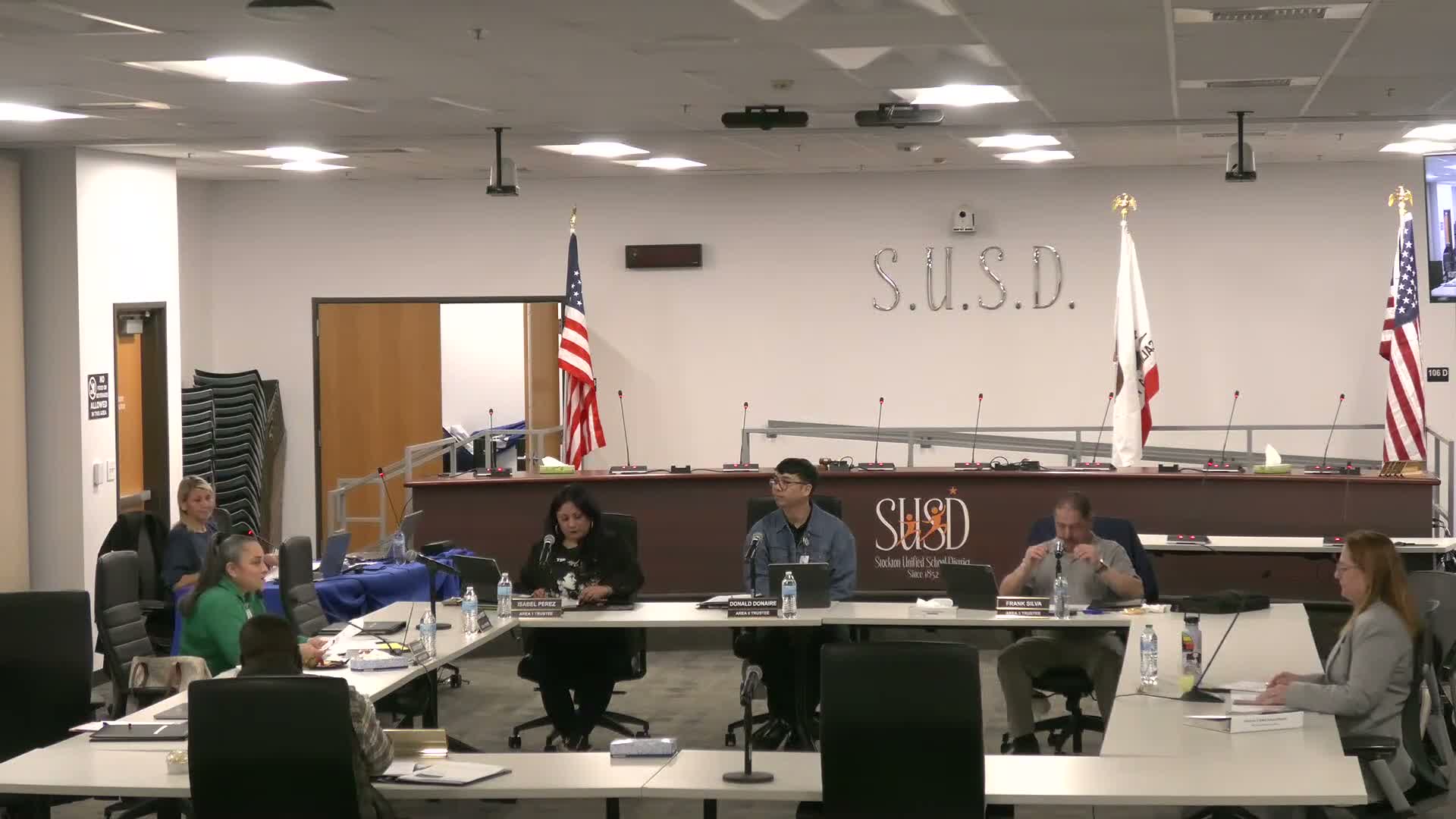
Attorney Cynthia Smith reviewed California’s Brown Act with Stockton Unified School District trustees on Friday evening, warning that a series of private communications among a majority of board members — including email, text or social-media posts — can amount to an unlawful "serial meeting." The special meeting included a question-and-answer period and a short governance team-building exercise led by Vice President Jada Priest.
Smith opened by tracing the Brown Act’s purpose and history and said the law and related provisions in the California Government Code and the Public Records Act exist to keep local government deliberations open to the public. "A meeting occurs whenever a majority of the legislative body gathers at the same time and place to hear, discuss, deliberate, or take action on any item within the subject matter jurisdiction of the local agency," she said, emphasizing that unintentional gatherings outside the public view can still violate the law.
Why it matters: The presentation clarified practical steps trustees should take to avoid inadvertent violations, including how to handle electronic communications, teleconferencing and closed-session confidentiality. Smith noted that recent grand-jury findings in the district had prompted additional training and underscored the consequences of noncompliance, including cure-and-correct demands, civil actions and, in cases of willful intent, potential criminal exposure.
Key rules and examples from the presentation included: agendas for regular meetings must be posted at least 72 hours in advance and attached materials provided to the public at the same time; special meetings require 24 hours’ notice; public comments are limited to three minutes per speaker and up to 20 minutes per item; and closed-session topics are tightly limited to listed items and must be reported out in open session. Smith said teleconferencing remains available under extended pandemic-era rules but requires specific access for the public (in-person, internet and call-in) and is limited to enumerated reasons such as caregiving, illness or district business travel.
On serial communications, Smith defined two problematic patterns — "daisy-chain" and "hub-and-spoke" — in which positions are shared among trustees until a majority has effectively deliberated outside a noticed meeting. She cited an attorney-general opinion and urged trustees not to forward position-setting emails or engage with another trustee’s social-media post about district business. "If one of you posts something about a matter that's up before the board, you as another board member cannot like that post. You cannot respond with a heart emoji or a frowny face," she said.
Smith also addressed practical governance issues raised in a recent grand-jury report, including a finding that a trustee failed to disclose an association with a consultant and later voted on that matter. She praised Trustee Perez for disclosing a perceived association and recusing herself at the dais during a recent meeting; Cynthia Smith said recusal and leaving the dais were consistent with recommended practice to avoid conflicts of interest.
Trustees asked several clarifying questions during the presentation: how to determine whether being "present" online counts toward a majority, how trustees should route constituent complaints (Smith said to refer them to the superintendent), and whether informal two- or three-person discussions risk violating the Brown Act (she cautioned trustees about conversations that might expand to a majority). Smith recommended annual refreshers though she did not cite a specific statutory frequency.
After the legal presentation, the board took a brief break and participated in governance team-building exercises led by Vice President Jada Priest. Trustees shared personal drawings and discussed priorities for student skills — including analytical thinking, resilience and leadership — and suggested district-level ideas such as student-led conferences, internships in district departments and expanded communications internships.
No formal actions were taken. The special meeting concluded at 7:08 p.m. with no votes recorded. The board indicated it will revisit topics and follow up as needed; Cynthia Smith offered to provide additional training on request.
Smith opened by tracing the Brown Act’s purpose and history and said the law and related provisions in the California Government Code and the Public Records Act exist to keep local government deliberations open to the public. "A meeting occurs whenever a majority of the legislative body gathers at the same time and place to hear, discuss, deliberate, or take action on any item within the subject matter jurisdiction of the local agency," she said, emphasizing that unintentional gatherings outside the public view can still violate the law.
Why it matters: The presentation clarified practical steps trustees should take to avoid inadvertent violations, including how to handle electronic communications, teleconferencing and closed-session confidentiality. Smith noted that recent grand-jury findings in the district had prompted additional training and underscored the consequences of noncompliance, including cure-and-correct demands, civil actions and, in cases of willful intent, potential criminal exposure.
Key rules and examples from the presentation included: agendas for regular meetings must be posted at least 72 hours in advance and attached materials provided to the public at the same time; special meetings require 24 hours’ notice; public comments are limited to three minutes per speaker and up to 20 minutes per item; and closed-session topics are tightly limited to listed items and must be reported out in open session. Smith said teleconferencing remains available under extended pandemic-era rules but requires specific access for the public (in-person, internet and call-in) and is limited to enumerated reasons such as caregiving, illness or district business travel.
On serial communications, Smith defined two problematic patterns — "daisy-chain" and "hub-and-spoke" — in which positions are shared among trustees until a majority has effectively deliberated outside a noticed meeting. She cited an attorney-general opinion and urged trustees not to forward position-setting emails or engage with another trustee’s social-media post about district business. "If one of you posts something about a matter that's up before the board, you as another board member cannot like that post. You cannot respond with a heart emoji or a frowny face," she said.
Smith also addressed practical governance issues raised in a recent grand-jury report, including a finding that a trustee failed to disclose an association with a consultant and later voted on that matter. She praised Trustee Perez for disclosing a perceived association and recusing herself at the dais during a recent meeting; Cynthia Smith said recusal and leaving the dais were consistent with recommended practice to avoid conflicts of interest.
Trustees asked several clarifying questions during the presentation: how to determine whether being "present" online counts toward a majority, how trustees should route constituent complaints (Smith said to refer them to the superintendent), and whether informal two- or three-person discussions risk violating the Brown Act (she cautioned trustees about conversations that might expand to a majority). Smith recommended annual refreshers though she did not cite a specific statutory frequency.
After the legal presentation, the board took a brief break and participated in governance team-building exercises led by Vice President Jada Priest. Trustees shared personal drawings and discussed priorities for student skills — including analytical thinking, resilience and leadership — and suggested district-level ideas such as student-led conferences, internships in district departments and expanded communications internships.
No formal actions were taken. The special meeting concluded at 7:08 p.m. with no votes recorded. The board indicated it will revisit topics and follow up as needed; Cynthia Smith offered to provide additional training on request.
Don't Miss a Word: See the Full Meeting!
Go beyond summaries. Unlock every video, transcript, and key insight with a Founder Membership.
✓
Get instant access to full meeting videos
✓
Search and clip any phrase from complete transcripts
✓
Receive AI-powered summaries & custom alerts
✓
Enjoy lifetime, unrestricted access to government data
30-day money-back guarantee
