District education director outlines multi‑year plan for curriculum adoption and pilots
March 20, 2026 | Pacific Grove Unified, School Districts, California
This article was created by AI summarizing key points discussed. AI makes mistakes, so for full details and context, please refer to the video of the full meeting. Please report any errors so we can fix them. Report an error »
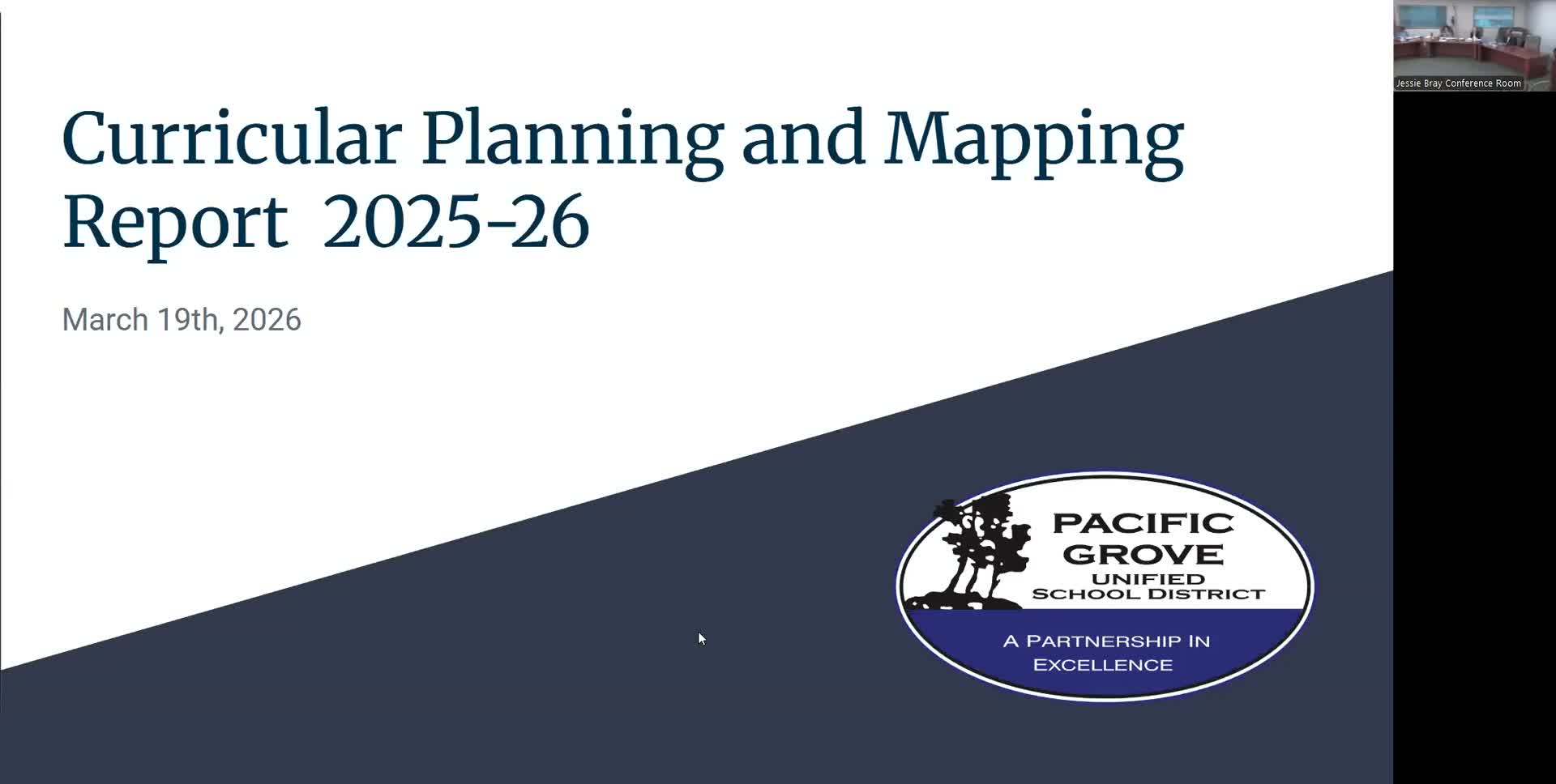
Larry Hadquist, the Pacific Grove Unified School District executive director of educational services, told the board the district is following the State Board of Education’s recent framework adoptions and planning a series of pilots and purchases to keep local instructional materials current.
Hadquist reviewed the district’s adoption pattern, explaining that state frameworks and the 2023 math framework have driven recent purchases and that the district is preparing to pilot algebra, geometry and algebra‑2 materials at the high school level aligned with the 2023 framework. He said the district had already purchased or piloted a range of materials, including EL Education at the elementary level, Frog Street and Wonders for TK, and supplementary texts for ethnic studies. “We’ll be piloting big ideas 2026–27 at the high school level for math,” Hadquist said, summarizing the planned sequencing.
Hadquist described the pilot process: the district invites multiple publishers, has teachers complete rubrics, runs pilots with participating classes, gathers teacher and student feedback, and reconvenes pilot teams for evaluation before making a recommendation to the board. On student input he said the district uses student committees and solicits written feedback; he cited student letters collected during the EL Education adoption as an example.
Trustees asked clarifying questions about pilot scope and data collection. Trustee Wax asked whether pilots run in every class for a given grade; Hadquist said pilots vary by adoption and level but that, for example, last year’s TK pilot was implemented broadly across TK classes. Trustee Atmar asked how implementation outcomes are measured; Hadquist said the district uses both classroom‑level diagnostic data in professional learning communities and larger, district‑level measures to assess implementation. “We are looking at the more macroscopic data,” Hadquist said, while professional learning communities focus on fine‑grained classroom effects.
Hadquist also discussed non‑core purchases and upcoming reviews: world language, music, health (Positive Prevention Plus is being piloted), intervention, culinary and PE materials are in current inventory; the district plans to review personal‑finance instructional materials for potential implementation in the 2027–28 school year. He listed next steps as continuing to monitor state adoptions, review instructional materials for personal finance and other upcoming adoptions, plan professional development aligned to pilots, and bring formal recommendations for adoption to the board in future years.
This item was informational; trustees did not take formal action. Hadquist referred the board to the written report in the packet for detailed tables and purchase lists and said pilot outcomes and adoption recommendations will be returned to the board when ready.
Hadquist reviewed the district’s adoption pattern, explaining that state frameworks and the 2023 math framework have driven recent purchases and that the district is preparing to pilot algebra, geometry and algebra‑2 materials at the high school level aligned with the 2023 framework. He said the district had already purchased or piloted a range of materials, including EL Education at the elementary level, Frog Street and Wonders for TK, and supplementary texts for ethnic studies. “We’ll be piloting big ideas 2026–27 at the high school level for math,” Hadquist said, summarizing the planned sequencing.
Hadquist described the pilot process: the district invites multiple publishers, has teachers complete rubrics, runs pilots with participating classes, gathers teacher and student feedback, and reconvenes pilot teams for evaluation before making a recommendation to the board. On student input he said the district uses student committees and solicits written feedback; he cited student letters collected during the EL Education adoption as an example.
Trustees asked clarifying questions about pilot scope and data collection. Trustee Wax asked whether pilots run in every class for a given grade; Hadquist said pilots vary by adoption and level but that, for example, last year’s TK pilot was implemented broadly across TK classes. Trustee Atmar asked how implementation outcomes are measured; Hadquist said the district uses both classroom‑level diagnostic data in professional learning communities and larger, district‑level measures to assess implementation. “We are looking at the more macroscopic data,” Hadquist said, while professional learning communities focus on fine‑grained classroom effects.
Hadquist also discussed non‑core purchases and upcoming reviews: world language, music, health (Positive Prevention Plus is being piloted), intervention, culinary and PE materials are in current inventory; the district plans to review personal‑finance instructional materials for potential implementation in the 2027–28 school year. He listed next steps as continuing to monitor state adoptions, review instructional materials for personal finance and other upcoming adoptions, plan professional development aligned to pilots, and bring formal recommendations for adoption to the board in future years.
This item was informational; trustees did not take formal action. Hadquist referred the board to the written report in the packet for detailed tables and purchase lists and said pilot outcomes and adoption recommendations will be returned to the board when ready.
View the Full Meeting & All Its Details
This article offers just a summary. Unlock complete video, transcripts, and insights as a Founder Member.
✓
Watch full, unedited meeting videos
✓
Search every word spoken in unlimited transcripts
✓
AI summaries & real-time alerts (all government levels)
✓
Permanent access to expanding government content
30-day money-back guarantee
