Department of Revenue presents fiscal model for SB 280: volumetric tax would lower cumulative local property revenue compared with current law
March 30, 2026 | 2026 Legislature Alaska, Alaska
This article was created by AI summarizing key points discussed. AI makes mistakes, so for full details and context, please refer to the video of the full meeting. Please report any errors so we can fix them. Report an error »
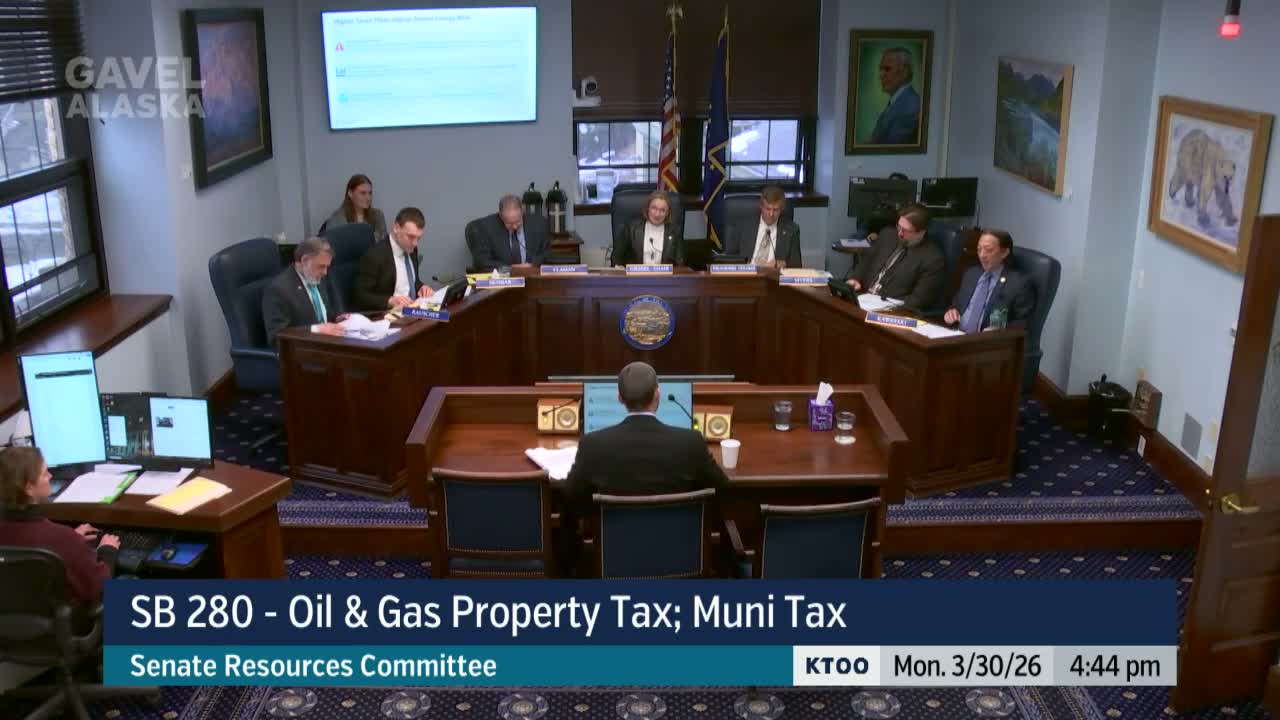
The Department of Revenue presented its fiscal analysis of Senate Bill 280 to the Alaska Senate Resources Committee on March 30, detailing how an alternative volumetric tax would work for the Alaska LNG project and the revenue implications for state and local governments.
Dan Stickel, chief economist in the Department of Revenue’s tax division, explained that under current law oil and gas property is centrally assessed and effectively taxed at 20 mills (2%); LNG plants are exempt from the state-level property tax but municipal property taxes still apply. "That is the tax that we're talking about suspending here for the AKLNG project," Stickel said.
Stickel said the bill would exempt the project from the current property tax during a ramp-up period of up to 10 years or until pipeline throughput exceeded 1 billion cubic feet per day, and then impose an alternative volumetric tax of 6¢ per thousand cubic feet, increasing 1% annually. He said DOR’s baseline construction cost for modeling is $46.2 billion (a 2023 AGDC estimate scaled to 2026).
Under the department’s baseline and allocation assumptions, full-project throughput would yield roughly $9 million per year to the state and about $64–65 million per year to municipalities. Stickel told the committee that cumulative local property tax under current law (if the project proceeded without tax relief) was modeled at about $5.7 billion through 2042 versus about $728 million under the proposed volumetric tax (both figures described as cumulative estimates).
Stickel also said the fiscal note assumes the project would not go forward under current law; under that assumption the bill produces a positive revenue outlook for the state in the fiscal note conventions DOR used. Committee members questioned that assumption and asked DOR to run sensitivity analyses and provide additional documentation.
DOR staff said they can provide sensitivity tables and run further scenarios; the committee requested follow-up materials and indicated it may invite additional analysts for future meetings.
Dan Stickel, chief economist in the Department of Revenue’s tax division, explained that under current law oil and gas property is centrally assessed and effectively taxed at 20 mills (2%); LNG plants are exempt from the state-level property tax but municipal property taxes still apply. "That is the tax that we're talking about suspending here for the AKLNG project," Stickel said.
Stickel said the bill would exempt the project from the current property tax during a ramp-up period of up to 10 years or until pipeline throughput exceeded 1 billion cubic feet per day, and then impose an alternative volumetric tax of 6¢ per thousand cubic feet, increasing 1% annually. He said DOR’s baseline construction cost for modeling is $46.2 billion (a 2023 AGDC estimate scaled to 2026).
Under the department’s baseline and allocation assumptions, full-project throughput would yield roughly $9 million per year to the state and about $64–65 million per year to municipalities. Stickel told the committee that cumulative local property tax under current law (if the project proceeded without tax relief) was modeled at about $5.7 billion through 2042 versus about $728 million under the proposed volumetric tax (both figures described as cumulative estimates).
Stickel also said the fiscal note assumes the project would not go forward under current law; under that assumption the bill produces a positive revenue outlook for the state in the fiscal note conventions DOR used. Committee members questioned that assumption and asked DOR to run sensitivity analyses and provide additional documentation.
DOR staff said they can provide sensitivity tables and run further scenarios; the committee requested follow-up materials and indicated it may invite additional analysts for future meetings.
Don't Miss a Word: See the Full Meeting!
Go beyond summaries. Unlock every video, transcript, and key insight with a Founder Membership.
✓
Get instant access to full meeting videos
✓
Search and clip any phrase from complete transcripts
✓
Receive AI-powered summaries & custom alerts
✓
Enjoy lifetime, unrestricted access to government data
30-day money-back guarantee
