City finance staff highlights $580 million debt portfolio, says debt used for capital not operations
March 16, 2026 | Port St. Lucie, St. Lucie County, Florida
This article was created by AI summarizing key points discussed. AI makes mistakes, so for full details and context, please refer to the video of the full meeting. Please report any errors so we can fix them. Report an error »
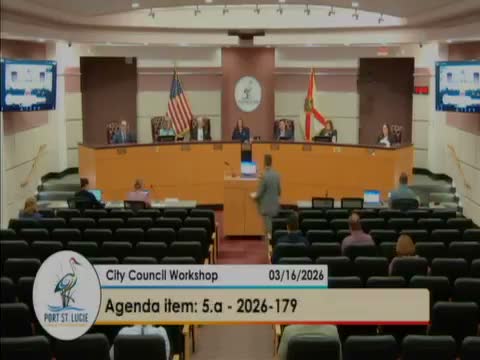
Charlie Perdue, the city's deputy finance director, told the Port St. Lucie City Council at its March 16 workshop that the city's outstanding debt portfolio totaled about $580,000,000 and that most of that debt funds enterprise and capital projects rather than general operations. "We cannot issue debt for operating. It does not pay for salaries," Perdue said as he explained why the city uses bonds for roads, stormwater, parks and public buildings.
Perdue said Port St. Lucie has reduced its debt per resident sharply over the last 15 years, falling from roughly $6,200 per resident to about $2,200, and described the decline as a nearly 70% drop. He attributed the improvement to a combination of pay-downs, strategic use of grants and other pay-go techniques, and repeated refundings when interest rates made refinancing advantageous. "To date, we saved over a $100,000,000 just by refunding bonds and being proactive," Perdue said.
The presentation broke the portfolio into components and noted that roughly half of the current portfolio is enterprise-related debt for utilities and stormwater; those obligations are paid from utility and stormwater rates, not property-tax funding in the general fund. Perdue identified the city's single remaining voter-approved general-obligation bond (the Crosstown bond) as about $163 million and said that, overall, the general-fund-supported portion of the portfolio is a small share of total debt.
Perdue also walked the council through how the city monitors its debt: an in-house finance team, an outside financial advisor (PFM), auditors and credit-rating agencies review portfolio decisions and refunding opportunities. He told the council that refunding the city's 2016 GO bonds generated about $1.3 million in savings and that an upcoming refunding is projected to save roughly $2 million. Perdue said most of the city's outstanding bonds include "refunding" in the title because the city routinely pursues call-date refundings to lower costs.
Councilmembers thanked Perdue for the briefing and asked staff to provide a slide that disaggregates the $5.80 (millage-related) figure to show which funds pay which portions of the portfolio so residents better understand what they are paying and what is paid from utility rates. Perdue said staff will prepare that detail for a future meeting.
The presentation concluded with councilmembers praising the fiscal outcome and asking that the slides be shared with county officials as an example of strategic debt management.
Perdue said Port St. Lucie has reduced its debt per resident sharply over the last 15 years, falling from roughly $6,200 per resident to about $2,200, and described the decline as a nearly 70% drop. He attributed the improvement to a combination of pay-downs, strategic use of grants and other pay-go techniques, and repeated refundings when interest rates made refinancing advantageous. "To date, we saved over a $100,000,000 just by refunding bonds and being proactive," Perdue said.
The presentation broke the portfolio into components and noted that roughly half of the current portfolio is enterprise-related debt for utilities and stormwater; those obligations are paid from utility and stormwater rates, not property-tax funding in the general fund. Perdue identified the city's single remaining voter-approved general-obligation bond (the Crosstown bond) as about $163 million and said that, overall, the general-fund-supported portion of the portfolio is a small share of total debt.
Perdue also walked the council through how the city monitors its debt: an in-house finance team, an outside financial advisor (PFM), auditors and credit-rating agencies review portfolio decisions and refunding opportunities. He told the council that refunding the city's 2016 GO bonds generated about $1.3 million in savings and that an upcoming refunding is projected to save roughly $2 million. Perdue said most of the city's outstanding bonds include "refunding" in the title because the city routinely pursues call-date refundings to lower costs.
Councilmembers thanked Perdue for the briefing and asked staff to provide a slide that disaggregates the $5.80 (millage-related) figure to show which funds pay which portions of the portfolio so residents better understand what they are paying and what is paid from utility rates. Perdue said staff will prepare that detail for a future meeting.
The presentation concluded with councilmembers praising the fiscal outcome and asking that the slides be shared with county officials as an example of strategic debt management.
Don't Miss a Word: See the Full Meeting!
Go beyond summaries. Unlock every video, transcript, and key insight with a Founder Membership.
✓
Get instant access to full meeting videos
✓
Search and clip any phrase from complete transcripts
✓
Receive AI-powered summaries & custom alerts
✓
Enjoy lifetime, unrestricted access to government data
30-day money-back guarantee
