Council approves west-only braided Marshall Parkway interchange option, cites preserve and neighborhood impacts to east connection
March 16, 2026 | Port St. Lucie, St. Lucie County, Florida
This article was created by AI summarizing key points discussed. AI makes mistakes, so for full details and context, please refer to the video of the full meeting. Please report any errors so we can fix them. Report an error »
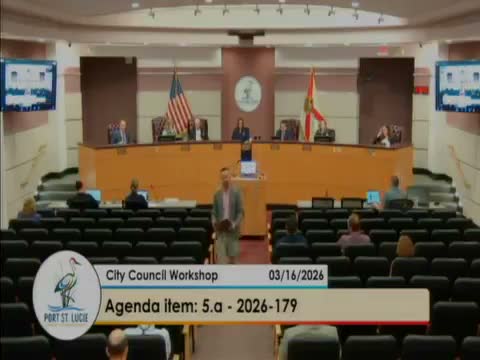
The Port St. Lucie City Council voted at its March 16 workshop to endorse a west-only Marshall Parkway connection to I-95 using a braided-ramp interchange configuration, directing staff to finalize the summary memo and advance discussions with the Florida Department of Transportation. The motion to accept "Scenario 2" (west-only, braided interchange) was made by a councilmember and carried by voice vote; the mayor announced the motion carried.
Tony Balsterre of the city's public works engineering group introduced the project context and said the interchange is now on FDOT's long-range plan, but currently scheduled between 2041 and 2050 unless additional funding is found. "Getting in early and having the conversations early" improves chances to identify partial or accelerated funding, he said.
Kaokwon Ma, the city's contracted engineer from Kittleson & Associates, presented three scenarios: no-build; a west-only connection (linking Marshall Parkway at Village Parkway to I-95); and a full connection both west and east (which would extend to Rosser/Rosser Lakes/Parr). Ma said model outputs show the west-only connection would reduce volume-to-capacity (VC) ratios on key nearby interchanges (Becker and Tradition) and that a full east+west connection produces further reductions but at heavy cost to nearby residential areas. "The connection to and from the East may provide regional relief, but ... it would require 100 or more property impacts," Ma said. He also noted interchange spacing and right-of-way constraints make east-side connection technically challenging.
Councilmembers repeatedly voiced concern about the east connection's impact on the Rosser Lakes preserve and adjacent neighborhoods. One councilmember said publicly purchased preserve land should not be put at risk, and several said they would not support an option that would "destroy" a neighborhood. Supporters of the west-only braided option argued it provides freight relief and meaningful congestion reduction on Becker while avoiding the substantial takings and preserve impacts of the east alternative.
Council discussion also covered FDOT's PD&E policy (adopted Jan. 7), which requires projected funding for construction within eight years of PD&E start; given the FDOT schedule, staff explained that achieving construction before 2041 would require new funding or accelerated prioritization. Several members asked staff to provide more information about how many undeveloped lots remain in the affected corridor and comparisons to past takings (Crosstown) so the council can better weigh long-term consequences against the benefit of preserving future options.
After debate the council moved, seconded and approved Scenario 2 with braided ramps by voice vote; staff were directed to present the finalized memo to FDOT District 4 and the TPO and to pursue steps toward a formal PD&E if the council continues to support the west-only option.
Tony Balsterre of the city's public works engineering group introduced the project context and said the interchange is now on FDOT's long-range plan, but currently scheduled between 2041 and 2050 unless additional funding is found. "Getting in early and having the conversations early" improves chances to identify partial or accelerated funding, he said.
Kaokwon Ma, the city's contracted engineer from Kittleson & Associates, presented three scenarios: no-build; a west-only connection (linking Marshall Parkway at Village Parkway to I-95); and a full connection both west and east (which would extend to Rosser/Rosser Lakes/Parr). Ma said model outputs show the west-only connection would reduce volume-to-capacity (VC) ratios on key nearby interchanges (Becker and Tradition) and that a full east+west connection produces further reductions but at heavy cost to nearby residential areas. "The connection to and from the East may provide regional relief, but ... it would require 100 or more property impacts," Ma said. He also noted interchange spacing and right-of-way constraints make east-side connection technically challenging.
Councilmembers repeatedly voiced concern about the east connection's impact on the Rosser Lakes preserve and adjacent neighborhoods. One councilmember said publicly purchased preserve land should not be put at risk, and several said they would not support an option that would "destroy" a neighborhood. Supporters of the west-only braided option argued it provides freight relief and meaningful congestion reduction on Becker while avoiding the substantial takings and preserve impacts of the east alternative.
Council discussion also covered FDOT's PD&E policy (adopted Jan. 7), which requires projected funding for construction within eight years of PD&E start; given the FDOT schedule, staff explained that achieving construction before 2041 would require new funding or accelerated prioritization. Several members asked staff to provide more information about how many undeveloped lots remain in the affected corridor and comparisons to past takings (Crosstown) so the council can better weigh long-term consequences against the benefit of preserving future options.
After debate the council moved, seconded and approved Scenario 2 with braided ramps by voice vote; staff were directed to present the finalized memo to FDOT District 4 and the TPO and to pursue steps toward a formal PD&E if the council continues to support the west-only option.
Don't Miss a Word: See the Full Meeting!
Go beyond summaries. Unlock every video, transcript, and key insight with a Founder Membership.
✓
Get instant access to full meeting videos
✓
Search and clip any phrase from complete transcripts
✓
Receive AI-powered summaries & custom alerts
✓
Enjoy lifetime, unrestricted access to government data
30-day money-back guarantee
