After family’s struggle, committee backs bill to require insurers cover police chemical cleanup
March 28, 2026 | 2026 Legislature MN, Minnesota
This article was created by AI summarizing key points discussed. AI makes mistakes, so for full details and context, please refer to the video of the full meeting. Please report any errors so we can fix them. Report an error »
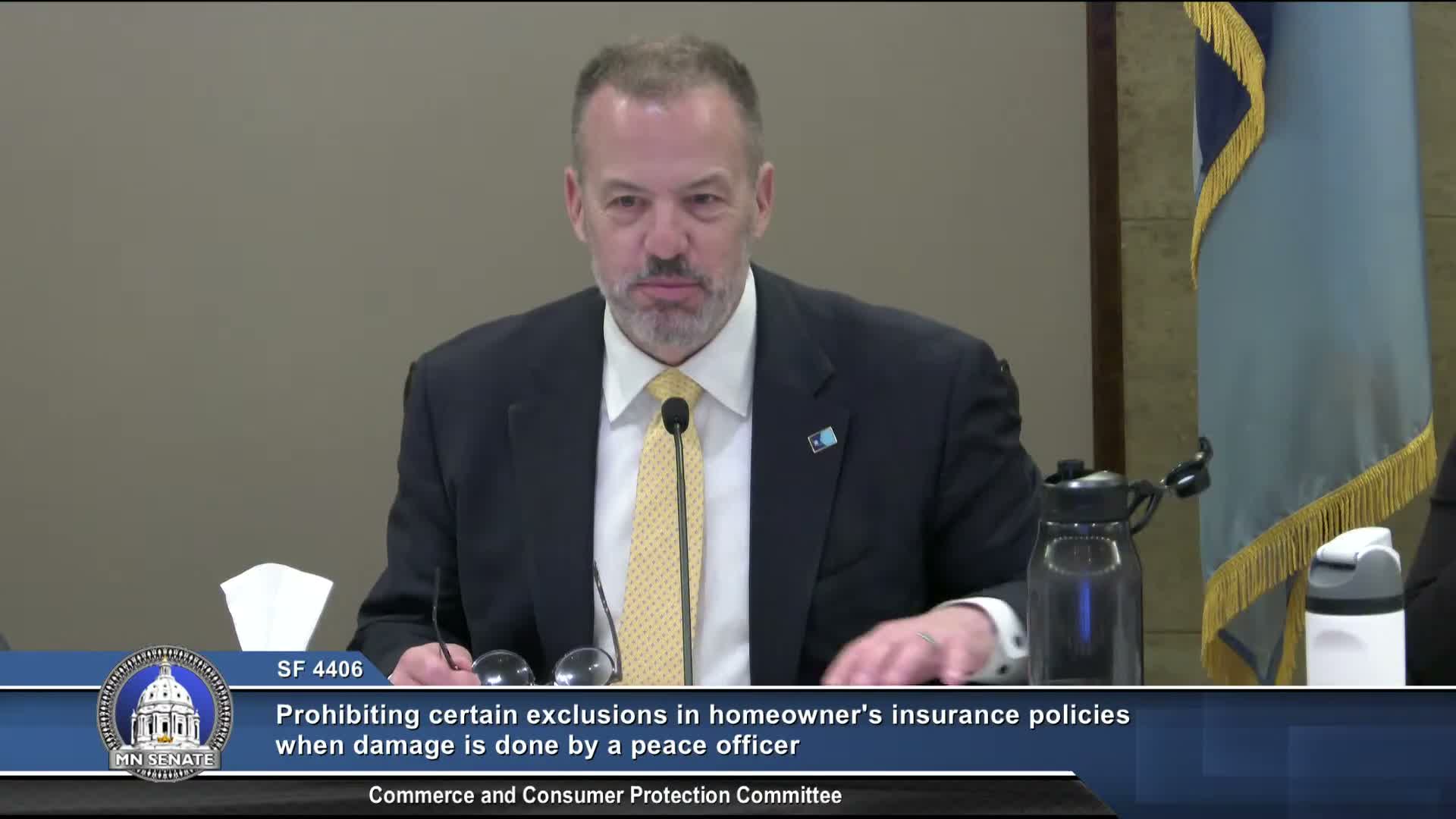
The Senate Commerce and Consumer Protection Committee voted Thursday to advance a bill requiring homeowners insurers to cover damage to innocent third‑party dwellings caused by peace officers’ use of chemical irritants, smoke or diversionary devices and allowing insurers to pursue reimbursement from the responsible local government unit.
Colin Hartman, whose parents’ home was contaminated after officers deployed diversionary devices during a police operation, described protracted disputes over cleanup standards and testing that delayed remediation for months. "After my parents were assassinated, law enforcement deployed diversionary devices ... There were multiple canisters used, at least one in every room, and the house was left covered in chemical residue," Hartman said, explaining his family’s costs and emotional toll.
Sponsor Sen. Wesselen said the bill requires insurers to pay claims promptly for innocent third‑party losses, then segregate and pursue reimbursement from the local government unit, and that amended language clarifies existing processes for determining which government unit is responsible.
Aaron Cocky of the Insurance Federation of Minnesota said the federation worked with the author and League of Minnesota Cities to narrow language; insurers supported the approach as a way to speed homeowner satisfaction while allowing insurers to recover costs through established channels.
The committee adopted an amendment that removed language that would have created a new, potentially confusing reimbursement allocation, and then recommended the bill to general orders.
Colin Hartman, whose parents’ home was contaminated after officers deployed diversionary devices during a police operation, described protracted disputes over cleanup standards and testing that delayed remediation for months. "After my parents were assassinated, law enforcement deployed diversionary devices ... There were multiple canisters used, at least one in every room, and the house was left covered in chemical residue," Hartman said, explaining his family’s costs and emotional toll.
Sponsor Sen. Wesselen said the bill requires insurers to pay claims promptly for innocent third‑party losses, then segregate and pursue reimbursement from the local government unit, and that amended language clarifies existing processes for determining which government unit is responsible.
Aaron Cocky of the Insurance Federation of Minnesota said the federation worked with the author and League of Minnesota Cities to narrow language; insurers supported the approach as a way to speed homeowner satisfaction while allowing insurers to recover costs through established channels.
The committee adopted an amendment that removed language that would have created a new, potentially confusing reimbursement allocation, and then recommended the bill to general orders.
View the Full Meeting & All Its Details
This article offers just a summary. Unlock complete video, transcripts, and insights as a Founder Member.
✓
Watch full, unedited meeting videos
✓
Search every word spoken in unlimited transcripts
✓
AI summaries & real-time alerts (all government levels)
✓
Permanent access to expanding government content
30-day money-back guarantee
