Addiction and Community Revitalization Committee hears bipartisan bill to certify recovery homes, create ombudsman
March 24, 2026 | Addiction and Community Revitalization Committee, Senate, Committees, Legislative, Ohio
This article was created by AI summarizing key points discussed. AI makes mistakes, so for full details and context, please refer to the video of the full meeting. Please report any errors so we can fix them. Report an error »
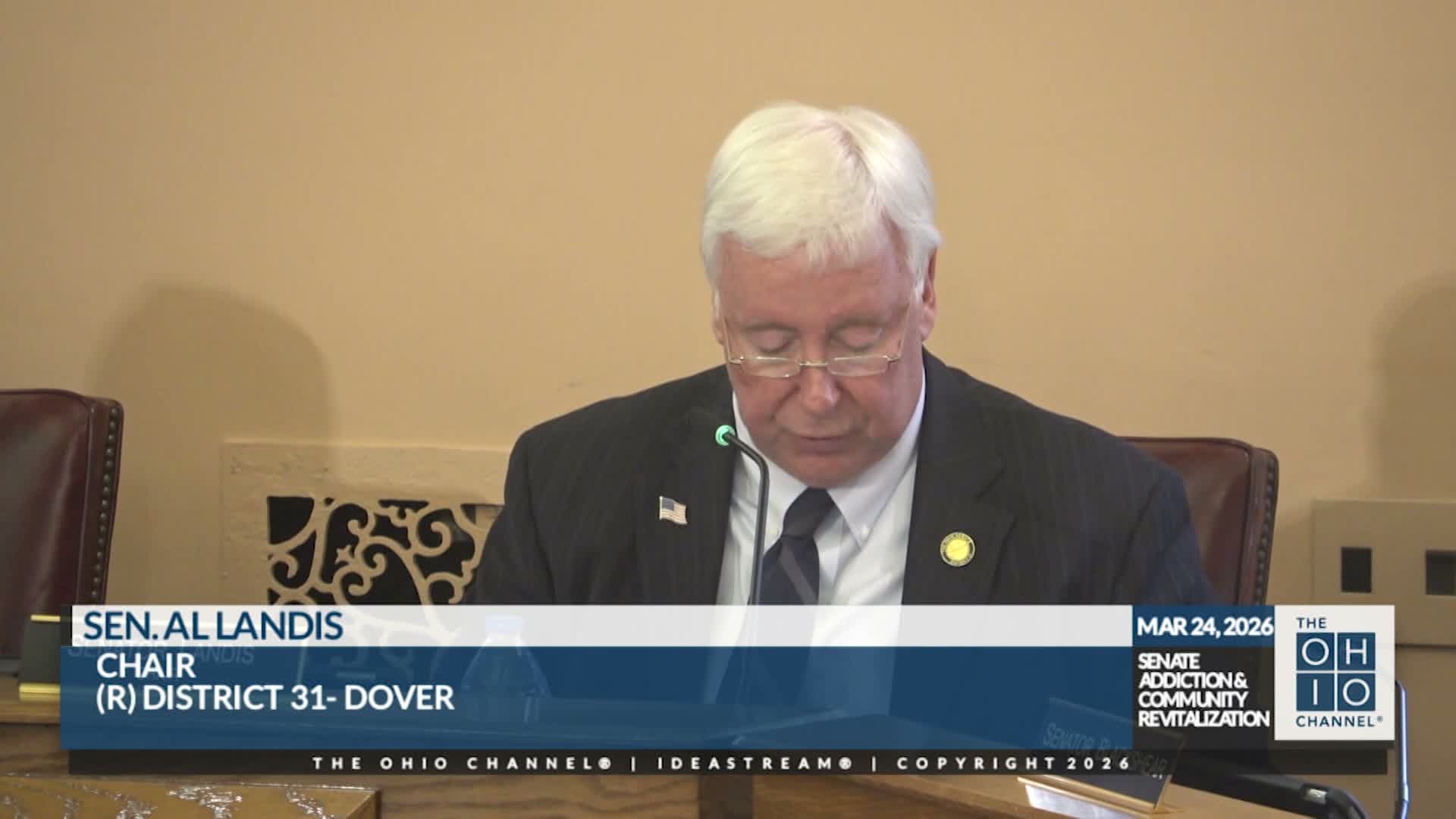
The Addiction and Community Revitalization Committee held a first hearing on House Bill 58, a bipartisan measure sponsored by Representatives Pizzoli and Jerrells that seeks to raise standards for recovery housing and strengthen oversight.
Representative Pizzoli opened her testimony with an inspection anecdote, saying the Ohio Department of Behavioral Health found ‘‘too many bunk beds, a door hanging off the hinges, dog feces on the floor, and one resident keeping a rat as a pet.’’ She told the committee about a constituent she called ‘‘Tom’’ who, she said, ‘‘wasn’t failing recovery. Recovery was failing Tom.’’ She characterized HB 58 as a step toward treating recovery housing ‘‘more like health care’’ and said the bill would crack down on kickbacks, give local prosecutors tools to shut down bad actors, and require enforceable standards from the Department of Behavioral Health.
Representative Jerrells, the joint sponsor, told the committee the bill builds on earlier work (Senate Bill 138) and would create a centralized, transparent list of certified recovery housing operators, an ombudsman to help residents navigate complaints, and a task force to study how recovery resources are distributed across the state. ‘‘This legislation creates a centralized transparent list of recovery housing operators,’’ Jerrells said, and added the bill would ‘‘authorize civil penalties’’ so communities could act against exploitative operators.
Committee members questioned sponsors about operational details. Vice Chair Johnson asked how the county of origin for people sent to treatment is determined and whether transportation back to an individual’s residence would be provided. Representative Pizzoli said sponsors had worked with Medicaid staff to define residency language and that the bill requires providers and courts to consider options for returning people to their county of residence rather than leaving them stranded.
Vice Chair Johnson and other members also raised the practical challenge of obtaining data about persons referred to out‑of‑county treatment, with Johnson noting constraints such as HIPAA that limit data access. Sponsors said the bill aims to reduce confusion by centralizing certification and by improving coordination among the Department of Behavioral Health, ADAMH boards and certifying agencies so complaints are handled more quickly and consistently.
Jerrells said the bill seeks to reduce stigma and create ‘‘no wrong door’’ access for people seeking help: ‘‘That hand that extends out back to that individual very well could be the first and the last,’’ he said, arguing that a reliable, certified system is necessary to keep people connected to care.
The committee did not take a vote on House Bill 58 at the first hearing. Sponsors said they were available to answer additional questions and the committee adjourned.
What’s next: HB 58 was given a first hearing; sponsors and committee members asked for clarifications about residency, transportation and data sharing, and no formal action was taken.
Representative Pizzoli opened her testimony with an inspection anecdote, saying the Ohio Department of Behavioral Health found ‘‘too many bunk beds, a door hanging off the hinges, dog feces on the floor, and one resident keeping a rat as a pet.’’ She told the committee about a constituent she called ‘‘Tom’’ who, she said, ‘‘wasn’t failing recovery. Recovery was failing Tom.’’ She characterized HB 58 as a step toward treating recovery housing ‘‘more like health care’’ and said the bill would crack down on kickbacks, give local prosecutors tools to shut down bad actors, and require enforceable standards from the Department of Behavioral Health.
Representative Jerrells, the joint sponsor, told the committee the bill builds on earlier work (Senate Bill 138) and would create a centralized, transparent list of certified recovery housing operators, an ombudsman to help residents navigate complaints, and a task force to study how recovery resources are distributed across the state. ‘‘This legislation creates a centralized transparent list of recovery housing operators,’’ Jerrells said, and added the bill would ‘‘authorize civil penalties’’ so communities could act against exploitative operators.
Committee members questioned sponsors about operational details. Vice Chair Johnson asked how the county of origin for people sent to treatment is determined and whether transportation back to an individual’s residence would be provided. Representative Pizzoli said sponsors had worked with Medicaid staff to define residency language and that the bill requires providers and courts to consider options for returning people to their county of residence rather than leaving them stranded.
Vice Chair Johnson and other members also raised the practical challenge of obtaining data about persons referred to out‑of‑county treatment, with Johnson noting constraints such as HIPAA that limit data access. Sponsors said the bill aims to reduce confusion by centralizing certification and by improving coordination among the Department of Behavioral Health, ADAMH boards and certifying agencies so complaints are handled more quickly and consistently.
Jerrells said the bill seeks to reduce stigma and create ‘‘no wrong door’’ access for people seeking help: ‘‘That hand that extends out back to that individual very well could be the first and the last,’’ he said, arguing that a reliable, certified system is necessary to keep people connected to care.
The committee did not take a vote on House Bill 58 at the first hearing. Sponsors said they were available to answer additional questions and the committee adjourned.
What’s next: HB 58 was given a first hearing; sponsors and committee members asked for clarifications about residency, transportation and data sharing, and no formal action was taken.
View the Full Meeting & All Its Details
This article offers just a summary. Unlock complete video, transcripts, and insights as a Founder Member.
✓
Watch full, unedited meeting videos
✓
Search every word spoken in unlimited transcripts
✓
AI summaries & real-time alerts (all government levels)
✓
Permanent access to expanding government content
30-day money-back guarantee
