Committee adopts amendment to let halfway houses help residents obtain state IDs before release
March 11, 2026 | Addiction and Community Revitalization Committee, Senate, Committees, Legislative, Ohio
This article was created by AI summarizing key points discussed. AI makes mistakes, so for full details and context, please refer to the video of the full meeting. Please report any errors so we can fix them. Report an error »
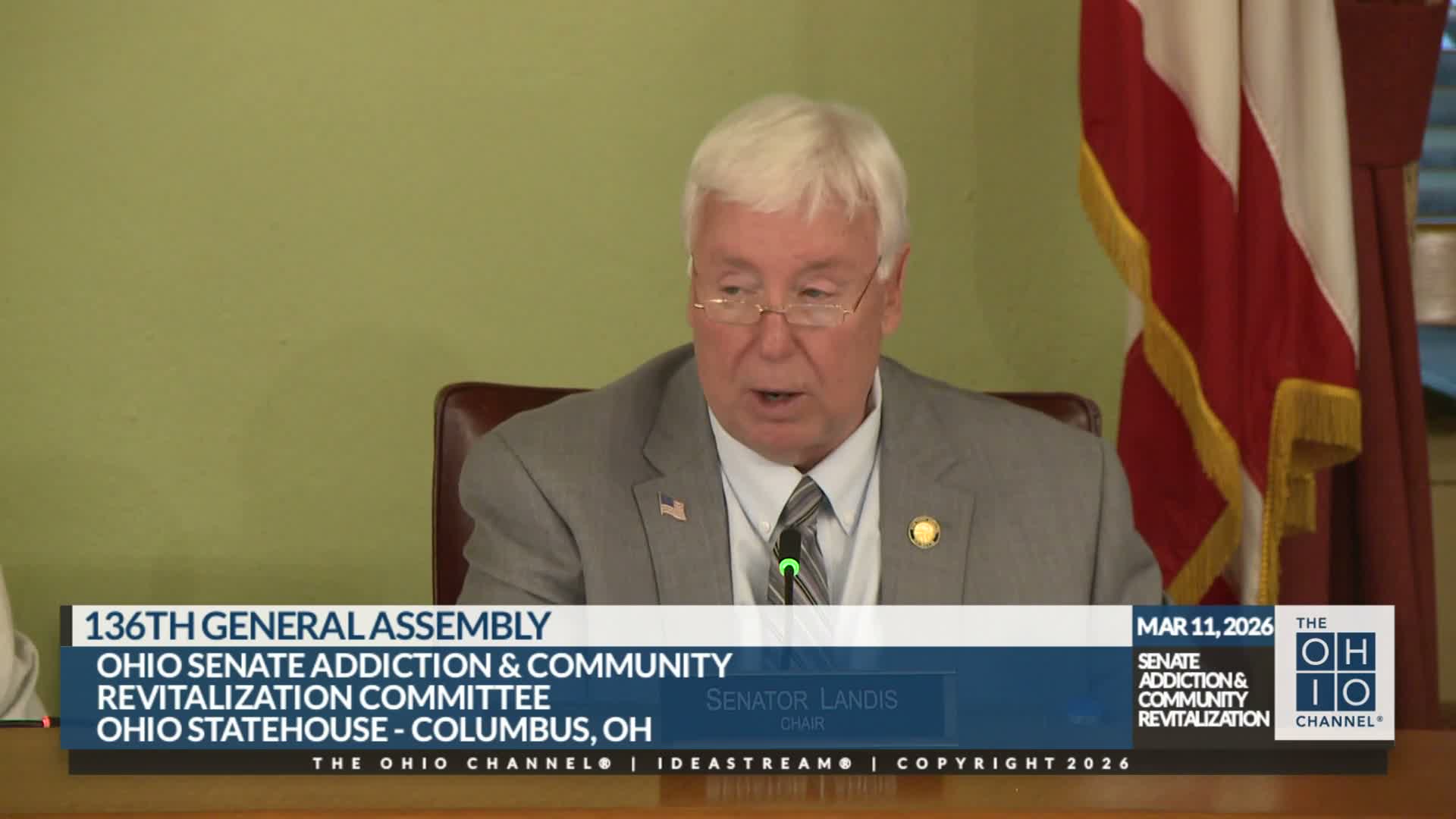
The Senate Addiction and Community Revitalization Committee on a procedural vote adopted an amendment to House Bill 393 that would let community-based correctional facilities and licensed halfway houses assist residents in obtaining state-issued identification before they return to the community.
At a proponent-only hearing, several witnesses told the panel the change would remove a practical barrier to reentry. "Having valid identification upon release from incarceration is essential for successful reentry into the community," said Dominique Page, executive director of the Franklin County Community Based Correctional Facility and a trustee of CORGES, Inc., which represents publicly operated CBCFs in Ohio. Page said a state ID is required for employment, housing, banking and accessing social services and estimated that roughly "70% of clients at my facility do not have a form of state identification upon arrival."
Roel Ensignkiewicz, senior director of strategic partnerships for Volunteers of America Ohio & Indiana and a representative of the Ohio Community Corrections Association (OCCA), told the committee OCCA members secured more than "4,000 identifications for our clients" in the previous year and serve over 15,000 people annually. Ensignkiewicz asked the committee to approve Amendment 1679 to explicitly add licensed halfway houses to the bill’s reach; the amendment was adopted "without objection," and the chair said it became part of the bill.
Support also came from advocacy and faith-based organizations. "This is a very simple but important bill," said Hannah Cubbins, legislative director for Americans for Prosperity Ohio, who described HB 393 as building on reforms that already allow state prison systems to help inmates obtain identification prior to release. Marsha Forsen, associate director for social concerns at the Catholic Conference of Ohio, said the change would advance restorative goals by helping returning citizens secure employment and stabilize family and community relationships.
Witnesses described practical challenges the bill is intended to address: lost birth certificates, long gaps without documentation and the expense or logistical hurdles of obtaining replacement documents while under supervision. Ensignkiewicz said many providers begin verifying identity documents at intake and cooperate with the Ohio Department of Rehabilitation and Correction (ODRC) and other agencies to complete applications.
Committee members pressed witnesses to be prepared for potential opposition in later hearings. Senator O'Brien encouraged proponents to anticipate counterarguments even if no organized opposition had appeared at this hearing; Ensignkiewicz clarified that when she previously said she saw "no opposition," she was referring to the 38 facilities represented by OCCA, not necessarily all stakeholders statewide.
Procedural items completed at the meeting included adoption of Amendment 1679 (moved by Vice Chair Johnson) by unanimous consent and agreement to the committee minutes from the Feb. 17, 2026 meeting "without objection." The committee did not hold a recorded roll-call vote on the amendment; vote tallies were not specified in the hearing record.
The hearing concluded with the chair saying this was the second hearing on House Bill 393; no final floor action on the bill was recorded in the committee during the session.
At a proponent-only hearing, several witnesses told the panel the change would remove a practical barrier to reentry. "Having valid identification upon release from incarceration is essential for successful reentry into the community," said Dominique Page, executive director of the Franklin County Community Based Correctional Facility and a trustee of CORGES, Inc., which represents publicly operated CBCFs in Ohio. Page said a state ID is required for employment, housing, banking and accessing social services and estimated that roughly "70% of clients at my facility do not have a form of state identification upon arrival."
Roel Ensignkiewicz, senior director of strategic partnerships for Volunteers of America Ohio & Indiana and a representative of the Ohio Community Corrections Association (OCCA), told the committee OCCA members secured more than "4,000 identifications for our clients" in the previous year and serve over 15,000 people annually. Ensignkiewicz asked the committee to approve Amendment 1679 to explicitly add licensed halfway houses to the bill’s reach; the amendment was adopted "without objection," and the chair said it became part of the bill.
Support also came from advocacy and faith-based organizations. "This is a very simple but important bill," said Hannah Cubbins, legislative director for Americans for Prosperity Ohio, who described HB 393 as building on reforms that already allow state prison systems to help inmates obtain identification prior to release. Marsha Forsen, associate director for social concerns at the Catholic Conference of Ohio, said the change would advance restorative goals by helping returning citizens secure employment and stabilize family and community relationships.
Witnesses described practical challenges the bill is intended to address: lost birth certificates, long gaps without documentation and the expense or logistical hurdles of obtaining replacement documents while under supervision. Ensignkiewicz said many providers begin verifying identity documents at intake and cooperate with the Ohio Department of Rehabilitation and Correction (ODRC) and other agencies to complete applications.
Committee members pressed witnesses to be prepared for potential opposition in later hearings. Senator O'Brien encouraged proponents to anticipate counterarguments even if no organized opposition had appeared at this hearing; Ensignkiewicz clarified that when she previously said she saw "no opposition," she was referring to the 38 facilities represented by OCCA, not necessarily all stakeholders statewide.
Procedural items completed at the meeting included adoption of Amendment 1679 (moved by Vice Chair Johnson) by unanimous consent and agreement to the committee minutes from the Feb. 17, 2026 meeting "without objection." The committee did not hold a recorded roll-call vote on the amendment; vote tallies were not specified in the hearing record.
The hearing concluded with the chair saying this was the second hearing on House Bill 393; no final floor action on the bill was recorded in the committee during the session.
View the Full Meeting & All Its Details
This article offers just a summary. Unlock complete video, transcripts, and insights as a Founder Member.
✓
Watch full, unedited meeting videos
✓
Search every word spoken in unlimited transcripts
✓
AI summaries & real-time alerts (all government levels)
✓
Permanent access to expanding government content
30-day money-back guarantee
