Council begins study of accessory dwelling units amid parking, wastewater and enforcement concerns
March 17, 2026 | The Colony, Denton County, Texas
This article was created by AI summarizing key points discussed. AI makes mistakes, so for full details and context, please refer to the video of the full meeting. Please report any errors so we can fix them. Report an error »
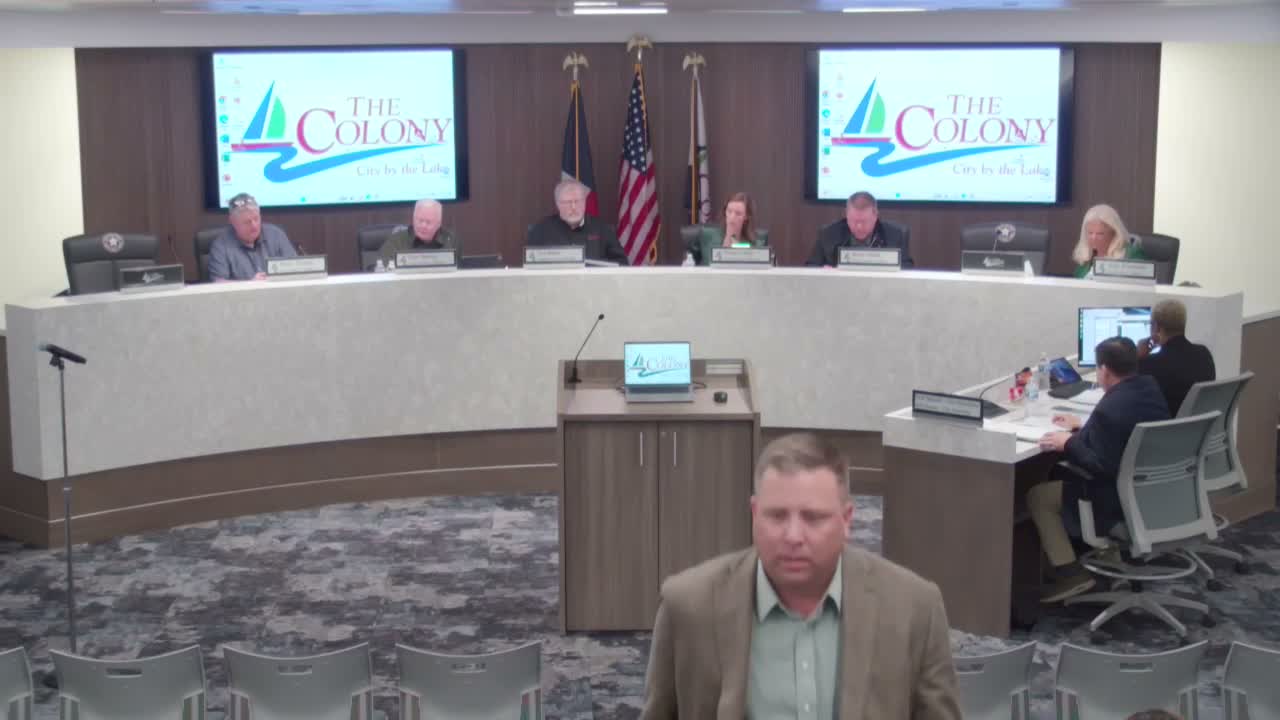
City planning staff introduced a work session item on accessory dwelling units (ADUs) on March 17 and asked the council for direction on whether to pursue an ordinance allowing ADUs and how to regulate them.
Staff outlined common ADU regulatory approaches used by other municipalities — size and lot‑coverage limits, minimum lot sizes, owner‑occupancy or familial‑use requirements, parking and setback rules, and special‑use or site‑specific permitting — and noted that the city currently prohibits most ADUs with only narrow exceptions.
Planning staff estimated the city has roughly 13,000 single‑family lots and that, under liberal filters, perhaps 5,000 lots could be eligible for an ADU; they urged careful drafting to avoid unintended impacts on neighborhood character. Staff identified potential mitigation measures including minimum lot sizes (for example, 7,000 square feet), stricter setbacks, on‑site parking requirements, and permit processes that would reduce the chance ADUs become income‑producing short‑term rentals.
Council members expressed repeated concerns. Several said the city already suffers parking shortages on narrow lots and that adding ADUs could worsen on‑street congestion. One councilor asked whether the wastewater treatment plant and stormwater infrastructure could handle additional density; staff said ADUs would increase density and utility demand and that those impacts must be assessed. Others noted that many neighborhoods are governed by homeowners associations that likely would prohibit ADUs, narrowing the pool of feasible lots.
Members also discussed legal constraints: whether an owner‑occupancy requirement or special rules for family members could run afoul of equal‑protection or other statutory issues. Staff and the city attorney's office will need to craft defensible language if council wishes to proceed.
Council directed staff to research best practices, examine infrastructure impacts (wastewater, parking, stormwater), and return with draft ordinance options that could include size thresholds, owner‑occupancy or non‑rental provisions, and a permitting path to mitigate negative impacts.
Staff outlined common ADU regulatory approaches used by other municipalities — size and lot‑coverage limits, minimum lot sizes, owner‑occupancy or familial‑use requirements, parking and setback rules, and special‑use or site‑specific permitting — and noted that the city currently prohibits most ADUs with only narrow exceptions.
Planning staff estimated the city has roughly 13,000 single‑family lots and that, under liberal filters, perhaps 5,000 lots could be eligible for an ADU; they urged careful drafting to avoid unintended impacts on neighborhood character. Staff identified potential mitigation measures including minimum lot sizes (for example, 7,000 square feet), stricter setbacks, on‑site parking requirements, and permit processes that would reduce the chance ADUs become income‑producing short‑term rentals.
Council members expressed repeated concerns. Several said the city already suffers parking shortages on narrow lots and that adding ADUs could worsen on‑street congestion. One councilor asked whether the wastewater treatment plant and stormwater infrastructure could handle additional density; staff said ADUs would increase density and utility demand and that those impacts must be assessed. Others noted that many neighborhoods are governed by homeowners associations that likely would prohibit ADUs, narrowing the pool of feasible lots.
Members also discussed legal constraints: whether an owner‑occupancy requirement or special rules for family members could run afoul of equal‑protection or other statutory issues. Staff and the city attorney's office will need to craft defensible language if council wishes to proceed.
Council directed staff to research best practices, examine infrastructure impacts (wastewater, parking, stormwater), and return with draft ordinance options that could include size thresholds, owner‑occupancy or non‑rental provisions, and a permitting path to mitigate negative impacts.
View the Full Meeting & All Its Details
This article offers just a summary. Unlock complete video, transcripts, and insights as a Founder Member.
✓
Watch full, unedited meeting videos
✓
Search every word spoken in unlimited transcripts
✓
AI summaries & real-time alerts (all government levels)
✓
Permanent access to expanding government content
30-day money-back guarantee
