Bill to create all-payer claims database aims to boost transparency, sponsors say
March 17, 2026 | Insurance, House of Representatives, Committees, Legislative, Ohio
This article was created by AI summarizing key points discussed. AI makes mistakes, so for full details and context, please refer to the video of the full meeting. Please report any errors so we can fix them. Report an error »
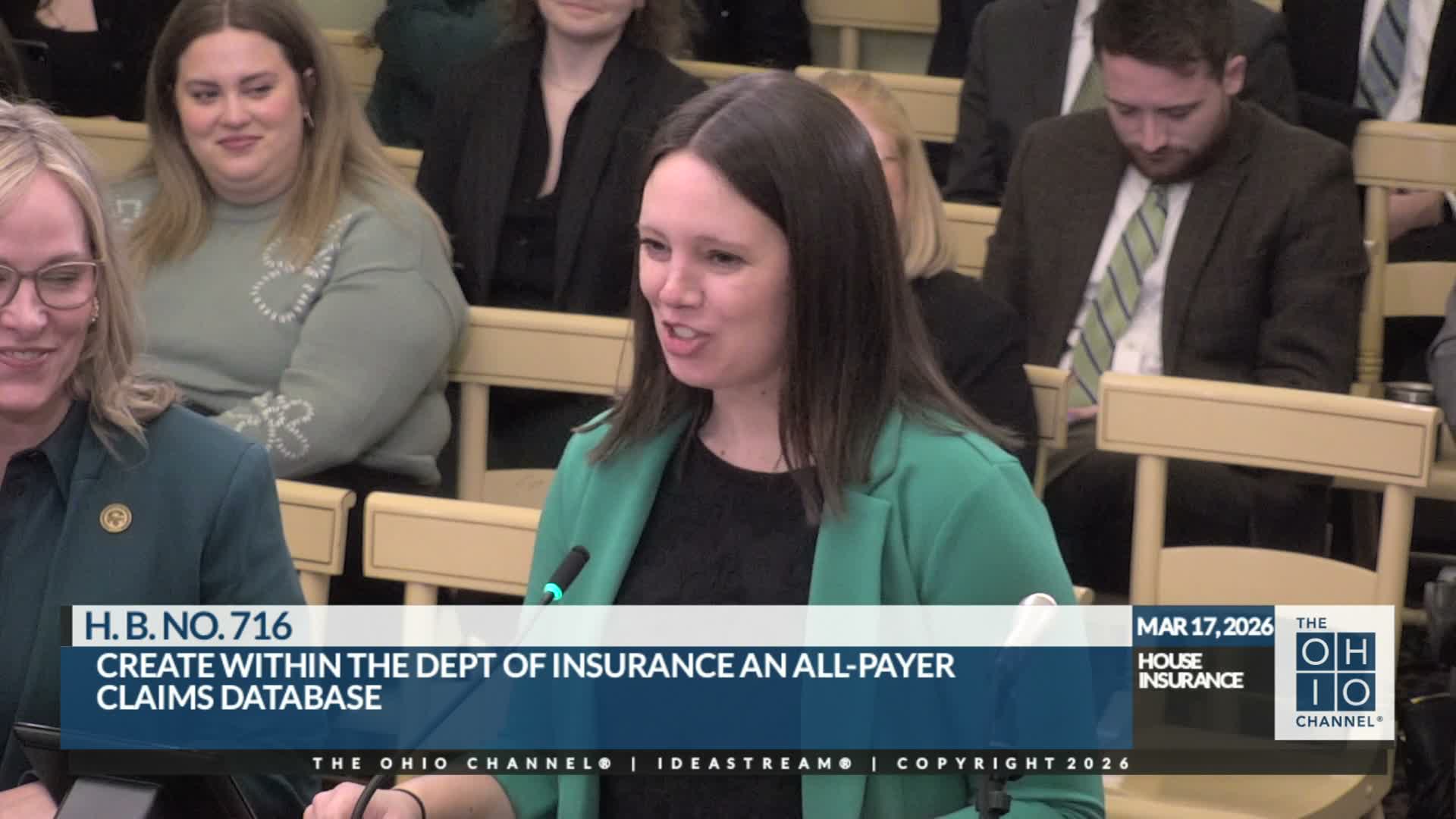
Vice Chair Meredith Craig presented House Bill 716 to the House Insurance Committee, saying the bill would create an all-payer claims database (APCD) within the Ohio Department of Insurance to collect standardized medical, pharmacy and dental claims from payers and provide policymakers, researchers and employers a clearer picture of utilization and costs.
"These databases allow policymakers, researchers, employers, and healthcare stakeholders to better understand how healthcare services are utilized, how much they cost, and how these costs vary across regions and payers," Meredith Craig told the committee. She said states commonly use APCDs to analyze price variation and policy impacts.
Representative Kelly Dieter, a joint sponsor, noted federal limits on states' authority: "In 2016, the Supreme Court ruled that states cannot require self-funded employer health plans governed by ERISA to submit claims data to an APCD because ERISA includes a federal preemption clause," she said. Dieter told the committee the database would collect de-identified data and that submission by self-funded plans could be voluntary; she estimated the bill could capture roughly 50% of claims based on research.
Committee members asked about HIPAA compliance and whether payers' identities would be protected. Sponsors said data would be de-identified, trade secrets protected through rulemaking and the Department of Insurance would exercise discretion about access and use. They also cited policy uses including targeting rural health funds and tracking opioid prescription patterns as examples of how APCD data could be applied.
The committee closed the bill's first hearing after members requested further stakeholder input on the database design and administration.
"These databases allow policymakers, researchers, employers, and healthcare stakeholders to better understand how healthcare services are utilized, how much they cost, and how these costs vary across regions and payers," Meredith Craig told the committee. She said states commonly use APCDs to analyze price variation and policy impacts.
Representative Kelly Dieter, a joint sponsor, noted federal limits on states' authority: "In 2016, the Supreme Court ruled that states cannot require self-funded employer health plans governed by ERISA to submit claims data to an APCD because ERISA includes a federal preemption clause," she said. Dieter told the committee the database would collect de-identified data and that submission by self-funded plans could be voluntary; she estimated the bill could capture roughly 50% of claims based on research.
Committee members asked about HIPAA compliance and whether payers' identities would be protected. Sponsors said data would be de-identified, trade secrets protected through rulemaking and the Department of Insurance would exercise discretion about access and use. They also cited policy uses including targeting rural health funds and tracking opioid prescription patterns as examples of how APCD data could be applied.
The committee closed the bill's first hearing after members requested further stakeholder input on the database design and administration.
Don't Miss a Word: See the Full Meeting!
Go beyond summaries. Unlock every video, transcript, and key insight with a Founder Membership.
✓
Get instant access to full meeting videos
✓
Search and clip any phrase from complete transcripts
✓
Receive AI-powered summaries & custom alerts
✓
Enjoy lifetime, unrestricted access to government data
30-day money-back guarantee
