House committee hears broad support for pharmacy reforms aimed at protecting community pharmacies
March 11, 2026 | Insurance, House of Representatives, Committees, Legislative, Ohio
This article was created by AI summarizing key points discussed. AI makes mistakes, so for full details and context, please refer to the video of the full meeting. Please report any errors so we can fix them. Report an error »
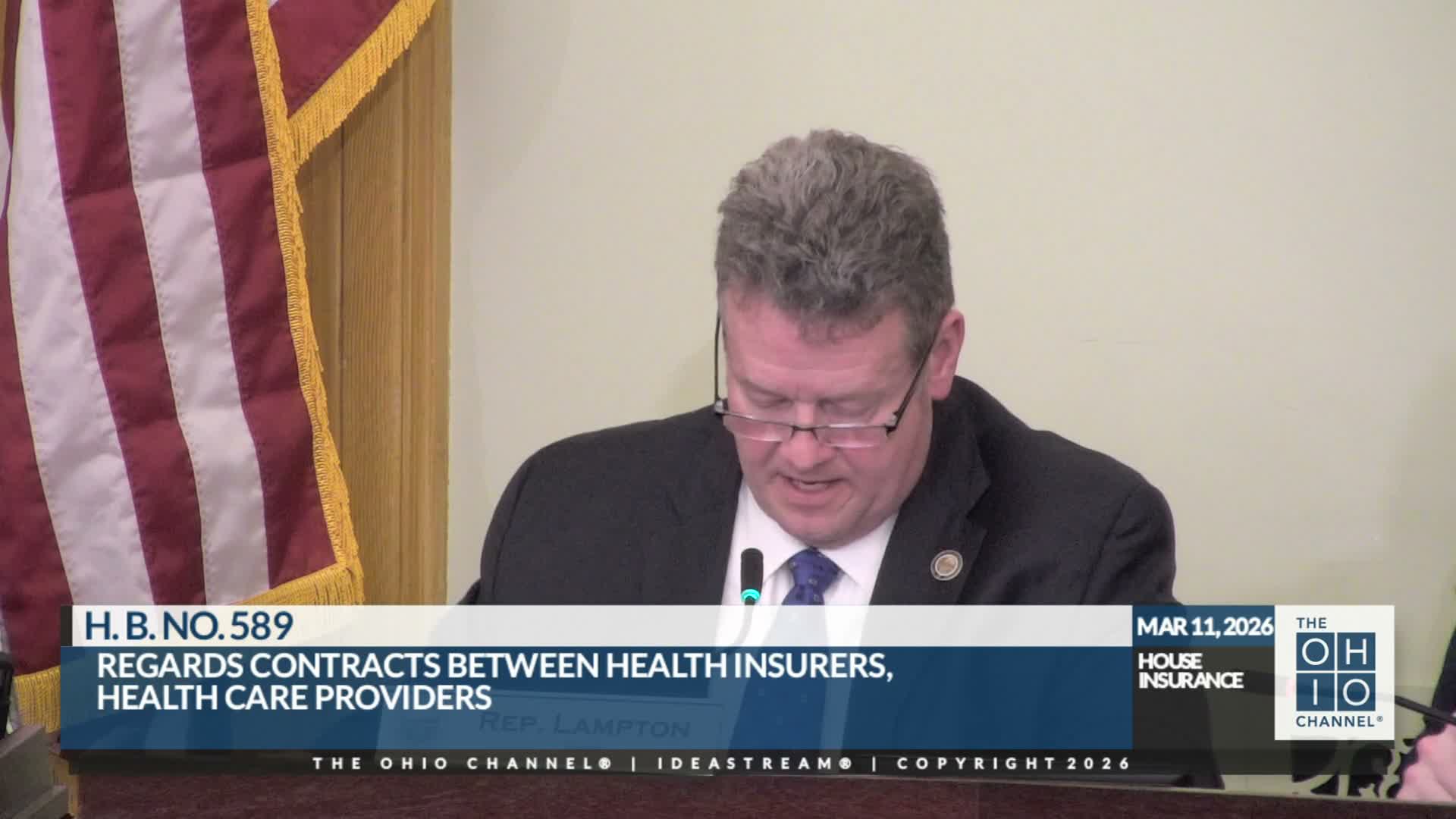
The House Insurance Committee held a sixth hearing on House Bill 1 92, a proposal intended to reshape pharmacy reimbursement and give patients and employers clearer, transaction‑level information about prescription pricing.
Representative Barhorst, the bill sponsor, told the committee the measure reflects several years of work and added amendments aimed at transparency and preventing a perceived “pill tax” characterization. He said the bill seeks to modernize payment practices and empower consumers and employers to shop for prescriptions more effectively.
Antonio Chacha, president of 3 Access Advisors, testified that plan sponsors lack an itemized accounting of what they are being charged and said HB 1 92 would restore that transparency. “The plan sponsor should have an itemized accounting of what they bought, what they were charged at any given moment for every single transaction that they are paying for,” Chacha said, urging standardized reporting so employers can see how costs flow through the supply chain.
Thomas Bonifield, a Doctor of Pharmacy student at Cedarville University, emphasized threats to community pharmacies and cited state data: “215 Ohio community pharmacies closed in 2024 alone,” he said, and argued the bill’s cost‑plus plus dispensing model would require PBMs to reimburse pharmacies for acquisition cost plus a dispensing fee set by the superintendent of insurance.
Jill McCormack, representing the National Association of Chain Drug Stores, and Steve Ferris, government affairs director at Discount Drug Mart, both described rapid store closures and urged legislation that balances acquisition cost benchmarks with a stable dispensing fee. Ferris cited a state figure, noting recent pharmacy closures and the “opaque” nature of PBM contracts that he said obscure the true value of PBM discounts.
Tim Crum, president of Greenback Health, urged policies that allow patients and pharmacies to compare insurer prices with cash prices at the counter. “The cash price is often cheaper than the insurance price for the same medication,” Crum said, arguing that giving patients real‑time benefit tools or the ability to authorize third‑party access to their insurance price estimator would increase competition and lower costs.
Witnesses described implementation risks and recommended ongoing monitoring to guard against off‑invoice or wholesale invoice inflation that could undermine benchmarks. Committee members asked about dispensing‑fee calculation, the role of the superintendent of insurance, and prior state experience; witnesses pointed to Ohio Medicaid’s actual acquisition cost surveys and monitoring as a model for adjusting benchmarks.
The committee accepted written proponent testimony from several organizations and concluded the hearing without a vote. No final action on HB 1 92 was taken at this meeting; sponsors and witnesses said they were available for follow‑up questions and additional data.
Representative Barhorst, the bill sponsor, told the committee the measure reflects several years of work and added amendments aimed at transparency and preventing a perceived “pill tax” characterization. He said the bill seeks to modernize payment practices and empower consumers and employers to shop for prescriptions more effectively.
Antonio Chacha, president of 3 Access Advisors, testified that plan sponsors lack an itemized accounting of what they are being charged and said HB 1 92 would restore that transparency. “The plan sponsor should have an itemized accounting of what they bought, what they were charged at any given moment for every single transaction that they are paying for,” Chacha said, urging standardized reporting so employers can see how costs flow through the supply chain.
Thomas Bonifield, a Doctor of Pharmacy student at Cedarville University, emphasized threats to community pharmacies and cited state data: “215 Ohio community pharmacies closed in 2024 alone,” he said, and argued the bill’s cost‑plus plus dispensing model would require PBMs to reimburse pharmacies for acquisition cost plus a dispensing fee set by the superintendent of insurance.
Jill McCormack, representing the National Association of Chain Drug Stores, and Steve Ferris, government affairs director at Discount Drug Mart, both described rapid store closures and urged legislation that balances acquisition cost benchmarks with a stable dispensing fee. Ferris cited a state figure, noting recent pharmacy closures and the “opaque” nature of PBM contracts that he said obscure the true value of PBM discounts.
Tim Crum, president of Greenback Health, urged policies that allow patients and pharmacies to compare insurer prices with cash prices at the counter. “The cash price is often cheaper than the insurance price for the same medication,” Crum said, arguing that giving patients real‑time benefit tools or the ability to authorize third‑party access to their insurance price estimator would increase competition and lower costs.
Witnesses described implementation risks and recommended ongoing monitoring to guard against off‑invoice or wholesale invoice inflation that could undermine benchmarks. Committee members asked about dispensing‑fee calculation, the role of the superintendent of insurance, and prior state experience; witnesses pointed to Ohio Medicaid’s actual acquisition cost surveys and monitoring as a model for adjusting benchmarks.
The committee accepted written proponent testimony from several organizations and concluded the hearing without a vote. No final action on HB 1 92 was taken at this meeting; sponsors and witnesses said they were available for follow‑up questions and additional data.
Don't Miss a Word: See the Full Meeting!
Go beyond summaries. Unlock every video, transcript, and key insight with a Founder Membership.
✓
Get instant access to full meeting videos
✓
Search and clip any phrase from complete transcripts
✓
Receive AI-powered summaries & custom alerts
✓
Enjoy lifetime, unrestricted access to government data
30-day money-back guarantee
