Testifier urges guardrails as committee weighs voluntary AI governance in House Bill 628
March 17, 2026 | Technology and Innovation, House of Representatives, Committees, Legislative, Ohio
This article was created by AI summarizing key points discussed. AI makes mistakes, so for full details and context, please refer to the video of the full meeting. Please report any errors so we can fix them. Report an error »
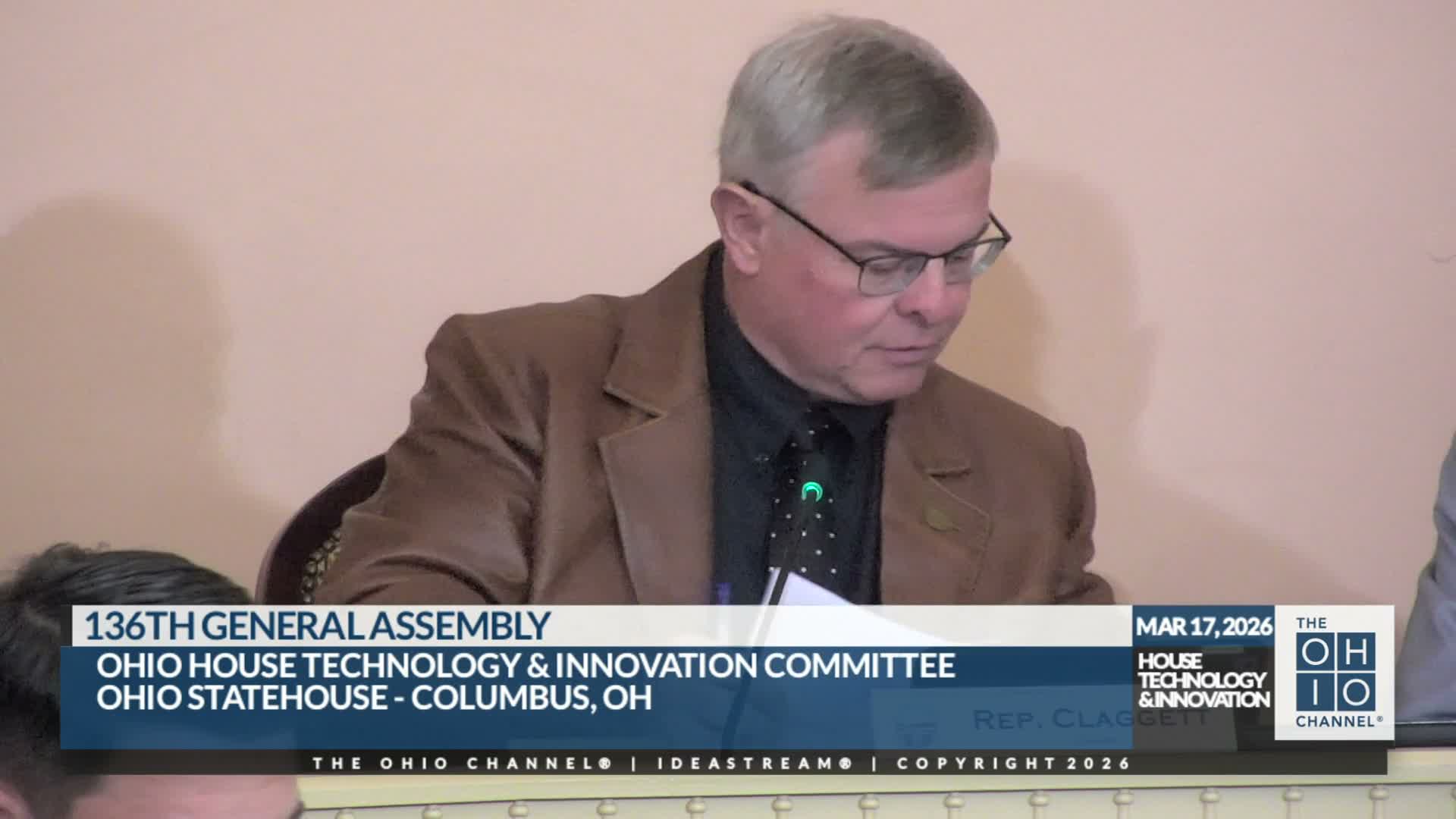
Logan Cullis, of the American Consumer Institute, told the House Technology and Innovation Committee that House Bill 628’s voluntary ‘‘soft law’’ framework could balance innovation and risk but warned lawmakers to guard against it becoming mandatory in practice.
Cullis, an Ohio native and longtime policy analyst, described soft law as “governance without government” and said HB628 creates a marketplace of voluntary independent verification organizations (IVOs) that would give companies a stronger defense in court if they follow recognized practices. “The rebuttable presumption that you’re putting in the law is only as good as what it’s protecting and trying to encourage,” Cullis said, adding that the attorney general’s guidelines are intended to provide oversight.
Why it matters: States are taking different approaches to AI oversight. Cullis pointed to other-state efforts and warned that hard law can quickly become outdated; he urged lawmakers to preserve flexibility while adding guardrails to prevent voluntary standards from becoming a de facto requirement.
Members pressed Cullis on several possible problems. Representative Demetrio asked whether the bill would allow large technology companies to shape standards to their advantage, saying “all the big tech companies want this… it feels like it’s kind of the foxes running the hen house a little bit.” Cullis replied that while market incentives are a concern, hard statutory requirements would likely impose higher compliance costs and could squeeze out smaller innovators.
Representative Mohammed asked whether oversight should be broader than the attorney general’s office; Cullis said the bill creates an AI advisory council and recommended drawing on existing standards such as the National Institute of Standards and Technology. Representative Ferguson proposed coordinating HB628 with a regulatory sandbox to let innovators operate under lighter rules temporarily; Cullis agreed that sandboxes and complementary bills (for example, a ‘‘Right to Compute’’ bill) could work in tandem.
Multiple members raised the same core question: how to keep a voluntary IVO regime voluntary. Cullis described several paths by which a voluntary certification could become effectively mandatory—contracting requirements, insurance incentives, or industry norms—and encouraged lawmakers to consider textual guardrails or companion legislation. The chair asked Cullis to work with Representative Ty Matthews’ office and legislative counsel on possible language.
The committee closed the third hearing on HB628 after extended testimony and questions. Members said they will continue to refine the bill and related proposals before future action.
Cullis, an Ohio native and longtime policy analyst, described soft law as “governance without government” and said HB628 creates a marketplace of voluntary independent verification organizations (IVOs) that would give companies a stronger defense in court if they follow recognized practices. “The rebuttable presumption that you’re putting in the law is only as good as what it’s protecting and trying to encourage,” Cullis said, adding that the attorney general’s guidelines are intended to provide oversight.
Why it matters: States are taking different approaches to AI oversight. Cullis pointed to other-state efforts and warned that hard law can quickly become outdated; he urged lawmakers to preserve flexibility while adding guardrails to prevent voluntary standards from becoming a de facto requirement.
Members pressed Cullis on several possible problems. Representative Demetrio asked whether the bill would allow large technology companies to shape standards to their advantage, saying “all the big tech companies want this… it feels like it’s kind of the foxes running the hen house a little bit.” Cullis replied that while market incentives are a concern, hard statutory requirements would likely impose higher compliance costs and could squeeze out smaller innovators.
Representative Mohammed asked whether oversight should be broader than the attorney general’s office; Cullis said the bill creates an AI advisory council and recommended drawing on existing standards such as the National Institute of Standards and Technology. Representative Ferguson proposed coordinating HB628 with a regulatory sandbox to let innovators operate under lighter rules temporarily; Cullis agreed that sandboxes and complementary bills (for example, a ‘‘Right to Compute’’ bill) could work in tandem.
Multiple members raised the same core question: how to keep a voluntary IVO regime voluntary. Cullis described several paths by which a voluntary certification could become effectively mandatory—contracting requirements, insurance incentives, or industry norms—and encouraged lawmakers to consider textual guardrails or companion legislation. The chair asked Cullis to work with Representative Ty Matthews’ office and legislative counsel on possible language.
The committee closed the third hearing on HB628 after extended testimony and questions. Members said they will continue to refine the bill and related proposals before future action.
View the Full Meeting & All Its Details
This article offers just a summary. Unlock complete video, transcripts, and insights as a Founder Member.
✓
Watch full, unedited meeting videos
✓
Search every word spoken in unlimited transcripts
✓
AI summaries & real-time alerts (all government levels)
✓
Permanent access to expanding government content
30-day money-back guarantee
