Northlake council orders staff to drop highest winter usage month after freeze; may adopt four-month averaging ordinance
March 12, 2026 | NorthlakeTown Council, Northlake, Denton County, Texas
This article was created by AI summarizing key points discussed. AI makes mistakes, so for full details and context, please refer to the video of the full meeting. Please report any errors so we can fix them. Report an error »
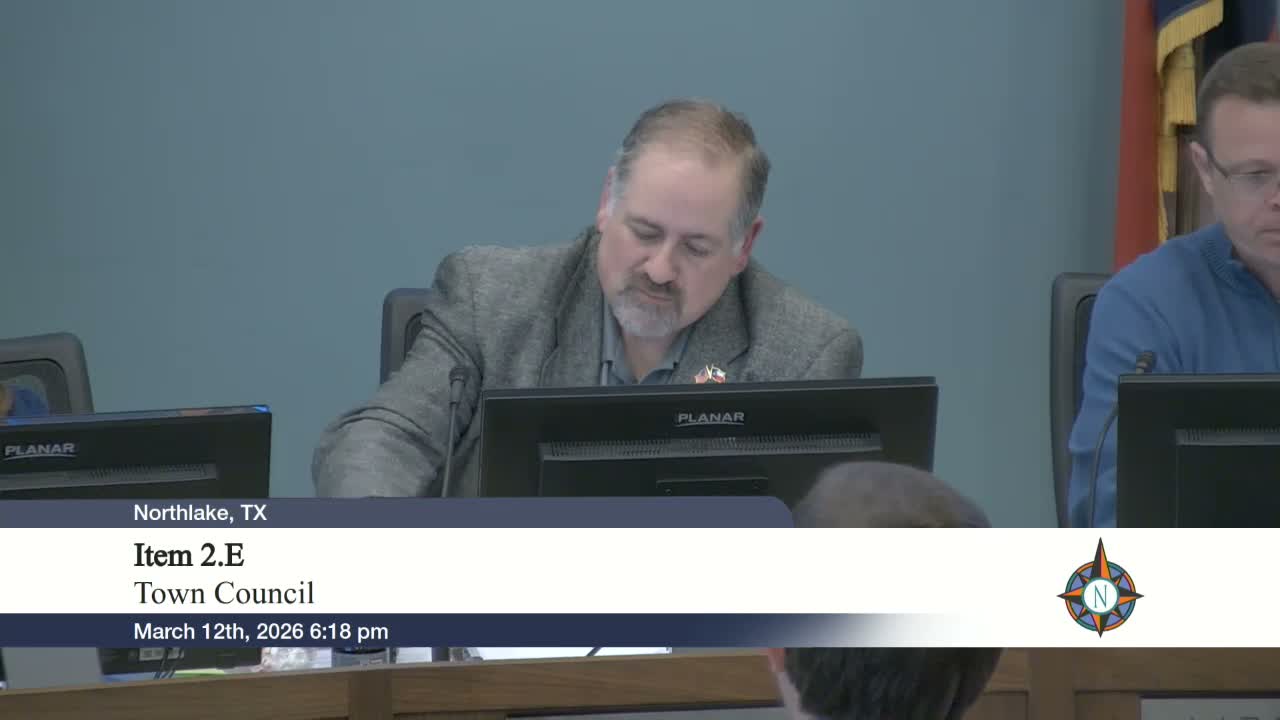
Mayor called the March 12 meeting to order and, after a presentation from utility staff, directed staff to exclude the highest winter billing month from this winter‑averaging calculation so bills can be set.
Staff member Drew said the town observed elevated residential water use during the recent five‑day freeze and reviewed three policy options: a defined freeze declaration with an automatic trigger, lengthening the winter averaging period from three to four months and dropping the highest month, or retaining the current annual‑evaluation approach. “The 4‑month winter average and dropping the highest helps to smooth out the effects instead of guessing from year to year whether we’re going to have a freeze,” Drew said in the council briefing.
Councilors discussed trade‑offs including predictability, administrative burden and revenue impacts. Councilmember (speaker 7) and others backed the four‑month approach as the easiest way to protect residents who face a single unusually high month. Staff noted current metering and billing systems can exclude entire billing cycles but cannot remove individual days within a cycle.
The council’s immediate direction was operational: staff should drop the highest winter usage month for this billing cycle so winter averaging can complete and bills can be issued. The body also asked staff to draft an ordinance to create a four‑month winter averaging period (dropping the highest month) and return it for future council consideration.
The action taken on March 12 affects how sewer charges tied to winter averages are calculated this year; any permanent change would require an ordinance and further council vote.
Staff member Drew said the town observed elevated residential water use during the recent five‑day freeze and reviewed three policy options: a defined freeze declaration with an automatic trigger, lengthening the winter averaging period from three to four months and dropping the highest month, or retaining the current annual‑evaluation approach. “The 4‑month winter average and dropping the highest helps to smooth out the effects instead of guessing from year to year whether we’re going to have a freeze,” Drew said in the council briefing.
Councilors discussed trade‑offs including predictability, administrative burden and revenue impacts. Councilmember (speaker 7) and others backed the four‑month approach as the easiest way to protect residents who face a single unusually high month. Staff noted current metering and billing systems can exclude entire billing cycles but cannot remove individual days within a cycle.
The council’s immediate direction was operational: staff should drop the highest winter usage month for this billing cycle so winter averaging can complete and bills can be issued. The body also asked staff to draft an ordinance to create a four‑month winter averaging period (dropping the highest month) and return it for future council consideration.
The action taken on March 12 affects how sewer charges tied to winter averages are calculated this year; any permanent change would require an ordinance and further council vote.
View the Full Meeting & All Its Details
This article offers just a summary. Unlock complete video, transcripts, and insights as a Founder Member.
✓
Watch full, unedited meeting videos
✓
Search every word spoken in unlimited transcripts
✓
AI summaries & real-time alerts (all government levels)
✓
Permanent access to expanding government content
30-day money-back guarantee
