Representatives Seagrest and Hoops propose residential stability zones to limit property tax hikes for long‑time homeowners
March 11, 2026 | Ways and Means, House of Representatives, Committees, Legislative, Ohio
This article was created by AI summarizing key points discussed. AI makes mistakes, so for full details and context, please refer to the video of the full meeting. Please report any errors so we can fix them. Report an error »
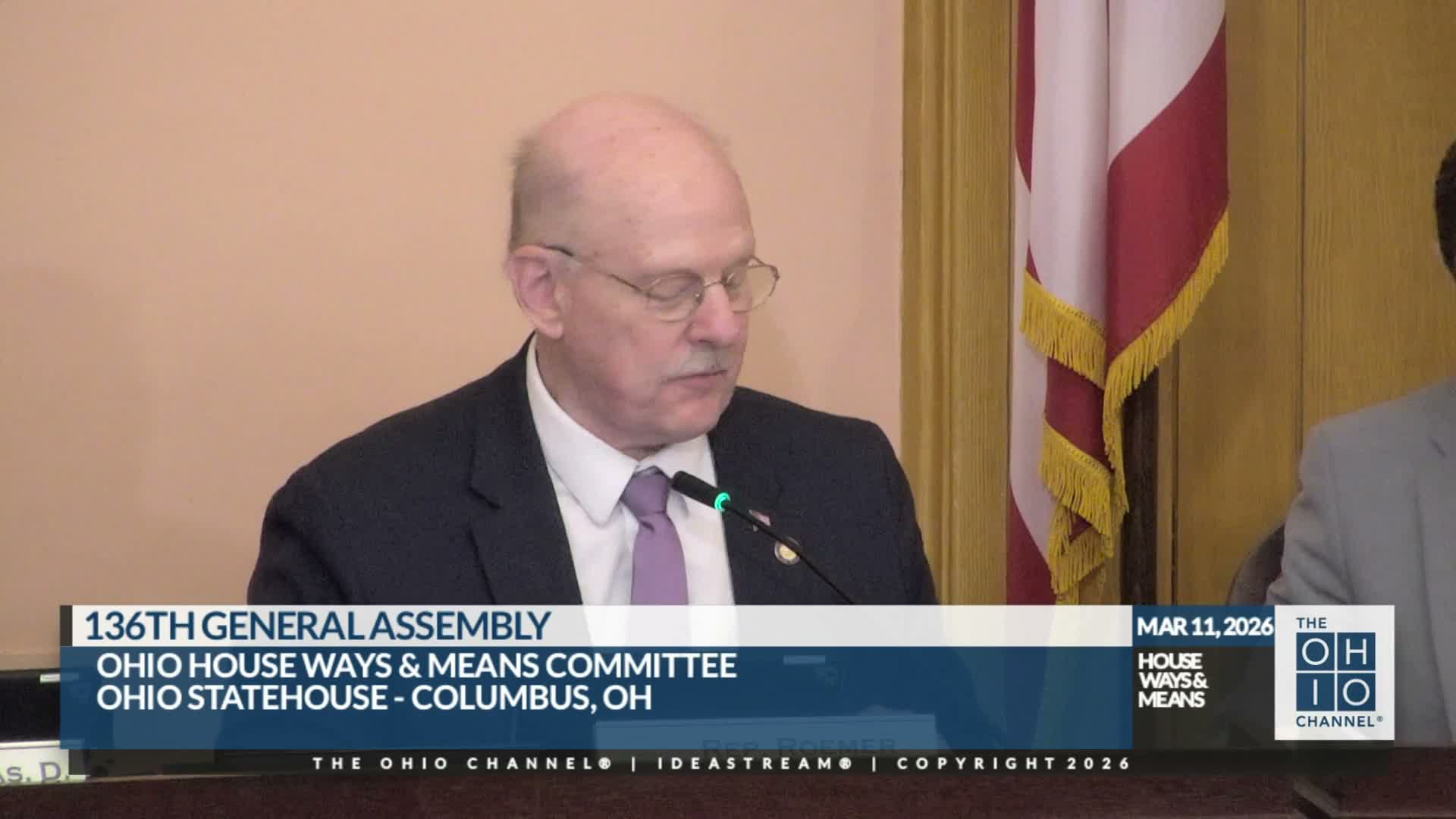
Representatives Seagrest and Hoops testified before the Ohio House Ways and Means Committee in favor of House Bill 598, a measure authorizing counties, municipalities and limited home‑rule townships to create "residential stability zones" that temporarily limit increases in assessed value for qualifying homeowners.
Seagrest, a committee member, said the RSZ is intended as a local tool and noted the bill is a companion to Senate Bill 42. He described the basic mechanics: “Under the RSZ, inside the 20 or inside the mill floor millage would be forgone, while outside millage would equalize up in levies,” and local governments could decide the zones’ location, duration and the generosity of any exemption. Hoops added, “House Bill 598 does not mandate a tax exemption,” and described eligibility limits and enforcement safeguards.
The bill would limit eligibility to homeowners whose income does not exceed 80% of the area median income (AMI), exclude properties already receiving major tax incentives, require occupancy, and include enforcement and recoupment provisions if an exemption was improperly obtained. Sponsors said the zones are capped at 10 years unless local authorities renew them; homeowners age 60 and older could maintain the exemption so long as they remain in the home, while other recipients would receive a time‑limited benefit.
Committee members pressed sponsors for specifics. Representative Richardson asked why the proposal used age 60; sponsors said they would follow up on the choice and that age could be reconsidered. Richardson also requested concrete dollar examples for the 80% AMI threshold; sponsors cited sample medians for illustration — in Williams County a median of about $62,000 would place 80% AMI just under $50,000, while in Union County a median near $115,000 would put 80% at about $90,000 — emphasizing that eligibility dollars would vary widely across the state.
Members raised revenue concerns. Ranking Member Troy noted that reducing assessed valuation shrinks revenue for taxing entities, particularly school districts, and asked whether local governments would be required or enabled to reimburse those entities as happens in some other programs. Sponsors said local governments would decide whether to reimburse affected taxing units and that state reimbursement was unlikely; they described HB 598 as one tool among several to help communities manage displacement pressures.
Representative Glasser asked whether the bill’s language applies at a metropolitan statistical area (MSA) level rather than to smaller subdivisions; sponsors acknowledged the geographic scale could be clarified and noted the proposal had received favorable review in earlier tax hearings with bipartisan feedback.
The committee took sponsor testimony and asked questions but did not vote. The sponsors signaled openness to amendment — including possible changes to the age threshold, geographic definitions and reimbursement language — and said they expect further discussions and technical work with local officials before the bill advances.
Next steps: HB 598 received sponsor testimony and committee questions; members requested follow‑up information on the age cutoff, concrete eligibility calculations by region, and potential approaches to protecting school district revenue if localities adopt RSZs.
Seagrest, a committee member, said the RSZ is intended as a local tool and noted the bill is a companion to Senate Bill 42. He described the basic mechanics: “Under the RSZ, inside the 20 or inside the mill floor millage would be forgone, while outside millage would equalize up in levies,” and local governments could decide the zones’ location, duration and the generosity of any exemption. Hoops added, “House Bill 598 does not mandate a tax exemption,” and described eligibility limits and enforcement safeguards.
The bill would limit eligibility to homeowners whose income does not exceed 80% of the area median income (AMI), exclude properties already receiving major tax incentives, require occupancy, and include enforcement and recoupment provisions if an exemption was improperly obtained. Sponsors said the zones are capped at 10 years unless local authorities renew them; homeowners age 60 and older could maintain the exemption so long as they remain in the home, while other recipients would receive a time‑limited benefit.
Committee members pressed sponsors for specifics. Representative Richardson asked why the proposal used age 60; sponsors said they would follow up on the choice and that age could be reconsidered. Richardson also requested concrete dollar examples for the 80% AMI threshold; sponsors cited sample medians for illustration — in Williams County a median of about $62,000 would place 80% AMI just under $50,000, while in Union County a median near $115,000 would put 80% at about $90,000 — emphasizing that eligibility dollars would vary widely across the state.
Members raised revenue concerns. Ranking Member Troy noted that reducing assessed valuation shrinks revenue for taxing entities, particularly school districts, and asked whether local governments would be required or enabled to reimburse those entities as happens in some other programs. Sponsors said local governments would decide whether to reimburse affected taxing units and that state reimbursement was unlikely; they described HB 598 as one tool among several to help communities manage displacement pressures.
Representative Glasser asked whether the bill’s language applies at a metropolitan statistical area (MSA) level rather than to smaller subdivisions; sponsors acknowledged the geographic scale could be clarified and noted the proposal had received favorable review in earlier tax hearings with bipartisan feedback.
The committee took sponsor testimony and asked questions but did not vote. The sponsors signaled openness to amendment — including possible changes to the age threshold, geographic definitions and reimbursement language — and said they expect further discussions and technical work with local officials before the bill advances.
Next steps: HB 598 received sponsor testimony and committee questions; members requested follow‑up information on the age cutoff, concrete eligibility calculations by region, and potential approaches to protecting school district revenue if localities adopt RSZs.
View the Full Meeting & All Its Details
This article offers just a summary. Unlock complete video, transcripts, and insights as a Founder Member.
✓
Watch full, unedited meeting videos
✓
Search every word spoken in unlimited transcripts
✓
AI summaries & real-time alerts (all government levels)
✓
Permanent access to expanding government content
30-day money-back guarantee
