Committee advances bill to end continuous levies and keep rollbacks in place
March 18, 2026 | Ways and Means, House of Representatives, Committees, Legislative, Ohio
This article was created by AI summarizing key points discussed. AI makes mistakes, so for full details and context, please refer to the video of the full meeting. Please report any errors so we can fix them. Report an error »
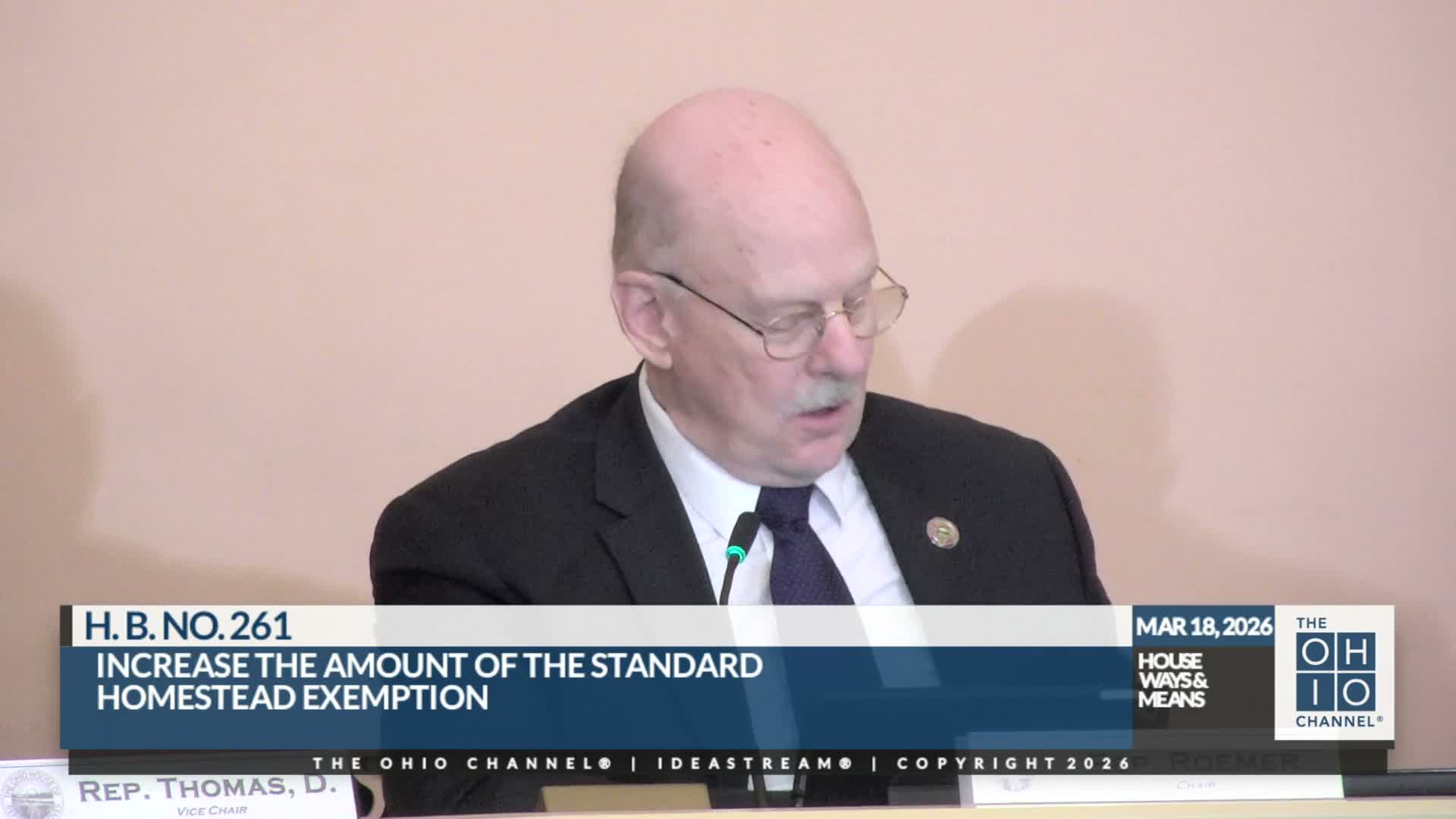
The House Ways and Means Committee advanced House Bill 420 on a second hearing after adopting a friendly amendment that preserves existing rollbacks (homestead, owner-occupied and nonbusiness) for eligible renewal levies.
Vice Chair Thomas moved the amendment and said it was supported by both sponsors; the committee accepted the amendment without objection. "This allows the rollbacks to continue to be placed on those eligible renewal levies that would result as a consequence of ending continuous levies," Thomas said when offering the change.
Hannah Cubbins, legislative director for AFP, testified that HB 420 aims to end the practice of continuous levies and require levies to be approved for a defined term so voters have periodic opportunities to weigh in. "A predictable tax system benefits both governments and taxpayers," Cubbins said, arguing the bill preserves levies pledged to repay bonds while restoring voter accountability.
Members pressed proponents about public-safety funding. Representative Cleck referenced press coverage suggesting essential services like EMS and fire could be threatened if levies lose continuous status. Cubbins replied that many levies have returned to the ballot and passed — the committee cited an 87% passage rate in the last general election — and argued voters typically reauthorize levies they value.
Sandusky County Auditor Jerry Miller testified in support of a review of continuous levies, saying his county has 45 continuous levies (some from the 1970s) and that the proliferation of different levy terms has made the system complex and difficult to explain to taxpayers. "Establishing a process for periodic review would provide voters with an opportunity to reaffirm their support and ensure that these levies remained aligned with present-day priorities," Miller said.
Why it matters: supporters say HB 420 restores transparency and voter oversight; critics and some members raised concerns about voter fatigue and local budget impacts. Auditors urged careful attention to Ohio Revised Code requirements and to local practice differences before broad changes are implemented.
Next steps: the committee concluded the second hearing on HB 420 and accepted the sponsor’s friendly amendment; sponsors and auditors signaled a need for further work on technical details and implementation timelines.
Vice Chair Thomas moved the amendment and said it was supported by both sponsors; the committee accepted the amendment without objection. "This allows the rollbacks to continue to be placed on those eligible renewal levies that would result as a consequence of ending continuous levies," Thomas said when offering the change.
Hannah Cubbins, legislative director for AFP, testified that HB 420 aims to end the practice of continuous levies and require levies to be approved for a defined term so voters have periodic opportunities to weigh in. "A predictable tax system benefits both governments and taxpayers," Cubbins said, arguing the bill preserves levies pledged to repay bonds while restoring voter accountability.
Members pressed proponents about public-safety funding. Representative Cleck referenced press coverage suggesting essential services like EMS and fire could be threatened if levies lose continuous status. Cubbins replied that many levies have returned to the ballot and passed — the committee cited an 87% passage rate in the last general election — and argued voters typically reauthorize levies they value.
Sandusky County Auditor Jerry Miller testified in support of a review of continuous levies, saying his county has 45 continuous levies (some from the 1970s) and that the proliferation of different levy terms has made the system complex and difficult to explain to taxpayers. "Establishing a process for periodic review would provide voters with an opportunity to reaffirm their support and ensure that these levies remained aligned with present-day priorities," Miller said.
Why it matters: supporters say HB 420 restores transparency and voter oversight; critics and some members raised concerns about voter fatigue and local budget impacts. Auditors urged careful attention to Ohio Revised Code requirements and to local practice differences before broad changes are implemented.
Next steps: the committee concluded the second hearing on HB 420 and accepted the sponsor’s friendly amendment; sponsors and auditors signaled a need for further work on technical details and implementation timelines.
View the Full Meeting & All Its Details
This article offers just a summary. Unlock complete video, transcripts, and insights as a Founder Member.
✓
Watch full, unedited meeting videos
✓
Search every word spoken in unlimited transcripts
✓
AI summaries & real-time alerts (all government levels)
✓
Permanent access to expanding government content
30-day money-back guarantee
