Senate rejects plan to fold county probate courts into state judiciary after extended debate
March 24, 2026 | 2026 Legislature ME, Maine
This article was created by AI summarizing key points discussed. AI makes mistakes, so for full details and context, please refer to the video of the full meeting. Please report any errors so we can fix them. Report an error »
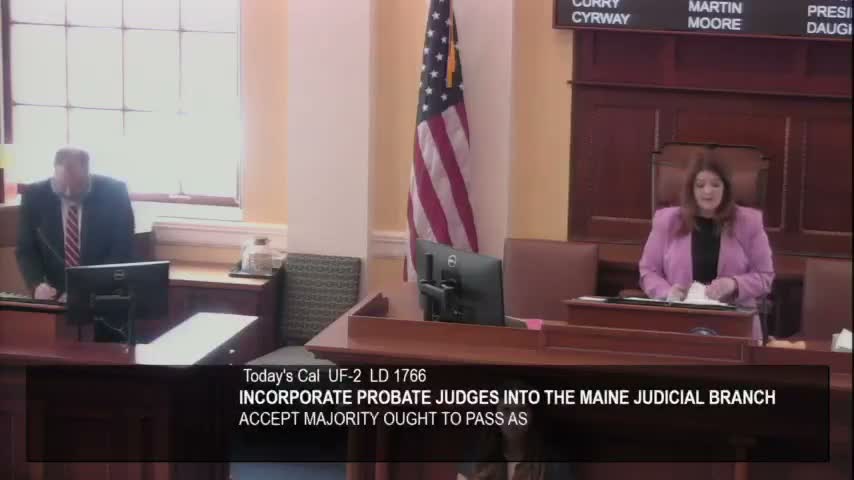
The Maine Senate on March 24 defeated a proposal to incorporate county probate judges into the state judicial branch. The motion to accept the majority "ought to pass" as amended failed on a roll-call vote, 16–19, after extensive floor debate that detailed competing views on local control, fiscal cost, and judicial ethics.
Sponsor Senator Carney and other proponents said LD 17 66 would end a dual-role system in which elected county probate judges may maintain private law practices, creating both the appearance and risk of conflicts of interest in probate matters. Carney described the measure as a structural reform to improve consistency, accountability and training for judges who decide guardianships, adoptions, and inheritance disputes, and said the plan would preserve local registry offices while creating a statewide probate docket and merit-selection process for full-time judges.
Opponents, including Senator Martin and Senator Bailey, argued the bill centralized power in Augusta, diminished local accountability, and risked slower access to justice for sensitive family-law matters in rural counties. Martin warned the change would impose new costs and administrative burdens on communities that could not easily absorb them; Bailey recommended creating a separate family court instead of the proposed probate division and said the judiciary may not be ready to absorb the functions now.
Fiscal concerns were raised on both sides. Senator Martin referenced the bill’s fiscal-note items and projected multi-million-dollar ongoing costs to operate a new probate division; Carney and supporters said a planning appropriation (included in the fiscal note) was intended to smooth transition work, and they argued the proposal addressed an impending shortage of qualified attorneys willing to serve as county probate judges.
The motion to accept the majority report was put to a roll-call vote and failed, meaning the majority-report path did not prevail at this stage. The record shows the chamber then moved to consider minority reports and other unfinished business.
Sponsor Senator Carney and other proponents said LD 17 66 would end a dual-role system in which elected county probate judges may maintain private law practices, creating both the appearance and risk of conflicts of interest in probate matters. Carney described the measure as a structural reform to improve consistency, accountability and training for judges who decide guardianships, adoptions, and inheritance disputes, and said the plan would preserve local registry offices while creating a statewide probate docket and merit-selection process for full-time judges.
Opponents, including Senator Martin and Senator Bailey, argued the bill centralized power in Augusta, diminished local accountability, and risked slower access to justice for sensitive family-law matters in rural counties. Martin warned the change would impose new costs and administrative burdens on communities that could not easily absorb them; Bailey recommended creating a separate family court instead of the proposed probate division and said the judiciary may not be ready to absorb the functions now.
Fiscal concerns were raised on both sides. Senator Martin referenced the bill’s fiscal-note items and projected multi-million-dollar ongoing costs to operate a new probate division; Carney and supporters said a planning appropriation (included in the fiscal note) was intended to smooth transition work, and they argued the proposal addressed an impending shortage of qualified attorneys willing to serve as county probate judges.
The motion to accept the majority report was put to a roll-call vote and failed, meaning the majority-report path did not prevail at this stage. The record shows the chamber then moved to consider minority reports and other unfinished business.
Don't Miss a Word: See the Full Meeting!
Go beyond summaries. Unlock every video, transcript, and key insight with a Founder Membership.
✓
Get instant access to full meeting videos
✓
Search and clip any phrase from complete transcripts
✓
Receive AI-powered summaries & custom alerts
✓
Enjoy lifetime, unrestricted access to government data
30-day money-back guarantee
