Alaska House Committee forwards resolution urging Congress to fully fund IDEA after testimony on rural service gaps
March 26, 2026 | 2026 Legislature Alaska, Alaska
This article was created by AI summarizing key points discussed. AI makes mistakes, so for full details and context, please refer to the video of the full meeting. Please report any errors so we can fix them. Report an error »
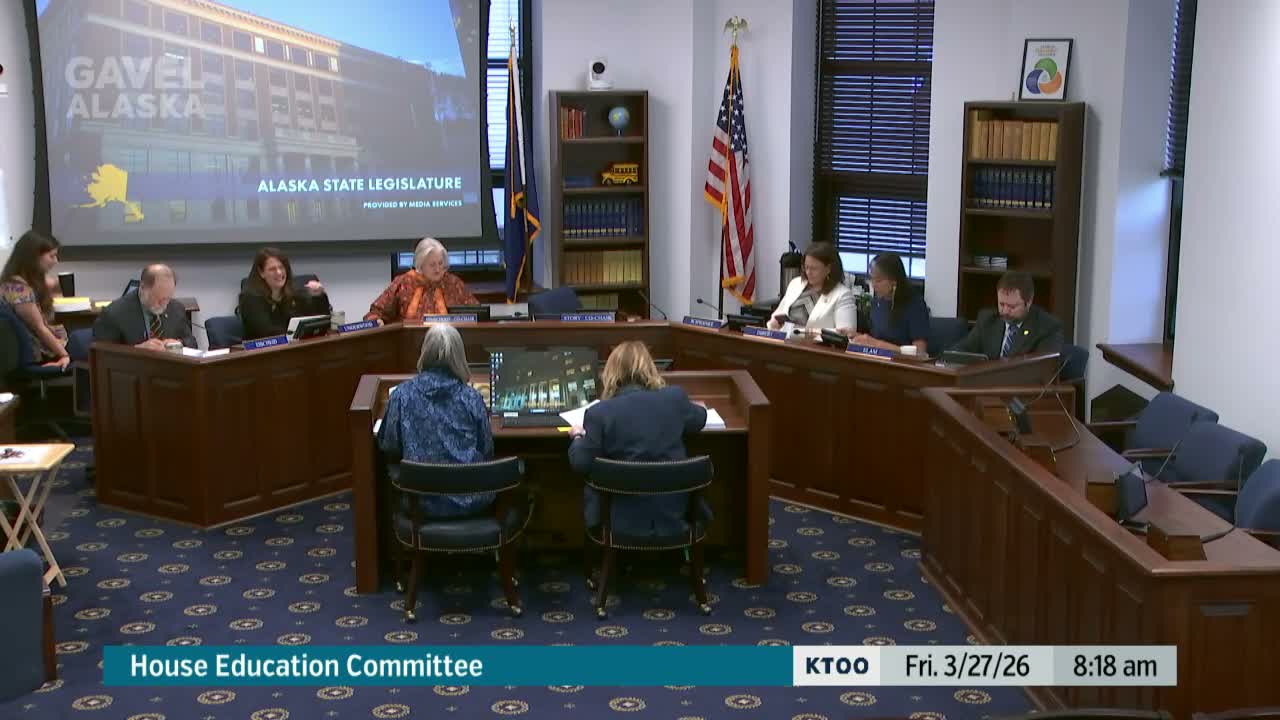
The Alaska House Education Committee on March 27 heard invited testimony and public comment in support of House Joint Resolution 45, which urges the U.S. Congress to fully fund the Individuals with Disabilities Education Act (IDEA) at the originally intended 40% level.
Co-chair Representative Andy Story framed the resolution, summarizing IDEA's history and the federal funding commitment embedded in the law. "IDEA's value is being undermined by chronic federal underfunding," Story told the committee, citing a typical funding shortfall that has left states and local districts to shoulder costs intended for the federal government.
Four invited witnesses described the consequences in Alaska. Kelly McBride, director of student support services for the Galena City School District, said rural districts face acute workforce shortages and high costs for recruiting and retaining related service providers. "Full federal funding of the IDEA is not optional, it's essential," McBride said, noting her district serves more than 500 students with individualized education programs and sometimes relies on telehealth and contract providers to fill gaps.
Olivia Yancey, executive director of the Special Education Service Agency (CISA), described rising demand for specialist services and a growing wait list for onsite visits: "There are at least... 9 students and their school teams on a wait list across seven school districts," she told the committee, arguing the resolution is urgent to protect critical early-intervention windows.
Sally Stockhausen, Ketchikan Gateway Borough School District special education director, called IDEA "a promise" and said federal contributions have fallen far short of the 40% target, forcing state and local districts to divert operating funds to meet legally required services.
Patrick Reinhardt, executive director of the Governor's Council on Disabilities and Special Education, voiced the council's long-standing support for full IDEA funding and said the state's current federal share is far below the statutory target.
Committee members questioned witnesses about how IDEA funds interact with state multipliers and correspondence programs, how districts onboard waiver and international teachers, and what an expansion of federal funding would mean for staffing and service delivery. Witnesses described heavy paperwork, high caseloads, and the difficulty of sustaining in-person specialists in remote communities.
After discussion, Representative Divert moved to forward HJR 45 from committee with individual recommendations and attached fiscal notes; the motion passed by voice consent with no recorded roll-call. The committee then briefly recessed to sign a report.
The resolution asks Congress to honor the IDEA funding commitment and to consider glide-path proposals that would gradually increase federal funding toward the 40% target. Committee members and testimony repeatedly framed the issue as both a moral obligation and a practical necessity to ensure timely, appropriate services for Alaska's students with disabilities.
Co-chair Representative Andy Story framed the resolution, summarizing IDEA's history and the federal funding commitment embedded in the law. "IDEA's value is being undermined by chronic federal underfunding," Story told the committee, citing a typical funding shortfall that has left states and local districts to shoulder costs intended for the federal government.
Four invited witnesses described the consequences in Alaska. Kelly McBride, director of student support services for the Galena City School District, said rural districts face acute workforce shortages and high costs for recruiting and retaining related service providers. "Full federal funding of the IDEA is not optional, it's essential," McBride said, noting her district serves more than 500 students with individualized education programs and sometimes relies on telehealth and contract providers to fill gaps.
Olivia Yancey, executive director of the Special Education Service Agency (CISA), described rising demand for specialist services and a growing wait list for onsite visits: "There are at least... 9 students and their school teams on a wait list across seven school districts," she told the committee, arguing the resolution is urgent to protect critical early-intervention windows.
Sally Stockhausen, Ketchikan Gateway Borough School District special education director, called IDEA "a promise" and said federal contributions have fallen far short of the 40% target, forcing state and local districts to divert operating funds to meet legally required services.
Patrick Reinhardt, executive director of the Governor's Council on Disabilities and Special Education, voiced the council's long-standing support for full IDEA funding and said the state's current federal share is far below the statutory target.
Committee members questioned witnesses about how IDEA funds interact with state multipliers and correspondence programs, how districts onboard waiver and international teachers, and what an expansion of federal funding would mean for staffing and service delivery. Witnesses described heavy paperwork, high caseloads, and the difficulty of sustaining in-person specialists in remote communities.
After discussion, Representative Divert moved to forward HJR 45 from committee with individual recommendations and attached fiscal notes; the motion passed by voice consent with no recorded roll-call. The committee then briefly recessed to sign a report.
The resolution asks Congress to honor the IDEA funding commitment and to consider glide-path proposals that would gradually increase federal funding toward the 40% target. Committee members and testimony repeatedly framed the issue as both a moral obligation and a practical necessity to ensure timely, appropriate services for Alaska's students with disabilities.
View the Full Meeting & All Its Details
This article offers just a summary. Unlock complete video, transcripts, and insights as a Founder Member.
✓
Watch full, unedited meeting videos
✓
Search every word spoken in unlimited transcripts
✓
AI summaries & real-time alerts (all government levels)
✓
Permanent access to expanding government content
30-day money-back guarantee
