House panel hears Alaska Broadband Office outline of BEAD awards, timeline and next steps
March 26, 2026 | 2026 Legislature Alaska, Alaska
This article was created by AI summarizing key points discussed. AI makes mistakes, so for full details and context, please refer to the video of the full meeting. Please report any errors so we can fix them. Report an error »
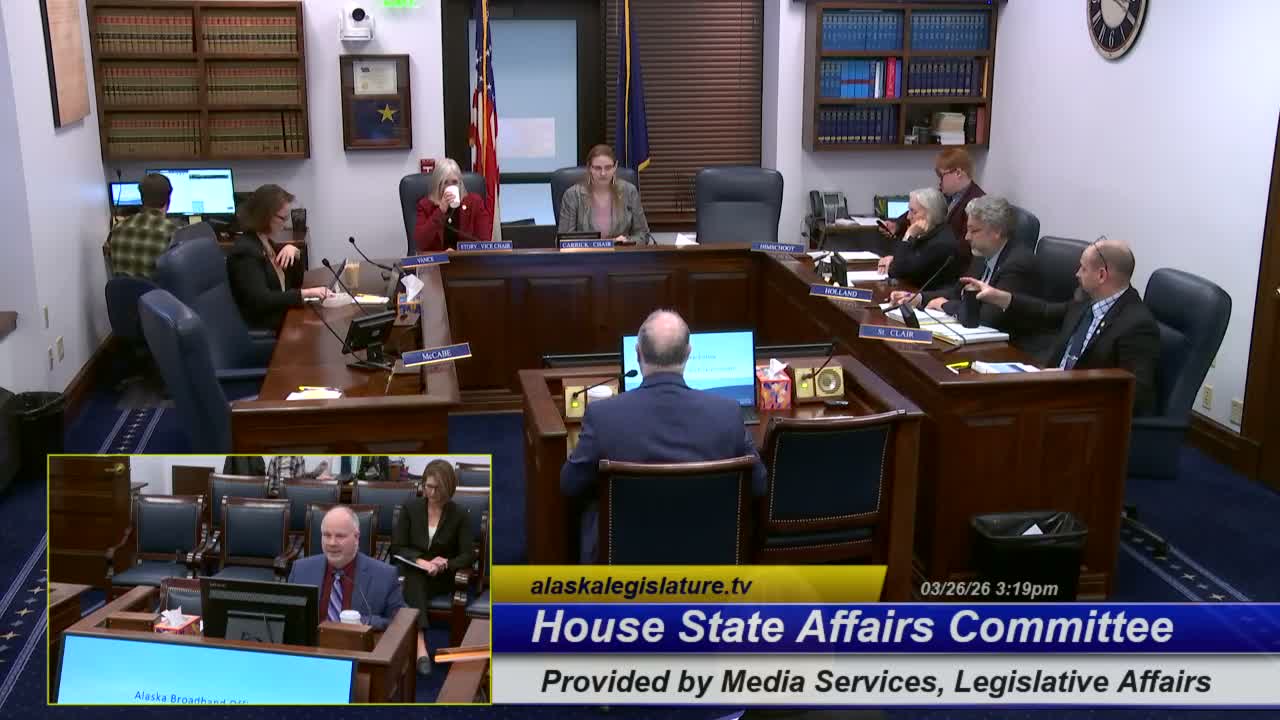
Chair Kerik convened the House State Affairs Committee on March 26 in Juneau for a hearing focused on statewide broadband deployment under the federal BEAD program. Director Thomas Lochner, director of the Alaska Broadband Office, said the state has received NTIA approval and a NIST subgrant notice for its first‑round awards and is now moving into contract negotiations and permitting.
"We received our notice of award from the National Institute of Standards and Technology," Lochner told the committee, adding the NTIA had approved BEAD grants totaling $629,172,952. He said the Office distributed awards across 15 subgrantees in 29 grants and that the state will have up to six months to negotiate subgrantee agreements and four years to complete construction under award terms.
Lochner described the multi‑year application timeline that began with a mapping challenge and an initial proposal process, went through a best‑and‑final‑offer step after NTIA set a roughly $50,000 per‑location threshold for the highest‑cost awards, and ended with the February approvals. He said the state can use up to 2 percent of funds for administration and noted roughly $362,000,000 of BEAD "non‑deployment" funds remain, subject to NTIA policy guidance.
Members pressed the director on durability and technology choices. Representative Himshoo asked whether awarding many low‑Earth‑orbit (LEO) satellite connections undermined long‑term service. Lochner said the Office will monitor subgrantees and hold them to the commitments they sign, and that LEO providers are developing higher‑capacity generations of satellites.
Committee members also asked about ancillary needs that communities will face when broadband arrives, including energy infrastructure and training to help residents use new services. Lochner said energy planning is outside the Office’s charter and that the Office hopes NTIA’s guidance for non‑deployment funds will permit digital‑equity and training programs.
The Office told the committee it will post an interactive map on its website showing every broadband serviceable location and the award status, and contract review is already with the Department of Law. As agreements are finalized, Lochner said the state will create permitting roundtables and a public dashboard to show whether each location is in permitting, in build, or signed off.
The committee did not take formal action; members asked agencies and providers to submit supplemental materials and data for follow‑up. The Office will proceed with signing subgrantee agreements and supporting providers through permitting and construction.
"We received our notice of award from the National Institute of Standards and Technology," Lochner told the committee, adding the NTIA had approved BEAD grants totaling $629,172,952. He said the Office distributed awards across 15 subgrantees in 29 grants and that the state will have up to six months to negotiate subgrantee agreements and four years to complete construction under award terms.
Lochner described the multi‑year application timeline that began with a mapping challenge and an initial proposal process, went through a best‑and‑final‑offer step after NTIA set a roughly $50,000 per‑location threshold for the highest‑cost awards, and ended with the February approvals. He said the state can use up to 2 percent of funds for administration and noted roughly $362,000,000 of BEAD "non‑deployment" funds remain, subject to NTIA policy guidance.
Members pressed the director on durability and technology choices. Representative Himshoo asked whether awarding many low‑Earth‑orbit (LEO) satellite connections undermined long‑term service. Lochner said the Office will monitor subgrantees and hold them to the commitments they sign, and that LEO providers are developing higher‑capacity generations of satellites.
Committee members also asked about ancillary needs that communities will face when broadband arrives, including energy infrastructure and training to help residents use new services. Lochner said energy planning is outside the Office’s charter and that the Office hopes NTIA’s guidance for non‑deployment funds will permit digital‑equity and training programs.
The Office told the committee it will post an interactive map on its website showing every broadband serviceable location and the award status, and contract review is already with the Department of Law. As agreements are finalized, Lochner said the state will create permitting roundtables and a public dashboard to show whether each location is in permitting, in build, or signed off.
The committee did not take formal action; members asked agencies and providers to submit supplemental materials and data for follow‑up. The Office will proceed with signing subgrantee agreements and supporting providers through permitting and construction.
View the Full Meeting & All Its Details
This article offers just a summary. Unlock complete video, transcripts, and insights as a Founder Member.
✓
Watch full, unedited meeting videos
✓
Search every word spoken in unlimited transcripts
✓
AI summaries & real-time alerts (all government levels)
✓
Permanent access to expanding government content
30-day money-back guarantee
