Panel advances bill allowing residential improvement districts to span county and municipal lines
March 26, 2026 | 2026 Legislative Meetings, South Carolina
This article was created by AI summarizing key points discussed. AI makes mistakes, so for full details and context, please refer to the video of the full meeting. Please report any errors so we can fix them. Report an error »
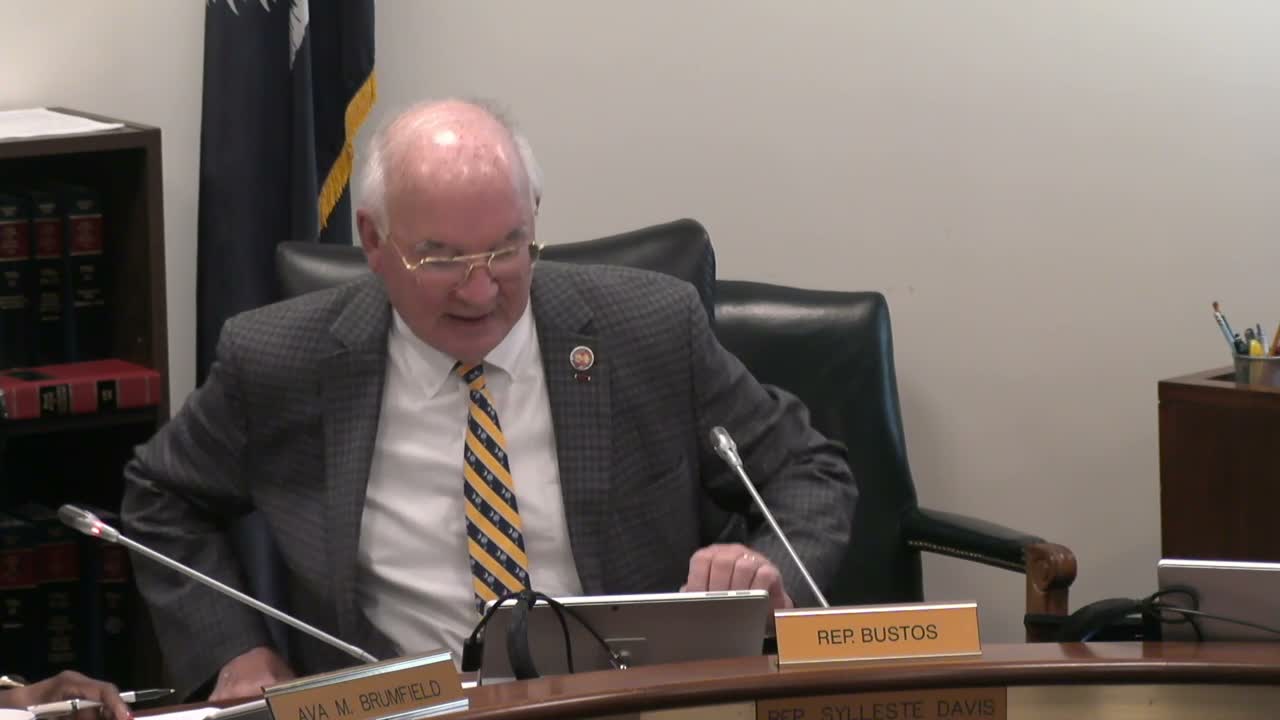
The Municipal Affairs Subcommittee voted unanimously to advance House Bill 4246, which would permit residential improvement districts to be created jointly by a county and a municipality when both governing bodies formally consent.
Supporters told the subcommittee the change would remove a legal obstacle that now prevents an RID from spanning jurisdictional lines even when a transportation project or other infrastructure clearly crosses them. "This bill is a practical common sense update to state law that will expand the tools available to local governments and the building community to invest in infrastructure," said Alicia Hutto of the Home Builders Association of South Carolina.
Witnesses and sponsors stressed that the bill preserves property-owner protections. Hutto said no district can be created without the consent of affected property owners and asked lawmakers to require intergovernmental agreements to spell out—up front—how costs will be divided so each property owner "know[s] what they'll owe and why." Rebecca Vance, who described long-running work between the town of Ridgeville and Dorchester County, said the improvement plan must list projects, cost estimates and the expected duration of assessments so owners understand how long a tax assessment will appear on their bill.
Jason Ward, who described projects in Dorchester County including the Ridgeville Industrial Campus and a nearly 3,000,000-square-foot Walmart distribution center, said the bill allows a single district to include both residential and industrial properties and to allocate assessments based on trip generation. He also noted local and federal funding already leveraged for the area, saying federal Department of Transportation funds in the amount of $13,250,000 have been used to support nearby projects.
Committee members asked about consent thresholds, whether an RID is an additional tax and oversight to prevent developers from profiting. Witnesses responded that RIDs are annual tax assessments (not one-time impact fees), that property owners must petition for a district so a nonconsenting owner's property cannot be assessed without consent, and that improvement plans are subject to county auditor/assessor oversight and modification rules that require formal readings by the governing body.
After discussion the chair called for the question and the roll call showed unanimous support: Mister Bustos, Miss Davis, Ms Edgerton, Mister Jones, Mister Sanders and Mister Scott recorded "Aye." The subcommittee approved the bill and sent it forward for further consideration.
Supporters told the subcommittee the change would remove a legal obstacle that now prevents an RID from spanning jurisdictional lines even when a transportation project or other infrastructure clearly crosses them. "This bill is a practical common sense update to state law that will expand the tools available to local governments and the building community to invest in infrastructure," said Alicia Hutto of the Home Builders Association of South Carolina.
Witnesses and sponsors stressed that the bill preserves property-owner protections. Hutto said no district can be created without the consent of affected property owners and asked lawmakers to require intergovernmental agreements to spell out—up front—how costs will be divided so each property owner "know[s] what they'll owe and why." Rebecca Vance, who described long-running work between the town of Ridgeville and Dorchester County, said the improvement plan must list projects, cost estimates and the expected duration of assessments so owners understand how long a tax assessment will appear on their bill.
Jason Ward, who described projects in Dorchester County including the Ridgeville Industrial Campus and a nearly 3,000,000-square-foot Walmart distribution center, said the bill allows a single district to include both residential and industrial properties and to allocate assessments based on trip generation. He also noted local and federal funding already leveraged for the area, saying federal Department of Transportation funds in the amount of $13,250,000 have been used to support nearby projects.
Committee members asked about consent thresholds, whether an RID is an additional tax and oversight to prevent developers from profiting. Witnesses responded that RIDs are annual tax assessments (not one-time impact fees), that property owners must petition for a district so a nonconsenting owner's property cannot be assessed without consent, and that improvement plans are subject to county auditor/assessor oversight and modification rules that require formal readings by the governing body.
After discussion the chair called for the question and the roll call showed unanimous support: Mister Bustos, Miss Davis, Ms Edgerton, Mister Jones, Mister Sanders and Mister Scott recorded "Aye." The subcommittee approved the bill and sent it forward for further consideration.
Don't Miss a Word: See the Full Meeting!
Go beyond summaries. Unlock every video, transcript, and key insight with a Founder Membership.
✓
Get instant access to full meeting videos
✓
Search and clip any phrase from complete transcripts
✓
Receive AI-powered summaries & custom alerts
✓
Enjoy lifetime, unrestricted access to government data
30-day money-back guarantee
