Oklahoma Senate approves placing voter-ID constitutional amendment before voters
March 26, 2026 | 2026 Legislature OK, Oklahoma
This article was created by AI summarizing key points discussed. AI makes mistakes, so for full details and context, please refer to the video of the full meeting. Please report any errors so we can fix them. Report an error »
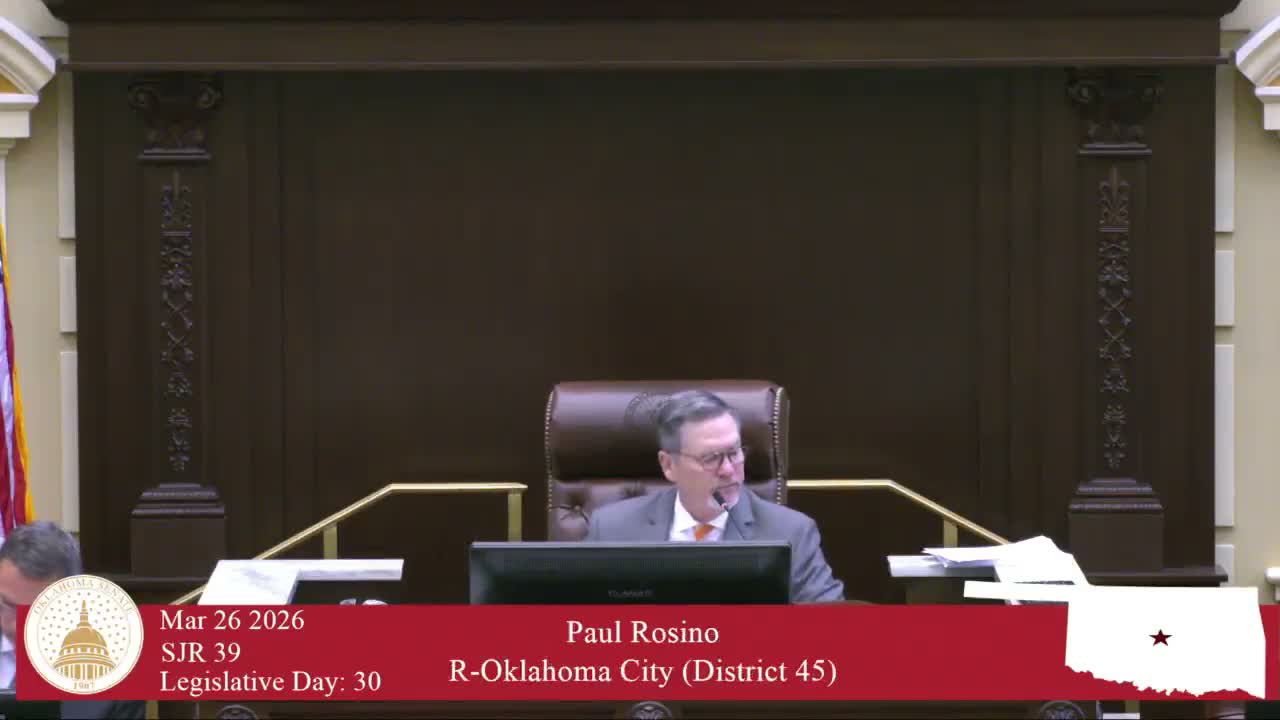
The Oklahoma Senate voted to place on the ballot a proposed constitutional amendment that would require ‘‘proof of identity’’ for voting and direct the legislature to define the required forms in statute.
Pro Tem Paxton, sponsor of SJR 47, said the measure ‘‘simply moves’’ the existing statutory voter-ID requirement into the constitution to make it harder for future legislatures to remove. ‘‘This simply moves that and puts it into the constitution so that for a future legislature... they would have a more difficult time to do so,’’ Paxton said.
Opponents pressed the sponsor that embedding an ID mandate in the constitution without specifying what documentary forms would ultimately be required leaves voters uncertain. ‘‘This proposal does not respond to documented widespread fraud,’’ Senator Hicks said on the floor. Hicks and others argued the amendment lacks specificity about what proof of identity might be required in future statute, and said that voters could be asked to amend the constitution without knowing the exact documentary standard that will be applied later.
Proponents said the change does not alter current law because Oklahoma already requires a photo ID or other statutorily authorized proofs and that provisional ballots and later verification remain options. Paxton said current statute allows provisional ballots to be proved later and that the legislature will set the specific evidentiary rules.
The Senate approved SJR 47 on third reading and also voted by the required two-thirds margin to order the measure to a special election; the roll-call totals reported on the floor were 39 ayes and 8 nays. The resolution will appear on the ballot on the date specified in the joint resolution unless the legislature selects a different schedule under the constitutional procedure.
Why it matters: By placing a requirement to ‘‘present proof of identity’’ in the constitution while leaving the legislature responsible for defining the exact documentary standard, the measure enshrines the concept of voter ID but leaves operational rules to future lawmaking. That combination prompted floor debate about both election integrity and potential voter uncertainty.
Next steps: If voters approve the constitutional amendment it will become part of the state constitution; if voters reject it the current statutory regime remains in force.
Pro Tem Paxton, sponsor of SJR 47, said the measure ‘‘simply moves’’ the existing statutory voter-ID requirement into the constitution to make it harder for future legislatures to remove. ‘‘This simply moves that and puts it into the constitution so that for a future legislature... they would have a more difficult time to do so,’’ Paxton said.
Opponents pressed the sponsor that embedding an ID mandate in the constitution without specifying what documentary forms would ultimately be required leaves voters uncertain. ‘‘This proposal does not respond to documented widespread fraud,’’ Senator Hicks said on the floor. Hicks and others argued the amendment lacks specificity about what proof of identity might be required in future statute, and said that voters could be asked to amend the constitution without knowing the exact documentary standard that will be applied later.
Proponents said the change does not alter current law because Oklahoma already requires a photo ID or other statutorily authorized proofs and that provisional ballots and later verification remain options. Paxton said current statute allows provisional ballots to be proved later and that the legislature will set the specific evidentiary rules.
The Senate approved SJR 47 on third reading and also voted by the required two-thirds margin to order the measure to a special election; the roll-call totals reported on the floor were 39 ayes and 8 nays. The resolution will appear on the ballot on the date specified in the joint resolution unless the legislature selects a different schedule under the constitutional procedure.
Why it matters: By placing a requirement to ‘‘present proof of identity’’ in the constitution while leaving the legislature responsible for defining the exact documentary standard, the measure enshrines the concept of voter ID but leaves operational rules to future lawmaking. That combination prompted floor debate about both election integrity and potential voter uncertainty.
Next steps: If voters approve the constitutional amendment it will become part of the state constitution; if voters reject it the current statutory regime remains in force.
View the Full Meeting & All Its Details
This article offers just a summary. Unlock complete video, transcripts, and insights as a Founder Member.
✓
Watch full, unedited meeting videos
✓
Search every word spoken in unlimited transcripts
✓
AI summaries & real-time alerts (all government levels)
✓
Permanent access to expanding government content
30-day money-back guarantee
