House committee advances bill to shrink Central State redevelopment board despite local objections
March 26, 2026 | 2026 Legislature Georgia, Georgia
This article was created by AI summarizing key points discussed. AI makes mistakes, so for full details and context, please refer to the video of the full meeting. Please report any errors so we can fix them. Report an error »
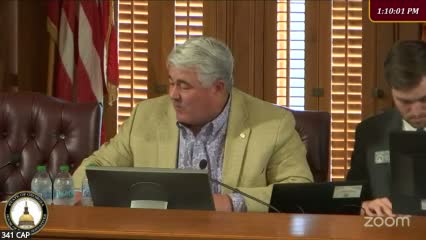
A Georgia House committee voted 6-4 on March 26 to give SB 260 a do-pass recommendation, advancing legislation that would shrink the Central State Hospital Redevelopment Authority board from nine members to five and transfer its oversight from the Department of Community Affairs to the State Properties Commission.
Sen. Rick Williams, the bill’s sponsor, told the committee the measure is aimed at making the authority “expeditious” and able to act on time-sensitive real estate offers. Williams outlined authority powers that already exist in the original 2012 statute — including the ability to lease or sell state property, issue bonds and enter long-term leases — and said a smaller board with a county and city seat would make meetings and transactions easier to schedule. “We have over 6,000 acres of state property in Baldwin County,” Williams said, describing the size and blight of the campus and urging quicker turnaround on offers.
Opponents, led by Rep. Griffin, urged the committee not to rush the measure. Griffin said an inspector general investigation into alleged past irregularities remains unresolved and warned the substitute arrived too late for adequate local review. “We should not pass this bill this year,” Griffin said, asking instead for a study that brings the mayor, county commission and authority members together before any structural change.
Local officials and authority members offered sharply different assessments. Milledgeville Mayor Parham said the city has invested seed funds and remains engaged in redevelopment efforts, arguing the authority’s mission is “not to make money — it’s to bring the economic base back.” Dr. Joyce Quinn Nelson, a longtime authority board member, defended the authority’s record, saying the board posts properties for 30 days to ensure fair access to buyers and reporting what she described as a “99% attendance rate” for meetings and robust local participation.
Board leaders and local real-estate representatives who testified said nine members make it difficult to respond to time-sensitive offers. Robert Binion, the authority’s chairman, said the existing practice of a 30-day hold on advertised sales and the logistics of convening nine volunteers were practical hurdles that have cost deals. “Real estate moves quickly,” he said, arguing a five-member board would allow more timely responses while preserving public notice and fairness.
Several lawmakers and city officials said they would prefer to see more local representation among any new five-member configuration. Councilmember Arlene Simmons, an authority officer, said she supports a smaller board only if a majority of seats are held by local appointees.
On procedure, the committee moved a do-pass motion and, after a hand-count roll call, reported six members in favor and four opposed. The committee record does not show identified individual votes on the record; the chair closed the session after the vote. The bill will proceed in the legislative process with the committee recommendation.
Supporters said SB 260 aims to resolve chronic quorum and responsiveness problems that have slowed redevelopment on the Central State campus; opponents asked for time to verify the substitute language, gather written local support or opposition, and await inspector general findings. The committee did not adopt a postponement; it voted to advance the substitute as presented.
Sen. Rick Williams, the bill’s sponsor, told the committee the measure is aimed at making the authority “expeditious” and able to act on time-sensitive real estate offers. Williams outlined authority powers that already exist in the original 2012 statute — including the ability to lease or sell state property, issue bonds and enter long-term leases — and said a smaller board with a county and city seat would make meetings and transactions easier to schedule. “We have over 6,000 acres of state property in Baldwin County,” Williams said, describing the size and blight of the campus and urging quicker turnaround on offers.
Opponents, led by Rep. Griffin, urged the committee not to rush the measure. Griffin said an inspector general investigation into alleged past irregularities remains unresolved and warned the substitute arrived too late for adequate local review. “We should not pass this bill this year,” Griffin said, asking instead for a study that brings the mayor, county commission and authority members together before any structural change.
Local officials and authority members offered sharply different assessments. Milledgeville Mayor Parham said the city has invested seed funds and remains engaged in redevelopment efforts, arguing the authority’s mission is “not to make money — it’s to bring the economic base back.” Dr. Joyce Quinn Nelson, a longtime authority board member, defended the authority’s record, saying the board posts properties for 30 days to ensure fair access to buyers and reporting what she described as a “99% attendance rate” for meetings and robust local participation.
Board leaders and local real-estate representatives who testified said nine members make it difficult to respond to time-sensitive offers. Robert Binion, the authority’s chairman, said the existing practice of a 30-day hold on advertised sales and the logistics of convening nine volunteers were practical hurdles that have cost deals. “Real estate moves quickly,” he said, arguing a five-member board would allow more timely responses while preserving public notice and fairness.
Several lawmakers and city officials said they would prefer to see more local representation among any new five-member configuration. Councilmember Arlene Simmons, an authority officer, said she supports a smaller board only if a majority of seats are held by local appointees.
On procedure, the committee moved a do-pass motion and, after a hand-count roll call, reported six members in favor and four opposed. The committee record does not show identified individual votes on the record; the chair closed the session after the vote. The bill will proceed in the legislative process with the committee recommendation.
Supporters said SB 260 aims to resolve chronic quorum and responsiveness problems that have slowed redevelopment on the Central State campus; opponents asked for time to verify the substitute language, gather written local support or opposition, and await inspector general findings. The committee did not adopt a postponement; it voted to advance the substitute as presented.
View the Full Meeting & All Its Details
This article offers just a summary. Unlock complete video, transcripts, and insights as a Founder Member.
✓
Watch full, unedited meeting videos
✓
Search every word spoken in unlimited transcripts
✓
AI summaries & real-time alerts (all government levels)
✓
Permanent access to expanding government content
30-day money-back guarantee
